


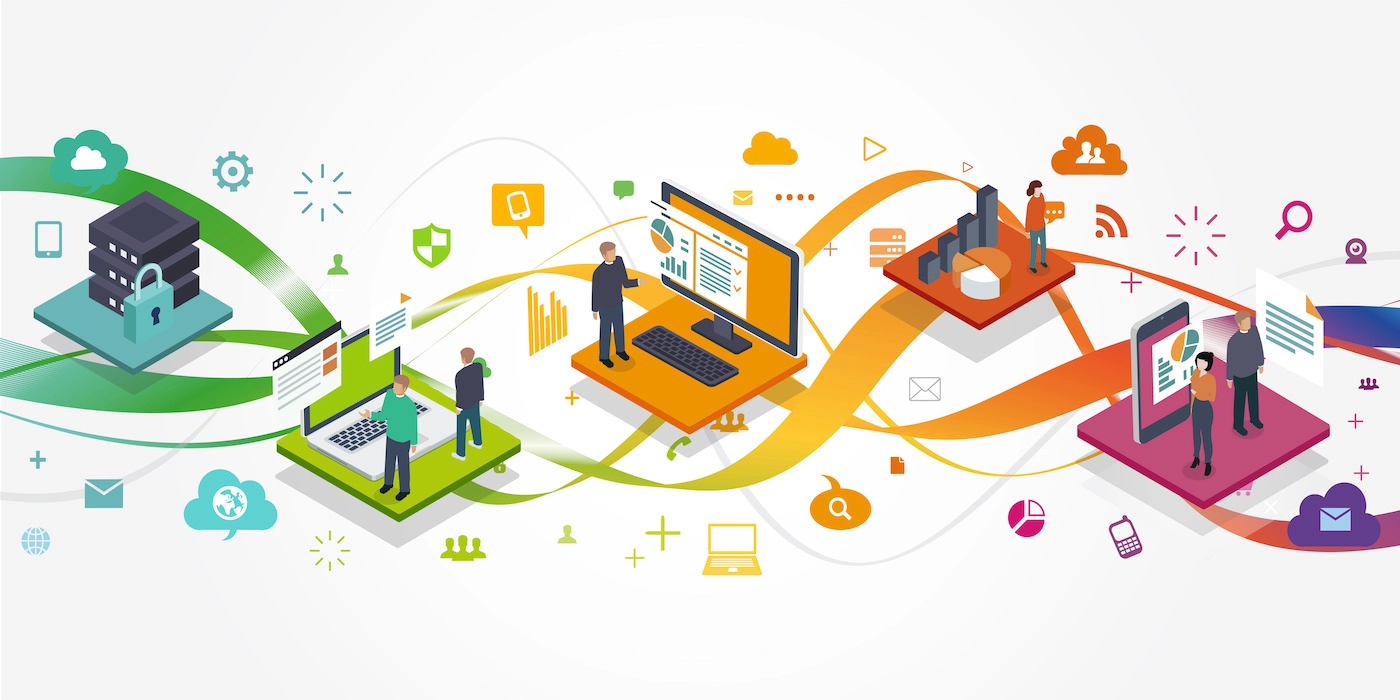
Digital transformation has become a key business strategy and necessity to survive in the competitive digital world. Businesses that have embraced the digital transformation have improved their customer journeys, business security, and even gathered insights of their business. Seeing the widespread benefits, companies like IKEA, DHL, and Nike have opted for digital transformation services to stay on top.
What is Digital Transformation?
Digital transformation is actually the business process of moving to digital systems for efficiency, scalability, and affordability. This is the transition of outdated systems to third-party digital solutions that make these systems efficient to work. Digital transformation requires some level of restructuring for optimized business operations.
· Moving to advanced telecommunications.
· Migrating to the cloud.
· Adopting machine learning.
Digital transformation is important to help businesses upgrade their operations. Beyond a general upgrade, digital transformation can bring other crucial advantages for enterprises.
Digital Transformation Trends to Implement in 2022
1. Automation across the Board
There’s no question that automation is needed in every possible aspect of business operations. In essence, automation is important to digital transformation, because it’s the easiest approach to reach scalability, efficiency, and lower costs. One aspect that has been accelerated by automation is the AIOps sector.
2. Cybersecurity
With the growth of 5G and IoT devices, cybersecurity is pushed to the forefront of business operations and digital transformation. In fact, a recent survey from IBM of more than 4,000 US, EU, and Chinese businesses showed that cybersecurity was the top use case for digital transformation.
Business brands leverage machine learning and artificial intelligence to identify malware and boost cybersecurity. Cybersecurity are often prioritized and will continue to play a big role in 2022. Tech giants are already implementing these technologies for their cybersecurity requirements too.
3. Growth of Artificial Intelligence
If automation is an essential part of the digital transformation services, artificial intelligence (AI) is the backbone of automation itself. It’s not wrong to say that a majority of systems and solutions adopted under digital transformation are AI solutions. Cybersecurity, and analytics software are all AI-based. Because of this, business organizations are opting AI to gain competitive advantages.
AI can support cybersecurity, business forecasting, marketing, and customer support. Experts suggest the market to grow 54% year-to-year in the next few years. Expect big gains in 2022.
4. Agility as a Top Priority
As mentioned earlier, cybersecurity is a growing concern for several industries. This rising concern is prompting businesses to focus on the fact that agility is important to address hacking attacks. Companies are looking for a point where they’re not preparing for ‘what if’ scenarios, but that they are looking for actual planning that is dynamic and will stop them from suffering through any outages. Beyond cybersecurity, increased agility is an important foundation of several digital transformations altogether.
Wrapping Up:
Digital transformation is a long term process offering key advantages at every stage. To enjoy success, it is important for business enterprises to build strategy and integrate latest digital transformation trends on a foundation of processes, systems, cultures, talents, and investments that support current innovation in existing capabilities. For a smooth digital transformation service, the IT departments must be trained properly regarding how to work efficiently.