


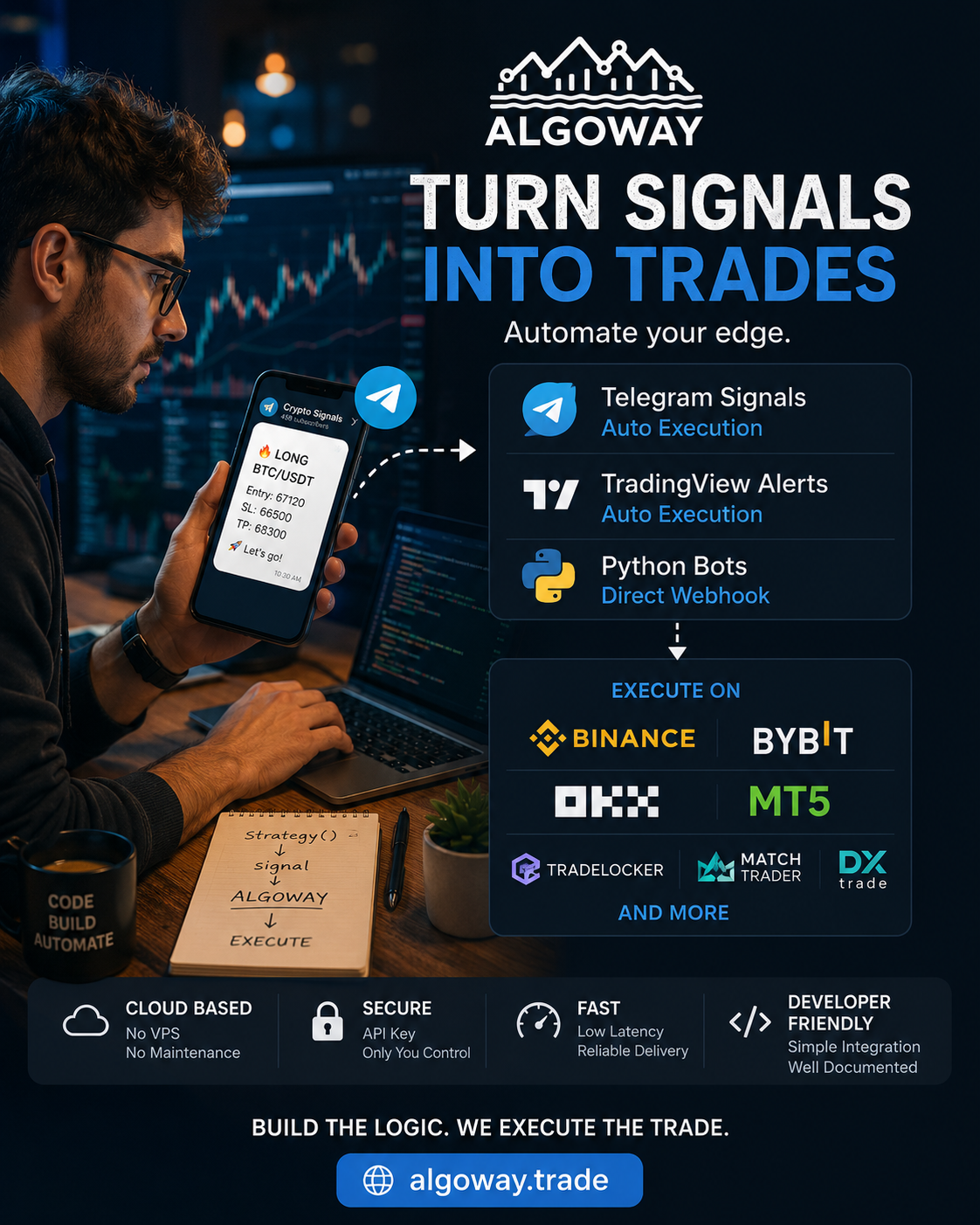
A message arrives in a Telegram trading channel. It contains an instrument, a direction, an entry range and two profit targets. A trader can glance at it and make sense of the instruction in seconds. Turning it into an order that a broker will actually accept is another matter. The trading platform does not understand the casual grammar of a chat room, and it has no patience for a missing quantity or an ambiguous entry price.
Consider this illustrative gold signal:
XAUUSD SELL NOW AT 4428 - 4433
Stop Loss: 4438
Take Profit 1: 4423
Take Profit 2: 4418
There is already a question hiding in those few lines. Does “NOW” mean sell immediately at the available price, or does the range describe prices at which a pending order should be placed? A human reader might resolve the contradiction by looking at the chart or asking the channel administrator. A copier cannot casually make that choice with somebody else's account. Nor can it assume that two targets mean two full-size trades. The message supplies the idea; the automation still needs execution rules.
This is why copying Telegram signals is not merely a matter of reading a notification and pressing Buy or Sell faster than a person could. A useful system must understand the message, decide whether it is actionable, translate it into a supported trading instruction and then deal with the requirements of the destination account. Those are separate jobs, and a mistake at any one of them can change the trade.
The message has to become an instruction
Telegram channels are written for subscribers, not trading APIs. One provider writes “SELL XAUUSD”; another says “short gold”; a third adds a screenshot, a paragraph of analysis and a cheerful row of emojis. Even the same provider may change the format between a market entry, a pending setup and a subsequent update. Regular expressions can extract numbers from a consistent template, but they cannot reliably decide what every sentence means when the template keeps changing.
An AI-based signal copier places a language interpretation stage before the execution system. Its first task is to distinguish a fresh trading instruction from a result announcement, a warning or ordinary discussion. Only then should it identify the instrument, direction, entry instruction, protective levels and any stated size. A message celebrating yesterday's profitable gold trade must not quietly become another sell order today.
TelegramSignal uses this approach with channels and groups available through the trader's own Telegram account. The account is connected using a phone number and verification code, with two-factor authentication when required; the trader then selects the source chat. There is no need to persuade the administrator of a private channel to install a bot. Incoming messages from the selected source are interpreted before they enter the trading route.
Interpretation is not a certificate of correctness. AI can misunderstand a reference price, confuse commentary with an instruction or fail to establish what a later message refers to. Its useful role is to turn variable human language into candidate structured data. Whether that candidate is allowed to reach a trading account is a different decision.
When the entry price changes the meaning of the trade
The execution rules become particularly important when a channel publishes ranges. In the example above, choosing market execution may produce an entirely different entry from waiting for a price inside 4428–4433. Neither interpretation can be declared universally correct just because a language model has recognized the words “sell” and “gold.” The trader needs to decide how such messages should be handled before the first one arrives.
In the Telegram Copier settings, Entry Order Mode makes that decision explicit. Automatic preserves eligible entry instructions, while Always Market deliberately ignores the detected entry price for execution. Skip Entry Ranges takes a more conservative route: it discards new entries containing a price range rather than trying to choose a price within it. These options are not cosmetic preferences. They determine whether a given message can open a trade at all and, when it can, what kind of order is sent.
A separate Disable Market Entries control can refuse instructions that require market execution, leaving eligible pending orders as the permitted path. Another setting, Only With SL & TP, requires the original signal to contain both a stop loss and at least one profit target. A later default stop configured elsewhere does not make an incomplete source message pass that requirement. This distinction is useful for a channel that sometimes posts “sell now” first and adds the protective levels a few seconds later: the first message can be rejected rather than treated as an invitation to improvise.
The rejection has a cost, of course. A trade may be missed. But the alternative is allowing incomplete or contradictory text to choose the timing and risk of a real position. A copier's task is not to trade every sentence that can be interpreted; it is to follow the rules the account owner has actually chosen.
The quiet arithmetic behind position size
Suppose a provider posts a signal with a total size of 0.30 lots and two profit targets. A trader who wants to divide that position between the targets would expect two orders of 0.15 lots, assuming the broker accepts that volume increment. That is what the First 2 TPs setting is designed to do. With Full Size For Each TP, however, each target receives 0.30 lots. The account is now attempting a total of 0.60 lots, even though the source message said 0.30. Both modes have a clear meaning; only one may match the trader's intention.
Size taken from the source also has rules worth reading closely. In Auto mode, an explicit quantity in the message is used, but an instruction with no usable quantity has no configured fallback. In Manual mode, the saved default size fills that gap; it does not override a valid size explicitly supplied by the provider. That difference matters when traders believe they have imposed a fixed limit on every incoming signal. For supported cryptocurrency routes, Fixed Money instead uses a configured monetary amount and disregards the provider's size, but calculating the quantity in that mode requires an entry price in the message.
Even after the right size has been selected, a destination can refuse it. A Forex account deals in broker-defined lots, a futures venue in contracts, and an exchange in quantities constrained by instrument-specific precision and minimums. The symbol needs the same care: a Telegram channel may say XAUUSD while the broker expects GOLD. The mapping XAUUSD:GOLD is an actual configuration example, not a rule that every gold broker should use.
The distance between a received signal and an executed trade
Once a message has been interpreted and checked against the copier's rules, the resulting instruction goes through AlgoWay and its configured execution route. The sequence is Telegram message, AI interpretation, copier rules, destination webhook, platform connector and finally the broker or exchange. The destination might be MetaTrader 5 through a running Expert Advisor, or a supported exchange connection that uses its API. The source language is the same; the machinery on the other side is not.
This separation explains a common and expensive misunderstanding. Delivering a webhook successfully is not the same thing as having an open position. The route may accept a command while the terminal is disconnected. An exchange can reject an order for insufficient balance, quantity precision or an unsupported instrument. A broker can refuse protective levels that violate its minimum stop distance. A pending order can be placed successfully and remain unfilled. Those outcomes are not interchangeable, no matter how reassuring a green notification may look.
To diagnose a failure, follow the evidence in the same order as the trade. Check the original Telegram message, the interpretation and copier decision, the webhook record, and the destination's order or position history. AlgoWay provides webhook and execution logs, but the broker-side state is still needed to establish what actually happened. Without that final check, an accepted instruction can easily be mistaken for a completed trade.
One channel, several messages, and the same account
The hardest moment may arrive after the entry. A provider posts another gold signal, then writes “move stop to breakeven” or “rebuy” in a reply. In chat, the relationship between the messages might be obvious to a subscriber. On the execution side, the instruction has to apply to the correct position, and there may be more than one position in the same instrument.
AlgoWay's Duplicate Protection operates on new entries for the same symbol during a configurable time window, which defaults to 30 seconds. It is not a promise that the account will never have two gold positions. A legitimate new entry inside that window can also be blocked, while another entry after the window may be accepted. Position-management actions are handled separately. A duplicate filter cannot decide which signal is the better one; it only applies the configured timing rule.
There is also a narrowly defined Reply Re-entry behavior for “rebuy” and “resell” messages sent as actual Telegram replies to an earlier signal. It derives the symbol and direction from that earlier message and creates a new market entry, but it does not inherit the old entry price, stop loss or profit targets. That limitation matters much more than the apparent convenience of typing one word in a channel. The interaction with market-entry restrictions and SL/TP requirements also has to be considered before enabling it.
A sensible first test therefore follows more than the opening message. Take one source channel, select a compatible destination and configure the quantity, entry policy, protective-level requirement and duplicate window. On a demo or otherwise controlled account, compare what the channel published with the orders actually accepted, the sizes allocated to targets and the response to subsequent messages. If the provider routinely edits old posts or manages several positions at once, verify those situations independently rather than assuming that understanding the words is enough.
By the end of such a test, the useful result is not a claim that AI can trade better than a person. It is a much plainer answer: which messages will be acted upon, which will be ignored, and how an instruction makes its way into a confirmed order. A Telegram signal copier earns its place in a trading workflow when those answers are predictable. The market will supply enough uncertainty without the order-routing system contributing its own.
Frequently Asked Questions (FAQ)
1) Will the copier execute a signal without a stop loss or take profit?
That depends on the entry rules. When Only With SL & TP is enabled, a new signal must contain both a stop loss and at least one profit target in the original message. A signal missing either one is not accepted as a new entry under that rule.
2) Does a successful webhook mean that the broker opened a position?
No. A successful webhook delivery confirms a step in the routing process, not a filled trade. The destination can reject the order, the terminal can be disconnected, or a pending order can remain unfilled. Check the execution logs and the broker's order or position history.
3) Does Manual position sizing always replace the volume written in a Telegram signal?
No. In Manual mode, the saved quantity is used when the message does not contain a valid quantity. When the provider includes an explicit usable size, that size takes priority. Traders should verify the final order volume, especially when a signal includes several take-profit targets.


The copier is an instrument that can quickly and inexpensively copy documents and images onto paper.The top three companies, Ricoh, Xerox and Canon, have about 43% of the market share.
Download FREE Sample of this Report @ https://www.grandresearchstore.com/report-sample/global-copier-2021-2027-308 Market Analysis and Insights: Global Copier Market In 2020, the global Copier market size was US$ 677.6 million and it is expected to reach US$ 706.5 million by the end of 2027, with a CAGR of 0.6% during 2021-2027.Global Copier Scope and Market SizeCopier market is segmented by region, by country, company, type, application and by sales channels.
The segmental analysis focuses on sales, revenue and forecast by region, by country, company, type, application and by sales channels for the period 2016-2027.
Segment by Type, the Copier market is segmented into Monochrome CopiersColor Copiers Monochrome copiers are the dominated type, which accounting for about 70% sales share in terms of volume in 2018.
Segment by Application, the Copier market is segmented into SchoolGovernmentOfficeRetail StoreOthers Office is the most common application of copier, which take up about 59% of the clients in 2018.
Regional and Country-level Analysis: North AmericaUnited StatesCanadaAsia-PacificChinaJapanSouth KoreaIndiaSoutheast AsiaAustraliaRest of Asia-PacificEuropeGermanyFranceU.K.ItalyRussiaNordic CountriesRest of EuropeLatin AmericaMexicoBrazilRest of Latin AmericaMiddle East & AfricaTurkeySaudi ArabiaUAERest of MEA Competitive Landscape and Copier Market Share AnalysisCopier market competitive landscape provides details and data information by companies.
