





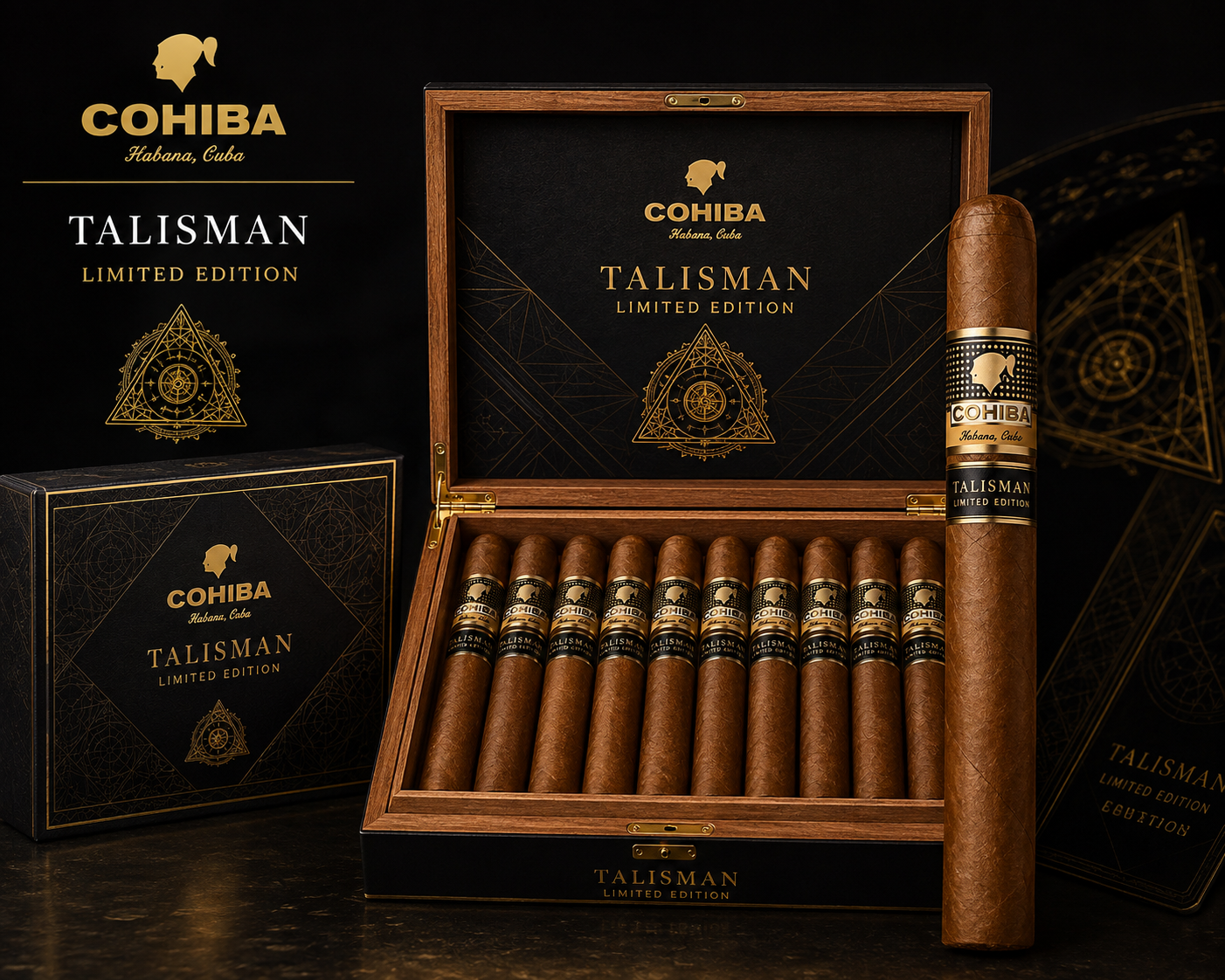
The Cohiba Talisman Limited Edition sits in a narrow category of modern Cuban releases that are bought as much for their market position as for their smoking performance. It is not a casual purchase, and it should not be treated like one. If you are collecting seriously, your objective is simple: secure genuine stock, in correct condition, with defensible provenance, and at a price that still makes sense once you factor in risk. This guide is designed for that purpose—direct, practical, and focused on the realities of the collector market.
Cohiba limited edition: why the Talisman matters to collectors, not just smokers
In collector terms, the Cohiba Talisman is significant because it combines three value drivers in one release. First, the Cohiba name sits at the peak of Cuban brand hierarchy in terms of global recognition and price elasticity. Secondly, the Limited Edition designation signals constrained supply, elevated presentation, and a predictable pattern of secondary-market interest. Thirdly, the format is deliberately contemporary: a wide ring gauge with a longer length, designed to deliver a slow, rich progression and to look imposing in photographs and display storage. That combination attracts buyers who may never light one, which tightens availability even further.
Collectors should also understand what “Limited Edition” means in practice. It does not guarantee excellence in every stick; it indicates a defined production run, intended to be distinct from standard production. The market treats these releases like events. The best-performing examples tend to be the ones stored correctly from day one and sold with a clear chain of custody. The worst-performing examples are often genuine cigars that have been mishandled—dried out, overheated, or left to absorb unwanted odours—then passed around the market until a buyer accepts the loss. Your job is to buy the former and avoid the latter.
Finally, the Cohiba Talisman has a particular advantage for long-term holding: it is built for ageing. Broad ring gauge formats can mature slowly and gracefully when humidity and temperature are held steady. For collectors, that matters because it supports both consumption value and resale value over time.
Talisman limited edition: the format, measurements, and what they mean in real terms
Collectors often talk about “format” as if it were just a specification, but it drives everything: how the cigar is packed, how it ages, how it draws, and how the market perceives it. The Cohiba Talisman Limited Edition is known for its large ring gauge (54) and substantial length (around 154 millimetres). In plain terms, it is thick and long enough to deliver a long smoking time, with a cool, dense smoke texture when construction is correct.
The practical implications of this size are straightforward. First, weight and firmness become more important indicators of storage quality. A well-kept Talisman will feel resilient and evenly filled, not brittle, not spongy, and not hollow at the foot. Secondly, draw can vary more noticeably in thick cigars: too tight and you fight it for over an hour; too open and it burns hot and loses complexity. When buying singles in the secondary market, you are accepting draw risk. When buying sealed boxes with strong provenance, you reduce handling risk but still accept natural variation.
From a collector’s angle, the format also affects damage risk. Larger cigars can suffer from wrapper cracking if they have been exposed to low humidity, and they can develop swelling or soft spots if they have been stored too wet. Both problems can exist in “authentic” stock, and both reduce value. You are not only checking authenticity; you are checking condition.
Cuban cigar box: what the correct presentation should communicate at a glance
With serious collecting, presentation is not decoration; it is a verification surface. A proper Cuban cigar box for a premium release should tell a coherent story through materials, printing quality, labelling alignment, and ageing marks that make sense for the stated production date. The Cohiba Talisman Limited Edition was released in premium packaging, typically in a ten-count format with high-quality finishing. Your expectation should be crisp printing, consistent colour, and clean joins. Any sign of rushed assembly, blurred printing, uneven stamp placement, or sloppy adhesive residue should prompt caution.
Pay attention to the outside first. The government warranty seal and its modern security features should look correctly applied, not peeled and re-stuck. Edges should be neat, and the seal should not look oddly glossy, too thick, or poorly cut. Then check the factory and date markings. You are looking for markings that appear factory-applied, with appropriate ink and pressure, not freshly added or suspiciously perfect on a box that otherwise shows age.
Inside, the cigars should sit neatly and consistently. The bands should match one another in colour tone and print sharpness. A mismatch in band colour within the same box is not automatically proof of forgery, but it is a reason to slow down and investigate. Also look for unnatural smells inside the box: heavy perfume-like notes, strong air freshener, or a damp basement smell are condition alarms even if everything else looks correct.
Understanding the Cohiba Talisman’s smoking profile so you can spot problems early
Even if you collect primarily for value, you should understand how a genuine, well-kept Talisman tends to behave. That knowledge helps you identify mis-storage and, in some cases, suspect stock. In good condition, the Talisman is typically full-bodied with a dense mouthfeel and a progression that rewards slow pacing. You should expect rich tobacco core notes, with darker sweetness, roasted character, and a long finish. The burn should be steady, the ash should hold reasonably well for a large ring gauge, and the smoke should remain cool if the draw is correct.
Warning signs do not need to be dramatic. A cigar that tastes flat, papery, or sharply bitter from the start may have been stored too dry or too hot. A cigar that constantly struggles to stay lit, burns unevenly despite touch-ups, or produces sour, stewed flavours can indicate storage that was too wet or unstable. These are not academic points: condition issues reduce both enjoyment and resale value, and they often appear before obvious physical damage shows.
If you ever decide to “test” a box by smoking one, do it strategically. Choose a cigar that has been allowed to settle in your humidity-controlled cabinet for at least a few weeks, so you are evaluating the cigar rather than the shock of travel. Record the draw, burn, and core flavours in your notes. That record is useful if you later decide to sell and want to describe the box honestly and credibly.
Provenance and authenticity: how to buy with confidence, not hope
For a serious collector, provenance is your protective barrier. Authentication is not one single check; it is a layered approach that reduces the chance of an expensive mistake. Start with the seller. An established, specialist retailer with a long history and transparent policies is often worth paying more for. A private seller with vague answers, no documentation, and pressure tactics is not a bargain; it is a risk transfer.
Next, assess the “paper trail”, even if it is informal. A purchase receipt, a recorded date of acquisition, photographs taken at the time of purchase, and a clear storage story all add credibility. If the seller claims the box came from a duty-free shop or a well-known retailer, ask for details that can be verified. Serious sellers do not get offended by serious questions.
On the physical side, examine seals, date markings, and labelling coherence. You want consistency between the external markings, the condition of the box, and the expected age. A box that looks brand new but claims to be older stock should be scrutinised. Similarly, a heavily worn box with pristine, freshly applied seals is suspicious. Always remember: counterfeiters often focus on the obvious elements and fail on the “boring” details like alignment, print sharpness, and material quality.
Buying channels: where the best Cohiba Talisman purchases actually happen
There are three common routes: authorised retail, reputable auctions, and private transactions. Authorised retail is the cleanest route, but availability is limited and premiums can be high. The upside is the strongest provenance and the lowest authenticity risk. For many collectors, that risk reduction is the entire point.
Auctions can be excellent if the auction house specialises in premium tobacco products, provides high-resolution images, and stands behind descriptions with enforceable guarantees. Read the terms carefully. If authenticity disputes are difficult or time-limited, you are effectively buying “as seen”, which demands greater expertise on your side. When auctions are good, they can deliver well-stored stock from long-term collectors; when they are bad, they can act as a clearing mechanism for questionable items.
Private transactions can be the best value and the highest risk. If you buy privately, insist on clear photographs of every relevant surface, ask direct questions about storage conditions, and be ready to walk away. The strongest private buys are often local, where you can inspect in person, verify storage, and reduce shipping exposure.
Secondary market pitfalls: the expensive mistakes experienced collectors still make
The most common error is over-trusting superficial cues. A clean-looking box and sharp bands do not guarantee authenticity or correct storage. Condition problems can hide in plain sight, especially if cigars have been kept too wet; they may look perfect but smoke poorly and age badly. Likewise, a seller may genuinely believe their stock is authentic because they bought it years ago, but good faith does not protect you from a counterfeit.
Another frequent mistake is ignoring storage history because the price looks attractive. If a box has been through repeated temperature swings—summer heat, winter dryness, loft storage, or frequent travel—the internal structure of the tobacco can be stressed. That stress shows up later as wrapper cracks, uneven combustion, and a general dulling of flavour. For collectors who care about value, that is a form of hidden depreciation.
A third pitfall is paying a “perfect-condition premium” for boxes that have clearly been handled. Look at the corners, hinges, internal edges, and the way cigars sit in the tray. If the box looks like it has been opened repeatedly, you should assume it has been exposed repeatedly. Exposure is not always fatal, but it must be priced in.
Storage standards: how to keep a Cohiba Talisman collection investment-grade
Once you own it, the responsibility shifts to you. If you want the Cohiba Talisman to remain investment-grade, storage is not optional and it is not casual. Use a humidity-controlled cabinet that can hold a stable environment. The generally accepted collector range is roughly 65–69% relative humidity at around 18–21°C. Many experienced collectors prefer the lower end of humidity for thick ring gauge cigars to reduce burn issues and prevent swelling, but the key is stability rather than chasing an exact number.
Protect the cigars from odours. Premium cigars absorb smells readily, and once contamination happens it is difficult to reverse. Keep them away from kitchens, perfumes, cleaning products, and aromatic woods. If you store multiple brands, consider separation so that strong-smelling blends do not influence more subtle ones.
Also protect your packaging. Collectors often forget that the box itself is part of the asset. Avoid direct sunlight, avoid high humidity that can warp wood and lift labels, and avoid repeated opening that changes the micro-environment. If you want to check condition, do it efficiently: a quick inspection, minimal handling, then back into stable storage.
Handling and shipping: preserving value when you move or sell
Shipping is where otherwise excellent cigars get ruined. Heat is the primary enemy, followed by physical shock. If you must ship, choose timing carefully: avoid peak summer heat and severe cold snaps. Insist on fast, trackable services and packaging that cushions the box and limits temperature exposure. A seller who ships a premium Limited Edition box in thin cardboard with minimal padding is signalling carelessness; you should treat that as a risk indicator.
When receiving a shipment, do not rush to open and handle the cigars extensively. Let the box rest in your storage environment so the internal humidity equalises. Sudden changes in humidity can stress the wrapper. If you plan to sell later, keep records of when you received it, how it was stored, and any notable events. In high-end collecting, documentation supports value.
If you sell, describe condition precisely and conservatively. Serious buyers value accuracy more than hype. A credible description reduces disputes and builds reputation, which matters if you plan to transact again.
Pricing, value logic, and when “cheap” is too cheap to be real
The Cohiba Talisman Limited Edition carries a premium because it sits at the intersection of brand power and limited supply. That also means it attracts counterfeiters and opportunistic resellers. If the price is dramatically below the prevailing market for comparable condition, assume there is a reason. It could be urgency, ignorance, or a genuine bargain—but you must prove that before you pay.
Value should be assessed across three dimensions: authenticity confidence, condition confidence, and liquidity. Authenticity confidence comes from seller reputation and verification detail. Condition confidence comes from storage history and physical inspection. Liquidity is the ease with which you can sell later without discounting heavily. A box with strong provenance, stable storage, and intact packaging is more liquid than loose singles with an unclear story.
Do not ignore transaction costs. Insurance, shipping, potential duties, and the risk of loss all affect your true cost. A purchase that looks attractive before costs can become average after costs, and risky after you add uncertainty.
A disciplined purchase approach: how serious collectors close deals without regret
A disciplined approach is repeatable. Start by defining what you are buying: sealed box, opened box, or singles. Sealed boxes are generally preferred for collectability, but only if the seal and markings are credible and the seller is trustworthy. Opened boxes can be excellent if the storage history is strong and the cigars show consistent condition. Singles are best treated as for-smoking purchases unless you have exceptional provenance.
Next, ask for the evidence you need. Request clear photographs of the front, back, base, and seal areas of the box, plus close images of date and factory markings and a representative view of the cigars and bands. Ask how long the seller has owned the box, how it has been stored, and whether it has travelled. If answers are vague, evasive, or inconsistent, end the process. You do not need to win every deal; you need to avoid losing deals.
Finally, decide your walk-away points before negotiation begins. Serious collectors do not negotiate themselves into risk. If provenance is weak, storage is uncertain, or the presentation shows multiple warning signs, your best move is to keep your capital available for a better example. The market will always offer another opportunity, but it will not refund a mistake.
Ageing potential and the smoke-or-hold decision for Cohiba Talisman owners
The Cohiba Talisman is widely regarded as a cigar that can improve with time when stored correctly. For collectors, that creates a decision: smoke now to enjoy and assess, or hold for maturity and potential value appreciation. The sensible approach is to align the decision with your objectives. If your goal is purely collecting, you may keep boxes intact and avoid disturbance. If your goal includes consumption, consider acquiring an extra cigar or two specifically for smoking, so your core collectible stock remains untouched.
Ageing is not magic; it is controlled change. With stable humidity and temperature, the cigar can become more integrated, the sharper edges can soften, and the overall profile can feel more polished. But ageing cannot repair poor construction, and it cannot reverse storage damage. That is why buying correctly at the start matters more than romantic ideas about time fixing everything.
If you do decide to smoke one from a box you plan to keep, document it. Note the date, storage settings, and smoking impressions. In serious circles, that level of care is respected, and it helps you manage your own collection with clarity rather than guesswork.
The Cohiba Talisman Limited Edition rewards collectors who act like custodians rather than gamblers. Buy with evidence, store with discipline, and treat presentation as part of the asset. Do that, and you will own a piece that holds its position in a serious collection—whether your final intent is to smoke, to hold, or to trade with confidence.


It seems like a pretty fair question.
But the more complete version of the title question is: What is the appeal of limited edition cigars for sale and why do people get so worked up over them?
If these limited edition cigars for sale are coming out from big, reputable brands, then we can assume the quality is there.
But if they are gone so quickly, then what is there to be gained?
After mulling over this question for a bit, cigar in hand, this is what we came up with as the reasons what limited edition cigars have to offer and why we might want to buy them.They Mark An EventOften we will see limited edition cigars come out to celebrate a special occasion for a company.
It’s a good time for all involved.They Are Fun While They LastNothing lasts forever.