


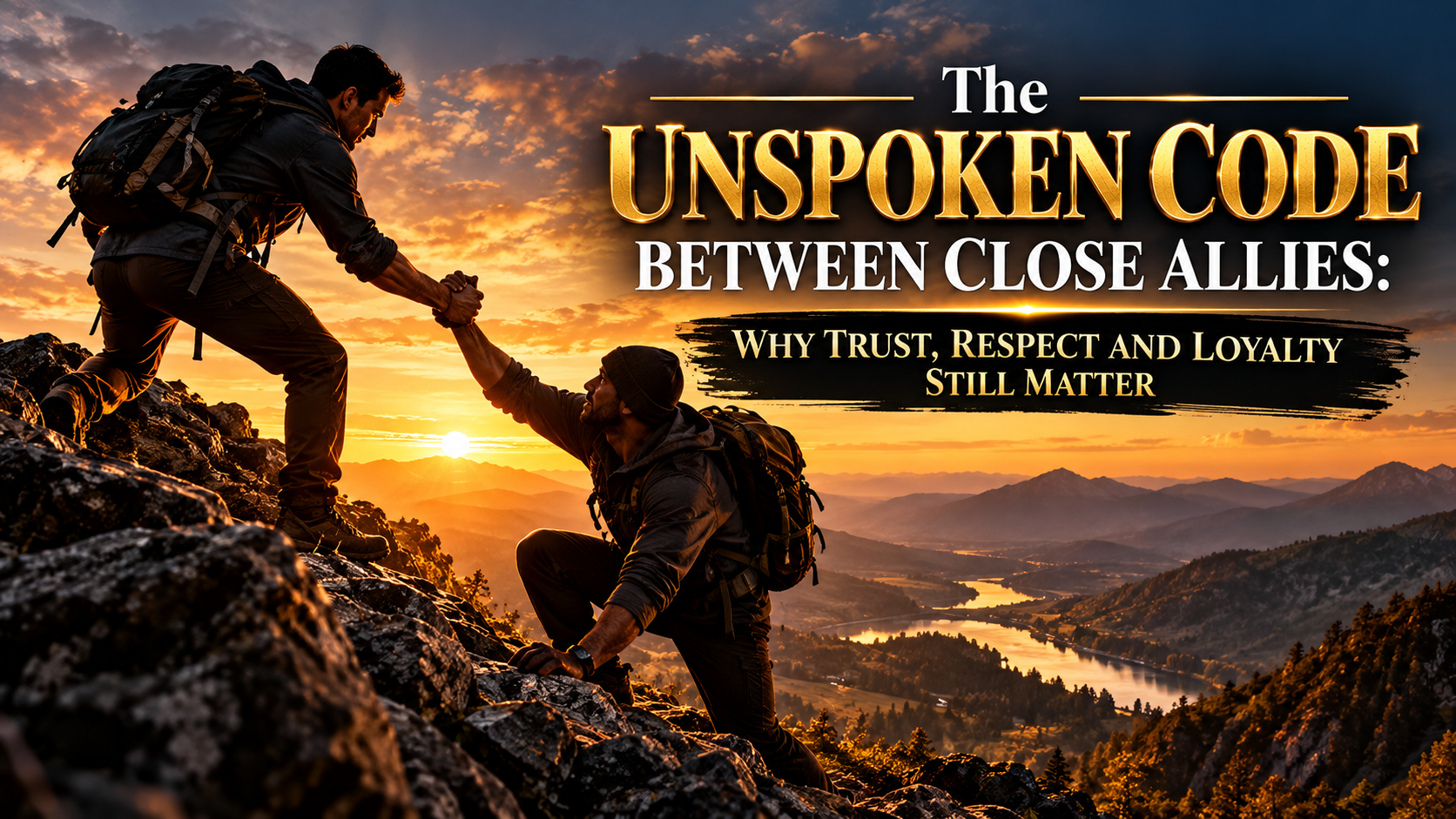
The Silent Architecture of Strong Alliances
Close alliances are rarely held together by contracts alone. Whether in personal circles, political partnerships or strategic cooperation between institutions, the strongest bonds often depend on an unspoken code. This code is not mysterious, nor is it sentimental. It is built on practical, demanding principles that determine whether a relationship can withstand pressure, disagreement and change. Among these principles, trust, respect and loyalty remain central. They are not outdated ideals. They are the working structure beneath every alliance that aims to last.
In an age that often celebrates speed, convenience and short-term advantage, these values can be treated as optional. That view is a mistake. Alliances fail not only because interests diverge, but because the character of the relationship weakens. When people or groups no longer believe that their position will be treated fairly, defended consistently or honoured seriously, the alliance begins to fracture from within. The unspoken code matters precisely because not every test arrives with warning.
Why Durable Bonds Depend on More Than Shared Interests
Shared interests may bring allies together, but they do not guarantee endurance. Two parties may agree on a goal today and still become unreliable partners tomorrow. The difference lies in whether the relationship can carry strain without collapsing into suspicion or opportunism. That requires more than strategic alignment. It requires confidence in motives, standards and conduct.
In personal relationships, this means knowing that support will not disappear when circumstances become inconvenient. In political and strategic settings, it means understanding that a partner will not abandon agreed commitments the moment pressure rises. The most effective alliances are not merely efficient arrangements. They are disciplined bonds in which each side recognises that credibility is a form of power and that honouring the relationship is part of preserving that power.
loyalty in relationships as a Test of Constancy Under Pressure
Loyalty in relationships is often misunderstood as blind agreement or permanent approval. In reality, loyalty is far more serious than that. It is the choice to remain principled in one’s commitment, especially when circumstances become difficult. A loyal ally does not vanish at the first sign of risk, nor do they exploit moments of weakness for personal gain.
This does not mean that loyalty requires silence, denial or endless tolerance of poor behaviour. On the contrary, mature loyalty has boundaries. It allows correction, disagreement and accountability. What it refuses is betrayal disguised as pragmatism. In close alliances, loyalty means protecting the bond from casual damage. It means speaking honestly in private rather than performing disapproval in public for advantage. It means refusing to trade long-built trust for short-lived leverage.
When loyalty is absent, relationships become transactional. Every difficulty is interpreted as a reason to withdraw. Every disagreement becomes a threat. In such conditions, no alliance can become truly strong, because no one feels secure enough to invest fully in it.
loyalty and respect as the Foundation of Mutual Dignity
Loyalty and respect are inseparable. Loyalty without respect becomes control, dependency or mere habit. Respect without loyalty can become polite distance with no real commitment behind it. Together, they create mutual dignity, which is essential in any enduring alliance.
Respect means recognising the other party as worthy of serious consideration, even when there is disagreement. It involves restraint in speech, fairness in judgement and discipline in action. Respect rejects contempt, mockery and the careless exposure of another’s vulnerabilities. In professional and strategic contexts, respect also means acknowledging competence, role and contribution rather than reducing partners to tools of convenience.
When loyalty and respect operate together, they produce a relationship that can absorb tension without humiliation. This is crucial. Many alliances do not fail because of conflict itself, but because conflict is handled with arrogance or disregard. A respected ally can hear criticism without feeling diminished. A loyal ally can offer criticism without seeking dominance. That balance is one of the clearest signs of a mature and durable bond.
trust and loyalty as Strategic Capital in Times of Uncertainty
Trust and loyalty are not merely emotional values. They are strategic capital. In uncertain conditions, they reduce hesitation, improve coordination and strengthen resilience. A trusted ally requires fewer defensive calculations. A loyal ally allows for long-term thinking because their support is not assumed to be fragile.
In politics, trust and loyalty shape negotiation, coalition stability and leadership credibility. In business and institutional partnerships, they influence decision-making speed, information sharing and the willingness to take measured risks together. In personal relationships, they create emotional safety, which allows honesty to deepen rather than threaten the bond.
Trust is earned through consistency. It grows when words align with actions, when promises are realistic and when conduct remains stable across changing conditions. Loyalty protects that trust by proving that the relationship is not only useful when circumstances are favourable. Together, trust and loyalty create an alliance that can move from convenience to conviction.
The Cost of Betrayal, Contempt and Silent Erosion
Not every alliance breaks through open conflict. Many weaken through smaller acts of neglect and quiet corrosion. Betrayal may be dramatic, but contempt, inconsistency and indifference can be equally destructive. A promise ignored, a confidence exposed, a partner publicly diminished or a commitment treated casually can all undermine the invisible structure of the relationship.
Once that erosion begins, repair becomes difficult. Trust, unlike enthusiasm, cannot be restored through slogans. It requires evidence, patience and changed behaviour. This is why the unspoken code should never be treated lightly. Damage to trust and respect spreads quickly because it alters how every future action is interpreted. Where confidence once existed, suspicion begins to dominate.
How Enduring Allies Preserve the Unwritten Code
Enduring allies preserve strong bonds through disciplined habits rather than grand declarations. They communicate clearly, especially when the truth is uncomfortable. They defend one another fairly, but they do not excuse conduct that endangers the alliance. They understand that reliability is demonstrated in patterns, not promises. They also recognise that loyalty must be reciprocal if it is to remain credible.
Most importantly, they do not confuse closeness with entitlement. Strong alliances survive because each side continues to act with intention. Trust is maintained, respect is shown and loyalty is proved repeatedly through conduct. That is the unspoken code in its clearest form: not sentiment, not performance, but sustained integrity.
In every sphere where alliances matter, from private life to public power, this code remains decisive. Trust, respect and loyalty still matter because human bonds, however sophisticated their context, still depend on whether people can rely on one another with confidence and honour. When those principles are present, alliances endure. When they are absent, even the strongest appearance of unity will eventually give way.