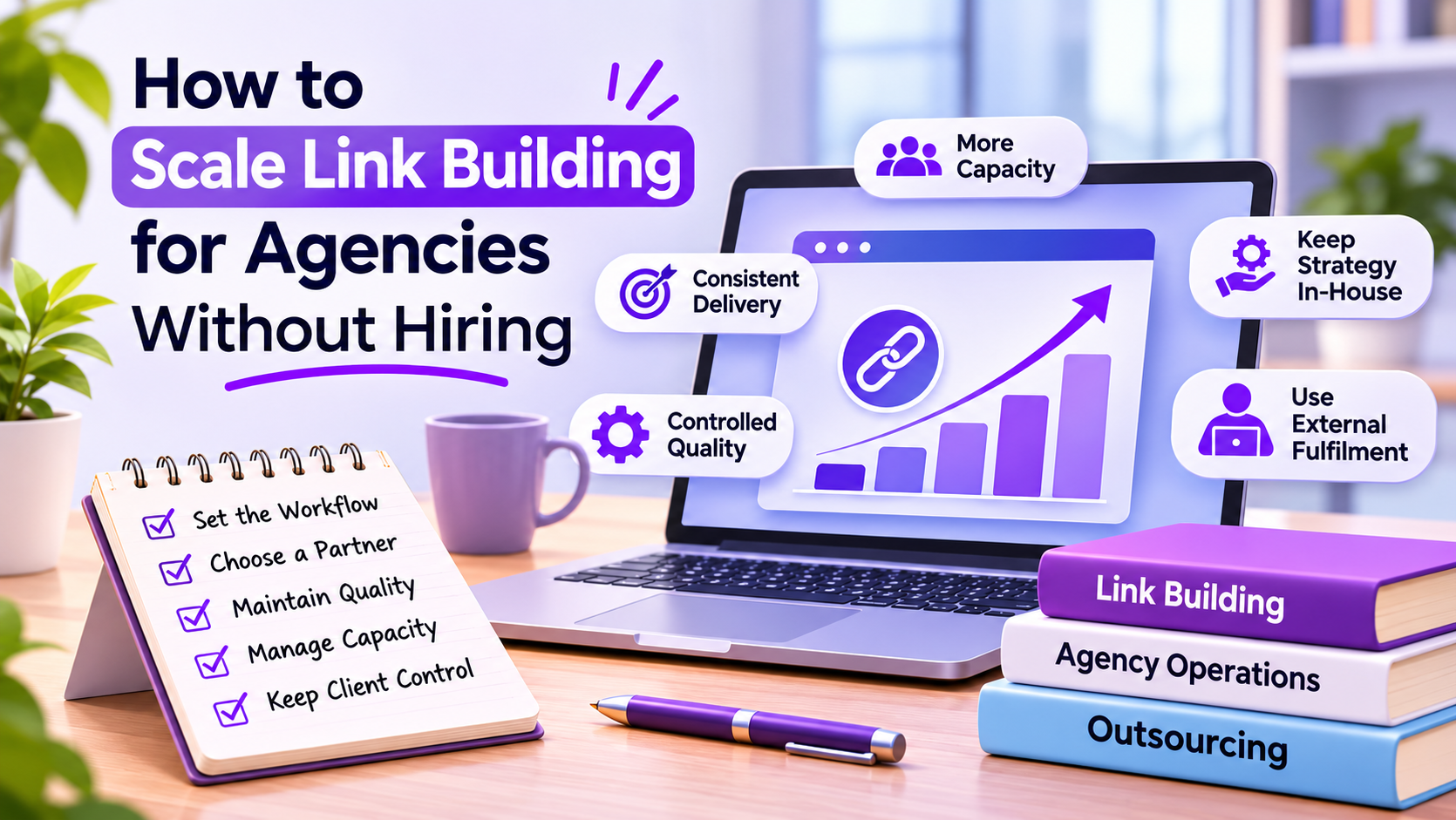
Outsourcing link building can help an SEO agency take on more clients without expanding its internal team. But choosing a fulfilment partner is not as simple as comparing packages and picking the provider offering the most backlinks for the lowest price. The quality of its publishers, outreach methods, content, and reporting will eventually reflect on your agency.
For agencies managing several client campaigns, the challenge is finding a provider that can deliver consistently without creating additional work for the internal team. The agency fulfilment resources available through VH Info provide useful context for understanding the operational side of outsourced SEO, including the importance of quality checks and delivery processes.
A good partnership should make fulfilment easier, not introduce another layer of problems. Before committing to a provider, use this checklist to understand what you are actually getting, what needs to be verified, and which questions deserve clear answers.
What Is White Label Link Building?
White label link building is a service in which an external provider handles some or all of the work involved in acquiring backlinks, while an SEO agency delivers the service under its own brand.
The agency remains responsible for its client relationship and strategy. The fulfilment partner may handle activities such as:
- Publisher and prospect research.
- Website quality checks.
- Outreach and communication.
- Guest article coordination.
- Content creation or editing.
- Link placement verification.
- Campaign reporting.
For example, an SEO agency working with five SaaS clients might not have enough internal resources to manage every outreach campaign. It can work with an external provider to support prospecting and fulfilment while its own SEO team decides which pages to promote and reviews the completed placements.
A well-managed white label link building arrangement allows the agency to increase delivery capacity without necessarily hiring dedicated outreach specialists.
However, the service is only useful when the provider follows the agency's quality standards. If placements are irrelevant, reports are incomplete, or communication is unreliable, the agency still has to deal with the consequences.
Why Do SEO Agencies Use White Label Link Building?
Managing link building internally requires people, tools, processes, and ongoing supervision. For a growing agency, these requirements can become difficult to balance with other client responsibilities.
Outsourcing can help address some of these challenges.
Access to specialist fulfilment
An external provider may already have researchers, outreach specialists, writers, and campaign managers. An agency can use those resources without recruiting and training an entire team.
More flexible delivery capacity
Client demand does not always remain consistent. One month may involve several new campaigns, while another may be quieter.
Working with an external fulfilment partner can provide additional capacity when required, depending on the agreed scope and availability.
More time for client strategy
When routine prospecting and coordination are handled externally, the agency's internal team can focus more on technical SEO, content strategy, client communication, and performance analysis.
Easier service expansion
Agencies that do not offer extensive link building internally may be able to add it to their service portfolio through a suitable fulfilment arrangement.
The important distinction is that outsourcing execution does not remove the agency's responsibility for strategy, quality, or client satisfaction.
The Quality Checklist Every Agency Should Follow
Before selecting a provider, evaluate the following areas. These checks can help you identify whether the partner is equipped to deliver consistent work across different client campaigns.
1. Check Publisher Relevance and Website Quality
Start with the websites where the provider plans to acquire links.
A publisher should be relevant to the client's industry, subject matter, or target audience. A link from a finance technology publication may make sense for accounting software, while a general entertainment blog may have little relevance.
Ask the provider how it evaluates publishers. A useful assessment should consider:
- Topical relevance to the client's business.
- The website's actual editorial focus.
- Publishing activity and content consistency.
- Quality and usefulness of existing articles.
- Audience and geographic relevance.
- The overall credibility of the publication.
Do not rely entirely on Domain Authority, Domain Rating, or estimated traffic. These metrics can help compare websites, but they cannot establish whether a publication is genuinely suitable.
Request a few examples of recent placements and inspect the actual pages. Read the articles, review the surrounding content, and look at the other websites the publisher references.
The publisher review approach discussed in VH Info's agency resources is relevant here: the website's subject matter and editorial environment deserve attention alongside numerical SEO metrics.
2. Understand How Backlinks Are Acquired
Ask the provider to explain its link acquisition methods.
Does it use personalised editorial outreach, contributor relationships, digital PR, relevant partnerships, or another approach? Who researches the publishers? How are opportunities approved? Who handles communication with editors?
You should also understand whether the provider uses private blog networks, automated placements, excessive reciprocal linking, or other practices designed primarily to manipulate rankings.
Be particularly careful when a provider describes its methods as confidential and refuses to explain the general process.
Ask these questions:
- Are publishers independently reviewed?
- Is outreach personalised?
- Are articles created for a genuine readership?
- Are paid or sponsored placements disclosed appropriately?
- Can we reject unsuitable websites?
- What happens when a placement does not meet the agreed criteria?
A trustworthy partner should be able to explain its process without making unrealistic promises.
3. Evaluate Content Quality and Editorial Standards
The quality of the article containing a backlink matters.
A relevant website can still offer a poor placement if its articles are thin, repetitive, heavily promotional, or created mainly to accommodate outbound links.
Ask who writes the content and what the review process looks like.
A good article should:
- Address a clear subject relevant to the publisher.
- Provide information that readers can use.
- Have a logical structure and natural language.
- Avoid unnecessary keyword repetition.
- Use accurate information and credible examples.
- Include external references where appropriate.
- Mention the client's product only when relevant.
You should also clarify whether content creation is included in the package or charged separately.
For specialised SaaS clients, subject knowledge can make a significant difference. An article about cybersecurity, financial technology, or healthcare software may require expert review before publication.
VH Info's agency fulfilment material highlights the need to treat content and placements as connected deliverables. A backlink should appear within an article that makes sense without it.
4. Review Anchor Text and Destination URL Control
Before a campaign starts, agree on which pages should receive links and how anchor text will be handled.
The provider should understand your client's priority URLs, important product pages, supporting resources, and pages that should not be promoted.
However, avoid demanding the same exact-match keyword in every placement. Repeating commercial anchors unnaturally can create an artificial-looking pattern.
A healthy editorial approach may include:
- Brand name references.
- Descriptive contextual phrases.
- Relevant partial-match anchors.
- Natural URL references.
- Other wording that fits the article.
The final anchor should make sense to the publisher and reader.
Also check that each backlink points to the intended destination. An otherwise useful placement can lose relevance when the link points to an unrelated homepage instead of the resource being discussed.
5. Demand Transparent Reporting
A monthly report containing only a total backlink count is not enough.
Your agency needs to know exactly what was delivered and be able to verify it.
For every placement, ask for:
- Publisher website and name.
- Live article URL.
- Client destination URL.
- Anchor text.
- Publication date.
- Link attributes, where applicable.
- Relevant quality notes.
Pending placements should be separated from completed work. Proposed websites should not appear in the report as acquired backlinks.
The report should also mention delays, rejected opportunities, removed links, or other issues requiring attention.
The reporting practices covered in VH Info's agency fulfilment resources are useful to consider because clear documentation makes it easier to review outsourced work before presenting it to clients.
6. Check Communication and Turnaround Time
Even a provider with good publishers can become difficult to work with if responses are delayed or responsibilities are unclear.
Before signing, understand how communication will work.
Will you have a dedicated account manager? Where will briefs and approvals be shared? How quickly should you expect responses? Who handles urgent issues?
Clarify typical turnaround times for research, prospect approval, content drafts, revisions, and reporting.
Be cautious of providers that promise fixed publication dates without explaining that external publishers control editorial schedules.
Also agree on escalation procedures. If an article goes live on an unsuitable website, the agency needs to know whom to contact and how the issue will be resolved.
7. Evaluate Scalability and Fulfilment Capacity
A provider may perform well with one campaign but struggle when your agency starts sending work for ten or fifteen clients.
Ask how the provider handles increasing volumes and whether it has enough research, outreach, writing, and quality-control capacity.
Consider:
- Maximum active campaigns.
- Monthly fulfilment capacity.
- Ability to manage different industries.
- Dedicated account management.
- Backup processes when team members are unavailable.
- Consistency of quality during busy periods.
Do not assume that a provider can scale indefinitely simply because it offers bulk packages.
The capacity planning considerations discussed in VH Info's agency resources are especially relevant for agencies managing multiple client accounts with different delivery requirements.
8. Understand Pricing, Replacements, and Contract Terms
A low package price may look attractive until additional charges begin appearing.
Ask for a clear breakdown of what is included. Does the price cover research, outreach, content, live placements, reporting, and account management? Are certain publisher categories charged differently?
Clarify the provider's policies for:
- Links removed shortly after publication.
- Articles that are edited or taken down.
- Placements that fail quality checks.
- Delayed fulfilment.
- Cancellation and unused credits.
- Additional content revisions.
Read the agreement carefully and understand payment terms, responsibilities, confidentiality, and reporting commitments.
The best commercial arrangement is one where both sides know what is included and how unexpected situations will be handled.
What Questions Should You Ask Before Choosing a Provider?
A quality checklist becomes more useful when you use it in an actual conversation.
Before signing, ask the provider:
How do you select publishers? Ask for its qualification process and examples from your client's industry.
Can we approve the websites before outreach? This helps your agency maintain control over publisher relevance.
Who creates the content? Understand the writer's experience, review process, and whether subject matter experts are involved.
How do you handle sponsored placements? Confirm disclosures and link attributes rather than assuming every placement is editorial.
What does your report contain? Request a sample with live URLs and destination details.
Can you manage different client requirements? A provider should be able to adapt briefs to industries, audiences, and priorities.
What happens when something goes wrong? Ask about replacement policies, removal issues, and escalation procedures.
If you are comparing providers, explore what a white label link building agency offers and assess its approach against these questions.
What Mistakes Do Agencies Make When Outsourcing Link Building?
Even experienced agencies can make mistakes when choosing a fulfilment partner.
Choosing based only on price: A cheaper package may create extra work if placements need constant rejection or correction.
Focusing only on link quantity: A large delivery target does not automatically mean relevant or useful links.
Skipping sample checks: Never assume that all placements will match the quality of a provider's sales examples.
Failing to share client requirements: An external team cannot deliver consistently if it does not understand the audience, target pages, and exclusions.
Giving up final approval: Outsourcing should not mean accepting every placement without review.
Ignoring reporting standards: Missing URLs and vague performance reports make it difficult to verify delivery.
Not reviewing performance over time: Evaluate quality, responsiveness, and consistency throughout the relationship, not just during onboarding.
How Can You Test a Provider Before Committing?
Rather than moving all client campaigns to a new provider immediately, start with a limited pilot.
Choose one suitable client and define a clear scope. Share the campaign brief, target pages, audience, preferred topics, and quality requirements.
Ask the provider to demonstrate its process through a small initial batch of publisher prospects. Review the websites before approving outreach.
Once placements are delivered, assess the live articles, relevance, content quality, link attributes, and reporting. Also consider how easy the provider was to communicate with and how it handled revisions or feedback.
A useful pilot review should answer four questions:
- Did the provider understand the campaign brief?
- Were the publishers relevant to the client?
- Was the delivery process transparent and organised?
- Did the work meet the quality standards agreed upon?
Do not judge the provider only by how many placements it delivers during the test. A pilot should help you understand the quality and reliability of the overall process.
Final Thoughts
Choosing a fulfilment provider is not simply about finding someone who can deliver backlinks under your agency's name. You need a partner that understands publisher relevance, produces useful content, communicates clearly, and provides enough information for your team to verify every placement.
Use the checklist before signing, review actual examples, and start with a controlled pilot. Keep responsibility for client strategy and final quality checks within your agency, even when execution happens externally.
The most dependable white label link building arrangements combine specialist fulfilment with clear agency oversight. When both sides agree on quality, responsibilities, and reporting, outsourcing can become a reliable part of agency operations rather