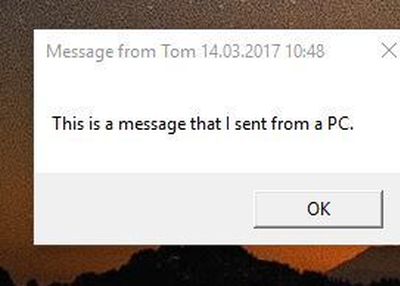
There are two simple ways for sending messages to others PCs via a local network. Some users use command prompt message like msg or net send. Other users prefers to install any simple application like LAN messenger for sending messages and file transfers via intranet connection in office.
Check this simple guide at tompai.pro



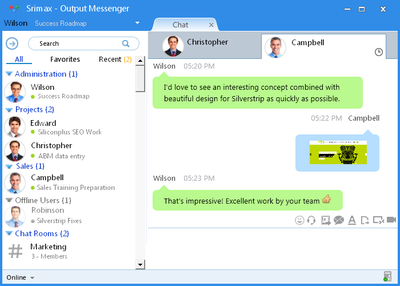
This is an article dedicated especially to life in offices, for those who need a private and secure chat tool that works only within a LAN.
Although the use of chat like WhatsApp, Skype and Facebook have made these private and local chat programs less popular, they are still business tools that work independently of the internet connection (the important thing is the internal network, even if it does not come out on the internet) and do not require access to social networks that may disturb the work.
They are therefore programs that work on a Peer to Peer network, without a central server and with direct connection between the various users, even if the network is limited, as often happens in the offices of larger companies.
No installation or configuration is required in Squiggle, which is ready to receive messages as soon as it is started.
The only problem with this program is that it has not been updated for 3 years.
BeeBEEP encrypts messages using the AES encryption standard, ensuring that they are accessible only to intended recipients.

The need to share information, synchronize actions with other users of the local network is perfectly understandable and does not need any justification. Windows developers also understood this by introducing the messaging engine into the operating system. This option is far from the most convenient, but it has one indisputable advantage - it is always at hand.
Exchange of text messages on Windows 2000 / XP / 2003 systems is via the command line. To send a message to another machine, start the console and type the command: net send 192.168.1.5 message_text, where 192.168.1.5 is the IP address of the computer to which the message is sent (you can use the network name of the machine).
It may not be convenient for everyone to send messages in this way, in which case the followers of the graphical interface can go to Start> Settings> Control Panel> Administrative Tools> Computer Management (or run the command compmgmt.msc in the Start menu). In the snap-in that appears, select Action> All Tasks> Send a Console Message, and click the "Add" button to add the computers to the list of recipients.
Messages sent by Windows tools appear in the pop-up window. In this way, you can call a user who plays or watches a movie - the window of the incoming message will curtail almost any full-screen application.
What is a modern way to send messages in Windows 10?