
Artificial intelligence has the potential to transform every business — in the same way, and possibly more as the internet has utterly transformed the way we do business. From smarter products and services to better business decisions and optimized or even automated business processes, AI has the power to change almost everything. Those businesses that don’t capitalize on the transformative power of AI risk being left behind.
Business strategy
Creating an AI strategy for the sake of it won’t produce great results. To get the most out of AI, it must be tied to your business strategy and your big-picture strategic goals. That’s why the first step in any AI strategy is to review your business strategy.
Strategic AI priorities
Now that you’re absolutely clear on where your business is headed, you can begin to identify how AI can help you get there.
Short-term AI adoption priorities
Transforming products, services or processes is never going to be an overnight task. It may take some time to deliver the use cases you’ve identified. For that reason, I find it helps to also identify a few (as in, no more than three) AI quick wins — short-term AI priorities that will help you demonstrate value and gain buy-in for bigger AI projects.
Data strategy
AI needs data to work. Lots and lots of data. Therefore, you need to review your data strategy in relation to each AI use case and pinpoint the key data issues.
Ethical and legal issues
Let’s not beat around the bush: the idea of super-intelligent machines freaks people out. It’s therefore crucial that you apply AI in a way that’s ethical and above board.
Technology issues
Here you identify the technology and infrastructure implications of the decisions you’ve made so far.
Skills and capacity
For those companies who aren’t Facebook or Google, accessing AI skills can be a real challenge. Therefore, this step is about reviewing your in-house AI skills and capabilities, and working out where you need a skills injection.


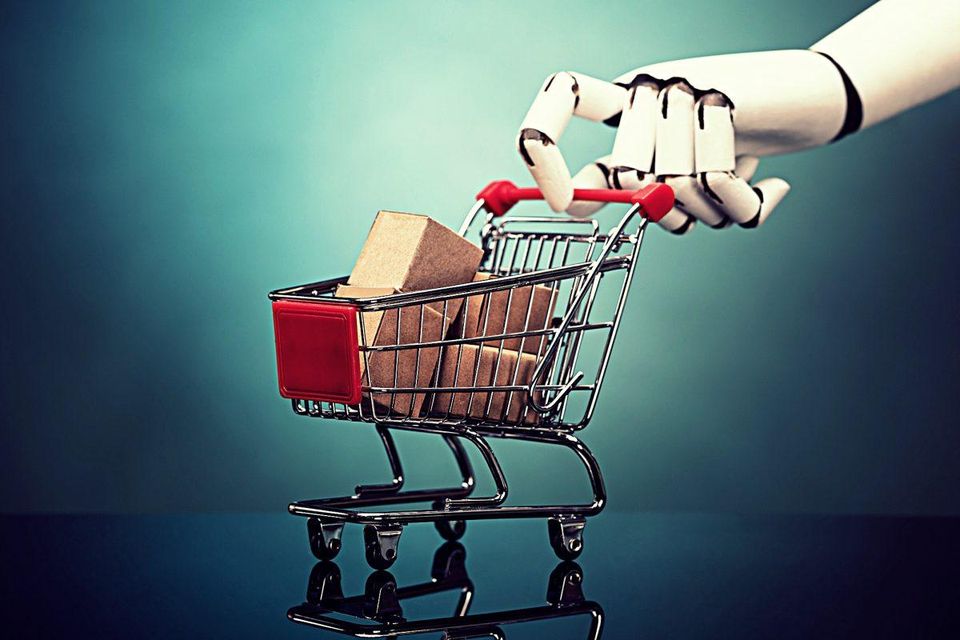

Artificial intelligence in the retail sector is being applied in new ways, from the entire product and service cycle to assembly-to-post customer service interactions, but the key questions for retail players are:What AI apps play a role in the automation or growth of the retail process?
How are retail companies today using this technology to stay ahead of their competitors, and what innovations are posed as potential retail game-changers over the next decade?In this article, we cover various examples of integrating AI into the retail industry, divided into the following sub-categories:1.Sales and CRM applications2.Customer Recommendations3.Manufacturing4.Logistics and Delivery5.Payments and payment servicesInnovation is a double-edged sword, and like any innovation, the results are a mixed bag.
Many AI applications have yielded increased ROI — this case study of AI in the retail marketing sector is an example — while others have failed and failed to meet expectations, such innovations shed light on the obstacles that must be overcome before becoming industry drivers.Below are 10 brief use cases in five retail domains or stages.
How AI technologies are used today and are being created and piloted as retail industry standards in eCommerce and brick-and-mortar operations.Readers can find additional insights into the retail space recently covered in our report on business intelligence.AI in Retail — Concluding RemarksApplications that have the highest likelihood of broader retail adoption are those that have a direct, hard-line return on investment.
“Improving customer engagement” — even with case studies and examples — is a softer benefit than “reducing lost packages by 6–10%.” Our retail executive guests using AI expect that the relatively stodgy committees in these large companies are likely to be extremely critical, safe, and bottom-line focused.As with many areas of AI innovation that are led by bigger industry players, the future will likely be dictated by the retail AI use-cases that are proven effective by leading industry players.
It’s safe to say that every at-scale retailer in the world is looking to Amazon for hints on “next steps,” and we can expect that the broad swath of relatively smaller retailers will be looking at Amazon, Walmart, Best Buy, and others for their own ideas on strategy.We advise businesspeople interested in retail AI applications to look closely for successful traction in AI use cases (i.e.

Applications interact with each other through a number of APIs, legacy systems, and an increase in complexity from one day to the next.
However, the increased complexity leads to a fair share of challenges that can be overcome by machine-based intelligence.As software development life cycles become more complex as day and delivery time decreases, testers need to provide feedback and evaluation to development teams promptly.
Given the breakneck pace of new software and product launches, there is no way to test soberly and rigorously in this day and age.To Know More: How Much Does It Cost To Make A Mobile App 2020Releases that happen once a month are now done on a weekly basis and updates are a factor almost every day.
After observing the hierarchy of controls, testers can create a technical map, looking at the AI Graphical User Interface (GUI) to obtain labels for various controls.Since testing is about verification of results, access to many areas of test data is essential.
Interestingly, Google DeepMind has created an AI program that uses deep reinforcement learning to play video games, thereby generating a lot of test data.Below the line, the Artificial Intelligence test site will be able to track users who are doing exploratory testing, to evaluate and identify applications being tested using the human brain.
By automating repetitive test cases and manual testing, testers can focus more on making data-driven connections and decisions.Finally, the limited time to test risk-based automation is a critical factor when it comes to helping users decide which tests to run to get the greatest coverage.