






Penny stock trading depends on your risk-taking ability. If you have the potential to take perils and acknowledge the different stocks through fundamental and technical analysis, profits can flow. Investment in blue-chip stocks is one of the sure-shot ways to earn an easy buck. Their products and services rule the market. Hence, there’s hardly or the least disadvantage involved in it.
On the other hand, Penny stocks are public companies that belong to high risk and low-price classes. So, penny stock trading is complex for traders.
These companies tempt traders to invest in them with an illusion of extreme profits or magnifying. Speculative traders are mostly on the radar of such stocks. People get driven by the greed of earning enormous money in a short time. However, they may be beneficial, but one has to be cautious. The following article sheds light on penny stock trading.
What is Penny Stock Trading?
Earlier, penny stocks were those stocks that have a per-share value of less than one dollar. In several nations, any stock that trades around or less than USD 5 is categorised under penny stocks. Moreover, the price of such stocks hardly rises. However, sometimes it may happen that due to unforeseen attention, there’s a huge rise. So, investors can take advantage of the movement. But the situation won’t stay for a long time, and the stock prices would fall flat.
Meanwhile, there have been instances that penny stocks found a listing in reputed exchanges like the NYSE (New York Stock Exchange). However, they trade through OTC (Over-The-Counter) transactions. They use OTC market groups (owned privately) or electronic OTCBB (OTC Bulletin Board). Notably, OTC transactions do not find any trading floor. Moreover, quotations take place electronically here.
Thus, penny stocks belong to companies that have a small market capitalisation and are also on the verge of delisting from a small exchange. Precisely, penny stocks are used during huge trend swings, high volatility and scams or frauds. So, a trader’s discretion is always advised here while initiating penny stock trading.
Penny stock companies generally target inexperienced investors.
Detailed information about penny stock company
Attempts have been made to mainstream penny stock trading and integrate it into the elite trading market. SEC (Securities and Exchange Commission of the US) modified the parameters to include most penny stocks into major stock exchanges. The agency works towards protecting investors’ interests and saving them from potential losses that may occur in the market while trading stocks. It is a federal government agency that is independent.
Its primary duty is to maintain orderly functioning and fair trading in the securities market.
The lack of liquidity in penny stocks is the biggest reason no one wants to invest in them. Those who make the investment either have to wait for the longest time or leave their hopes. So, it is important to understand that even if someone wishes to invest in the market must not put a big chunk of their funds into them. The buyers hardly exhibit any interest in buying them. Also, looking at their growth prospects, the product and services they sell have zero to low probability to make an impact in the market.
Their balance sheet and income statement do not show any credible outputs or inputs that a trader can trust and invest in them. Also, there’s no guarantee of dividends. So, even long-term traders distance themselves from penny stocks. Moreover, most online brokers do not provide services to trade penny stocks.
Furthermore, the prices of penny stocks do not present the actual picture of the market. So, when there’s a bearish trend, these stocks may continue to fall.
Hence, due to price quotes or comprehensive bidding and asking prices, and the tiny size of companies, the stocks of these companies remain speculative but on the borderline. In short, any investor who puts his money in it may lose all funds or a sizeable amount.
However, no one wants to lose money with low trading volumes during penny stock trading. Even stock promoters stay away from promoting such stocks. Therefore, a buyer is at his/her own risk.
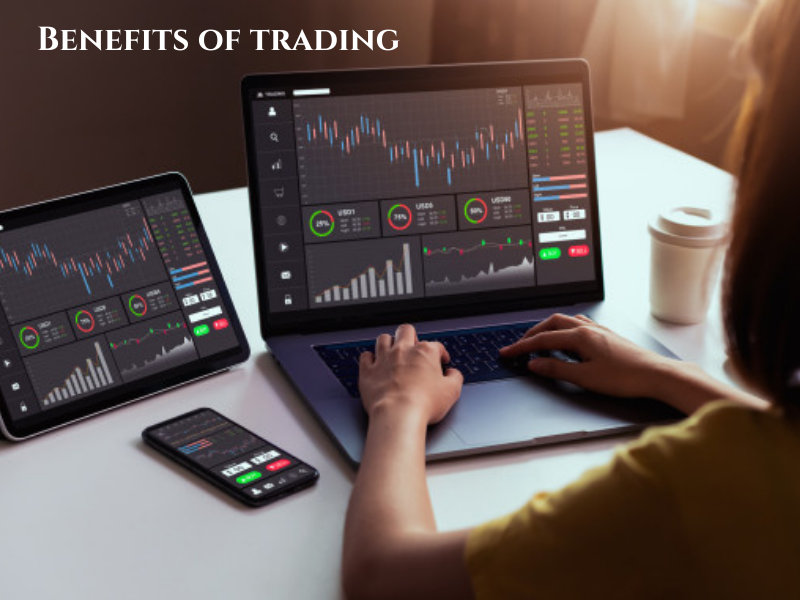
Foreign exchange (forex) or currency trading is a highly liquid worldwide market with a massive daily trading volume.
Forex trading, like many other investments, is not for the faint of heart or the inexperienced trader.
After you've learnt the ropes, the forex market has some distinct advantages over other markets.For the next five days, there will be a 24-hour market.Because the forex market is global, trading can take place at any time as long as a market is open somewhere in the world.
High liquidity in the forex market means that huge sums of money can be transferred into and out of currencies with relatively small spreads—the gap between the bid and ask prices for potential buyers and sellers.Transaction Fees Are MinimalIn the forex market, the cost of a transaction is often included into the price as a spread.
(A pip is the second place after the decimal point, or one percent, in Japanese yen trading.
)The spread for a forex transaction was 2 pips if the bid price was 1.3244 and the ask price was 1.3246.Brokers may also charge a commission, which can be a fixed fee or a percentage of the transaction's value.You Have the Option to Use LeverageForex brokers frequently allow traders to purchase and sell in the market with large leverage, allowing them to trade with much more money than they actually have in their accounts.For example, if you trade at a 50:1 leverage, you may trade $50 for every $1 in your account.

The forex market is different from other markets in so many ways.
Forex trading demand is increasing day by day due to its advanced trading tools.
The main reason behind the success of experienced traders is that they know how to evaluate the patterns in trading data.
Forex trading tools help traders to deal smartly with their emotions.
The technical analysis tools help to locate new trading opportunities, and they may also generate sell and buy indicators.
Traders can access millions of data of the past 15 years by only enhancing the speed and by making improvements in software.

For more information and fxgm opinions, the web is full.
One great place to read various discussions about fxgm twitter as well as fxgm facebook.
Their discussions usually also involve old investors with a lot of experience in the matter.
You can also ask anything that bothers you in forex, you will definitely get an answer from someone.
You should also read the fxgm discussion where many share good experiences with this type of investing.