


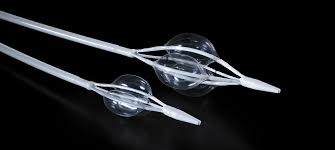
In minimally invasive diagnostic and therapeutic procedures, balloon catheters are used to dilate vessels, open blockages, and insert stents, among other uses.
Balloon angioplasty is a less invasive cardiac catheterization treatment for opening blocked or narrowed arteries. Heart stents are thin metal tubes with a lattice pattern that act as scaffolding to keep the artery open.
The stent is inserted into the constricted artery using a balloon catheter over a guide wire. The balloon is inflated and the stent expands to keep the artery open permanently after it is in place, after which the balloon is deflated and withdrawn from the artery.
High-pressure balloons nowadays can have thinner walls, stronger strength, and smaller profiles, and they can be used in a variety of minimally invasive operations. They are available in a variety of diameters, lengths, and forms.
Medical device designers now have more freedom thanks to advancements in balloon design and technology, allowing for the development of new and better devices. As a result, high-pressure balloons are employed in a wide range of diagnostic and therapeutic treatments, including:
-
Multi-point ablation rather than single-point ablation in cardiology
-
In urology, a combination of temperature sensors allows for Piezoelectricity testing.
-
A balloon-integrated catheter can be used to open sinuses in ENT.
-
Today, specialised balloon catheter usage in neurology and gynaecology include combining examination with slow-release medicines administered by a balloon catheter employing a tilting motion.
Balloon Catheter Design Considerations
-
Some essential performance factors have a significant impact on balloon catheter design. The first is the amount of time it takes to inflate and deflate the balloon (inflation/deflation time), which should be kept to a minimum.
-
In order to do this, catheter manufacturers aim to construct the inflation balloon in such a manner that the interior area is maximised.
-
The catheter's tracking ability to proceed through the specified path and reach the treatment location is the second important feature. This is critical for complicated anatomy, such as in the use of a neurological balloon catheter.
-
Finally, the insertion profile is an important feature of a balloon catheter. It refers to the size of the incision that must be made in the patient to place the catheter. Smaller insertion profiles are obviously better since they allow for faster patient recovery and repair.
Balloon catheters take up the volume of a physiological area or cavity's inherent geometric form. As a result, they are by far the least intrusive and patient-friendly form of operation and therapy. Furthermore, balloon catheters provide an excellent platform for installing flexible circuit combinations, allowing for the creation of novel operating methods.
Read more @ https://www.tradove.com/blog/What-is-Balloon-Catheter-and-its-Application.html




This is accomplished by precisely expressing light-sensitive ion channels, pumps, or enzymes in the target cells.
Light-activated enzymes and transcription factors provide precise regulation of biochemical signalling pathways at the level of individual cells.
The capacity to regulate the activity of a genetically specified group of neurons has been utilised in systems neuroscience to better understand their role in decision-making, learning, fear memory, mating, and addiction.
After transduction, these light-sensitive ion channels turn on or off in response to illumination, allowing researchers to investigate disease patterns and therapy efficacy.
Even the more complicated tissues of the live brain may be investigated with this method.
For example, in a mouse experiment, "light pipes" send light to specific parts of the brain, stimulating olfactory nerves to engage the motor centre, which then activates physical action.

The Automatic Platform Screen Door is a safety feature that separates the platform from the railway in subways and LRT (Light Rail Transit).
At the right location on the platform, fixed and sliding doors are fitted.
When an electric train stops at a defined location, sliding doors interact with car doors, opening and closing as an ATO (Automatic Train Operation) system make a signal.Impact and recovery of Covid-19, major manufacturers, share, value analysis, product kinds, and market size with five-year revenue prediction are all included in the Automatic Platform Screen Door market.
In addition, the article contains information about the companies, such as revenue, gross profit, shipment, price, and other important details.
To get a competitive advantage, companies in the global Automatic Platform Screen Door market are focusing on mergers and acquisitions as well as new product releases.New Metro Stations Segment Projected to Paramount in Global MarketWith the large increase in the number of automated metro trains around the world, the new metro train sector is expected to gain traction in the worldwide platform screen doors market.
Furthermore, increasing digitalization in the current metro train network is expected to be a key driver of the worldwide platform screen doors market in the future decades.Read more @ https://cmilatestinsights.blogspot.com/2021/10/automatic-platform-screen-doors-market.html
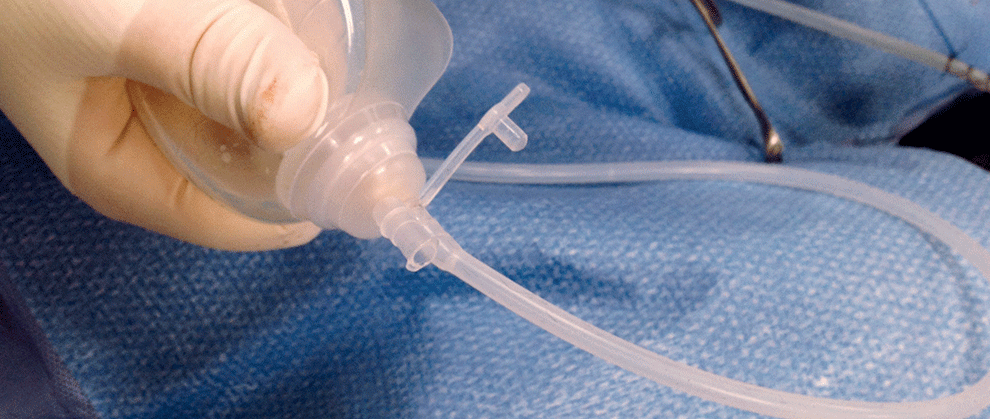
The Global Surgical Drainage System Market is the best to get the simplest business choice.
More people are willing to use more currencies to urge accurate and accurate demographics of the market.
Bard (US), Redax (Italy), Ethicon (US), Stryker (US), Romsons (India), Medtronic (Ireland), Medline Industries (US), Cook Medical (US), Poly Medicure (India), Zimmer Biomet (Indiana), Global Medikit (India)Request Sample Copy @t: https://introspectivemarketresearch.com/request-samples.php?_id=9&_sid=1990The research methodology that analysts use to review the present situation within the market and predict the longer term begins with the gathering of valuable information on various categories.
The report states that readers know precisely the major role they play within the global Surgical Drainage System Market.
Industry standard tools like SWOT analysis are wont to measure the strengths, weaknesses, opportunities and limitations of this market.Product Segment Analysis: Passive Drains, Active DrainsApplication Segment Analysis: General Surgery, Cardiac & Thoracic Surgery, Orthopedics Surgery, Obstetric/Gynecological Surgery, OthersRegional Segment Analysis: United States, China, Europe, Japan, Southeast Asia, IndiaVarious factors that support the expansion trend of the market are studied long within the report.
The report also lists the constraints that are threatening the worldwide Surgical Drainage System market.