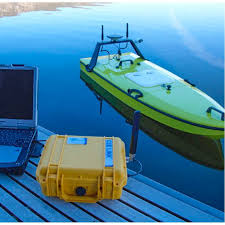


Different tools are utilised during hydrographic surveying. From tide stations to sonars, each tool and piece of equipment fills a special role during the survey. These pieces of equipment are used by professionals to produce accurate charts to keep the mariner safe.
Multi-beam sonars
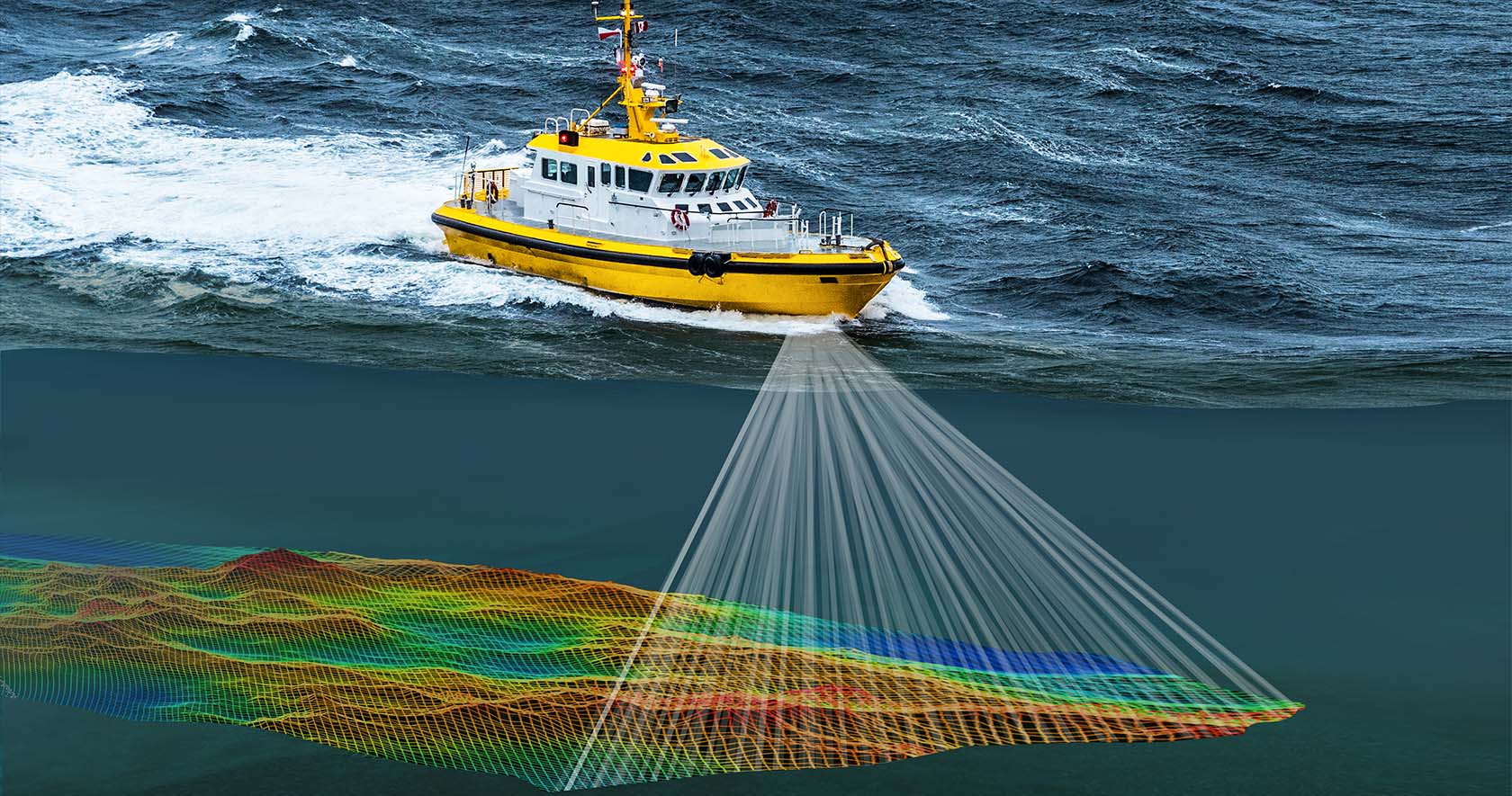
These are pieces of equipment that transmit sound energy. They then analyse the echo or the return signal that has bounced off the floor of the ocean or other objects. These pieces of equipment emit sound waves from beneath the hull of the ship to produce fan-shaped coverage of the floor of the ocean. These systems also measure and record the time it takes for the acoustic signal to move from the transmitter to the seafloor and back to the receiver.
To ensure full coverage of a certain area, multi-beam sonars produce swaths of soundings. The coverage area of the floor depends on the depth of the water. A lot of multi-beam echo sounders are capable of recording acoustic backscatter data. This equipment backscatter is data that can be processed to produce low-resolution images. Backscatter is often co-registered with the bathymetry data. It is also used to help bathymetric data post-processing and interpretation.
Side-scan sonars
These are specialised sonar systems that are used to search and detect objects on the floor of the ocean. Just like other types of sonars, these sonars transmit sound energy. They then analyse the return signal that bounced off the floor or other objects. Side-scan sonar used in hydrographic surveying consists of three basic components: a transmission cable, a tow fish, and the topside processing unit. The transmitted energy in a side scan is formed into the shape of a fan. It sweeps the floor of the ocean from under the tow fish directly to either side. There is a continuous recording of the return echo that creates a picture of the bottom of the ocean.
Lidar
This is a light detection and ranging advanced technology that measures depth or elevation by analysing the reflection of laser light pulses off an object. Lidar systems are aircraft-mounted. They provide contiguous and seamless coverage between sea and land. Bathymetric lidar is typically used to determine the depth of water by measuring the time it takes between the transmission of a pulse and the return signal.
A lot of NOAA field units use topographic lasers to measure and locate various features such as islets, rocks and small islands. Laser heads produce sixteen laser beams. These beams reflect off the target object as received back by the head. The computer then uses the information along with altitude and precise positioning data to determine the location and height of the object.
GPS for surveys
These types of hydrographic surveying equipment are the basis for almost all positions measurement in hydrography. They provide location information for launches and ships. Accurate positioning is necessary for other elements of hydrography. Fixed Aids to navigation are occasionally found to be out of their positions. The location of the ATONS should be accurately measured to be used for charting.

This gives us accurate information about the movement of water above the seafloor and how the seafloor looks.
The information obtained in its most public form is then published as sailing directions and nautical charts both in hardcopy and digitally.In a navigational context, these publications are important when it comes to providing mariners with the information they require to navigate ships efficiently and safely.Used together with meteorological data, nautical publications provide the basis for making decisions on when and where a ship can be taken.
It also provides important base mapping to support scientific research.Communities and cities that have prospered over time due to their close proximity to railways and roads in modern times, airports, superhighways, access to navigable waters and harbours have been the earliest cornerstone for economic development and discovery.
What makes water navigable?Knowing the depth of water, tides, hazards, and current is very important.
The safety of life at the sea, the room to run from the storm and finding an ice-free course to steer are supported by the information obtained during hydrographic surveying.
The reduced carbon footprint associated with sea transportation and economic efficiency will surpass all the transportation modes.