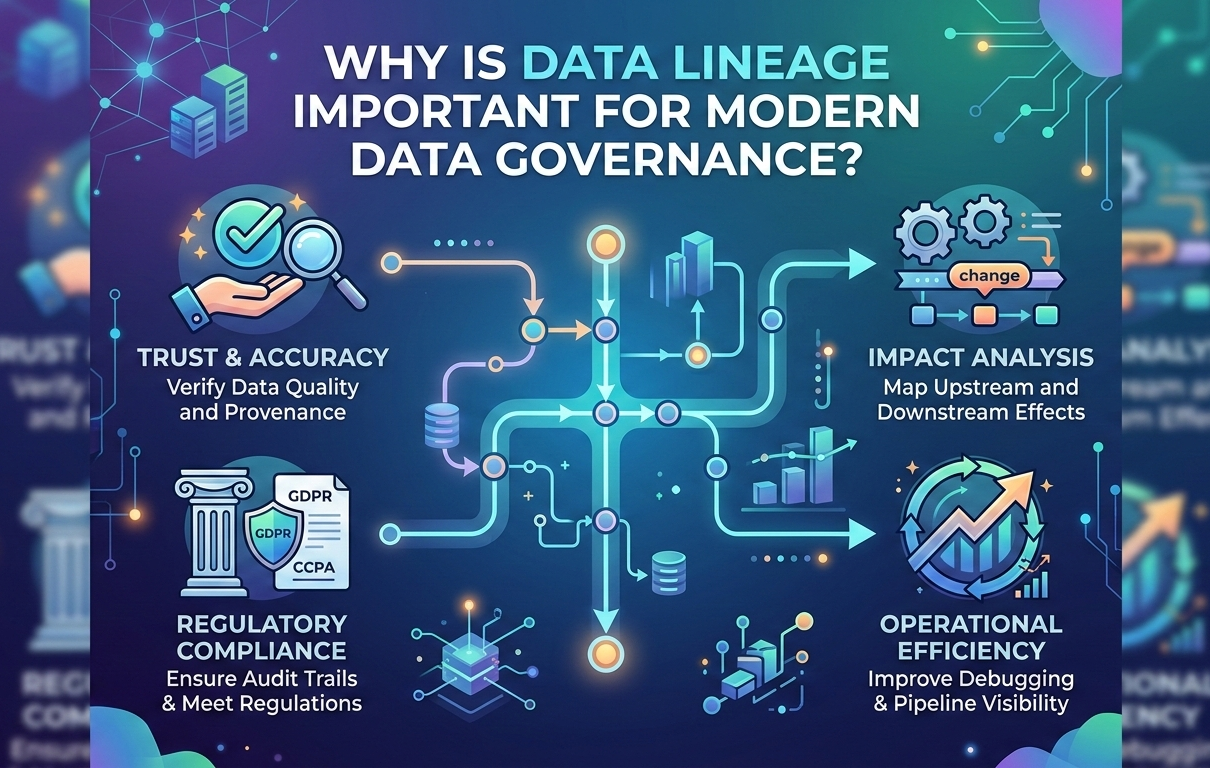
Data governance has long been thought of as the role that notifies you what you can & can't do with data and how to manage security and risk. But what if data governance is the key to unlocking the potential of data, allowing you to extract more value, develop more quickly, and make better decisions?
Maintaining Pace
Data has been extensively driving insights and decision-making for the past two decades. Advances in AI and machine learning put data science, research, and analysis at the center of everything. According to a new study, data science, which includes AI and machine learning, is vital to the performance of marketing and sales departments.
This expansion has occurred at a much quicker rate than the governance surrounding it. That's only natural: things evolve naturally, then rules, regulations, and processes are implemented, and the innovation party is over.
However, suppose data governance can figure a way to be just as adaptable and quick-moving. In that case, there's a chance for innovation and regulations to coexist, increasing the value of data without obstructing discovery. So, how does data governance stay up with the rest of the world of data science? It must take advantage of the very tools that are speeding up the process: artificial intelligence and machine learning.
What is Data Governance in AI?
In a nutshell, data governance assists an organization in better managing five aspects of data: accessibility, usability, integrity, and security. It can deliver corporate value and help AI transition by using the proper technology. In terms of technical terms, it entails:
1- Data Security: Keep your data safe from unwanted access.
2- Data Loss Prevention: Your clients entrust you with their data management. You must ensure that sensitive data is not lost or exploited for purposes other than those intended.
3- Data Integrity: Ensuring that data is correct and useable across systems.
4- Data Integration: Any transfer of data and changes in form and shape.
5- Data lineage: Tracing the origins of data and determining where it could end up.
6- Completeness of Data: How comprehensive is your data?
Why Better Data Governance Is the Key to Better AI?
If you use strong data governance to maintain your corporate data, you'll be able to:
- Cut down on time it takes to cleanse data and "fill in the blanks" for your data.
- Increased awareness of your organization's capabilities – when you approach data as a strategic resource, the only way of knowing what you have vs. what you don't is to profile and understand the data quality.
- Higher accuracy and quality AI – Having adequate data for training your machine learning or AI neural networks allows you to make more accurate judgments. Having reliable data can have a dramatically considerable advantage.
- Online inference that is both better and more efficient
Driving Transformation
We should be able to trust our statistics now more than ever. To know that it is of the finest quality and that it originates from sources that have treated it well. If such is the case, the conclusions and insights we reach will be correct. A strong foundation of trust allows for more intelligent business decisions and benefits consumers, citizens, and employees, who will progressively base their decisions on how effectively you handle their data.
If trust is the most valuable commodity, data governance is well equipped to play a significant role. When a data analyst, engineer, or scientist can be sure that their work is based on high-quality, accurate, and timely data, the value of their output skyrockets. To put it another way, if we get data governance right, we'll gain even more value out of our other efforts.
Is there a data governance practice in place at your company to help you speed up your data science program? If not, contact us at SG Analytics; we are a one-stop solution for all your data governance services.


And where doI still start with Python, it is rising so rapidly in the tech sector that it capacity even return Java (the God of all the programming languages) in the close to future.
Moreover, having the information of Data Science and Python is the greatest combination, mainly if you’re coming from a B.tech background.Therefore, if you’ve too learned python, it will advance yourcareer prediction as a data scientist.
It’s highly flexible, simple to learn, simple, and clear.This is exactly why it has become an silent rule to know pythonbefore venture into the world of data science.Some of the key benefits of Python take in:Python is simple tocomprehend and is elastic: Python has a easy syntax and is simple to learn.It is not compound or complicated like extra programming languages and this is exactlywhy it is also not hard to understand.
It is also remarkably versatile as it can be used for about every sector counting machinery, web processing, and even ecology.
also, it is too the second most profitable programminglanguage.
consider it or not, there are a excess of industries that are actively by python at the moment.