

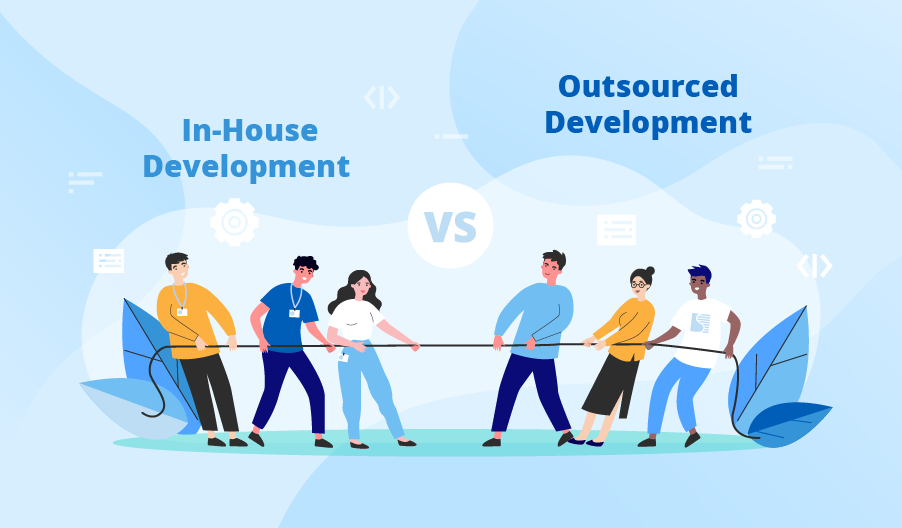
Any startup or successful business that decides to create its software is faced with the question of how to organize the development process. Entrepreneurs have two options that will create a program but will differ in terms of time and cost: outsourcing and in-house development.
In-house development is the creation of software with the involvement of only those people who are in your unit. In this case, the founder of the business needs to create their own team of specialists and not turn to the help of IT companies.
Outsourcing is using the resources of a group of programmers who are not your employees but have expertise in your niche.
To choose the right app development model, a startup founder needs to know both options' pros and cons.
Pros of In-House Software Development
Creating your own software in the era of digitalization is the right decision for any business. According to Statista, total revenue in the App market is projected to reach US$420.70bn in 2022.
In-house development is an option in which the business owner has a lot of responsibility. It starts with the entrepreneur needing to select their team of experienced programmers. Each employee needs to know and fulfill their goal clearly, and for this, it is necessary to understand the intricacies of development and constantly monitor the process.
In-house development has advantages and disadvantages that you need to consider before starting work.
Well-Selected Employees
For the right selection of developers for the staff, you will need more time than for the selection of an outsourcing team since you will have to interview each company member separately. In-house specialists are usually more involved in the work than employees who came only to the project. The programmers on your team depend entirely on you, so their productivity is enhanced by close contact with the company's owner.
Easy Communication Within the Team
The in-house development team knows all the company members they need to work with. That is why communication is simple and fast, which positively influences the quality and timing of software development. If something does not suit you in the process of work, you can discuss it with the team and fix the error in a short period.
Full Control and Change
Since you are recruiting a team yourself, you have the opportunity to train it in all the tools that your employees use to work effectively in the company. It will be easier for you to observe their professional progress and reward them if they have made a profit.
In-house developers will quickly adapt to changes within the project and can also convey their knowledge to new developers that you hire to strengthen.
Cons of In-House Software Development
Despite the advantages of in-house development, it also has disadvantages that force business owners to use the help of an outsourcing company.
Lack or Little Experience in Different Niches
Each project requires the developer to have a specific set of skills that will help successfully complete tasks. Having hired the necessary specialists, you will successfully close the project, but if new features are needed for the software, you will have to look again for a new candidate who can complete this mission. Building a team is costly in terms of time and money, so not every business can afford in-house development.
Budget Waste
Maintaining your own IT team is much more expensive than using the services of an outsourcing company. Such factors influence this:
- fixed salary regardless of workload;
- provision of equipment;
- taxes;
- training and benefits;
- paid vacation and sick leave.
Even if, at some point, you can't load the developers enough with work, you will have to pay them money to keep them in the company.
Staff Turnover
There is a lot of competition in the IT market for valuable personnel, so experienced software developers often leave, and companies face a turnover. Conforming with Apollo Technical, the overall turnover rate is 57.3%. Keeping an employee in place is always a significant expense, but they do not guarantee that the specialist will stay with you for a long time. New team members will have to be onboarded and trained, which will take up your and the HR department’s time.
Differences Between In-House and Outsourcing Development
If the business owner decides not to create a separate development team, they can turn to outsource IT companies that will take the project at any stage and bring it to a result. Such companies are experts in many areas of technology, so in addition to software development, you can turn to them for advice.
Outsourcing cooperation is chosen by those who want to achieve a high-quality app while saving their budget and time. According to Fortunly, 78% of businesses all over the world feel positive about their outsourcing partners.
The main differences between outsourced development and in-house software are:
- Cost reduction. Unlike in-house development, an outsourcing team does not require them to provide equipment and jobs in the office. Such specialists do not need to pay for sick leave or vacation and try to keep them with special offers. The team signs a contract with you and works according to clearly specified deadlines without disruption. If cooperation with one company does not achieve the desired result, you can always turn to other contractors for help.
- Ability to form a team. One of the most significant benefits of outsourced collaboration is the ability to scale or reduce the team, depending on the budget you are willing to allocate. For this, you do not need to hire or fire an employee, which means that this will not influence you as an employer.
- Increases productivity. Outsourcing can increase productivity even if you already have a development team. With the help of contractors, you will relieve your specialists and give them the opportunity to perform work better. Your employees will be able to focus on more important tasks, and your partners will solve smaller ones.
In order to obtain software that satisfies your business needs, you have to select an outsourcing company that already has experience in your field and knows the intricacies of interacting with the audience.
What to Choose: In-House or Outsource Development
The popularity of outsourcing cooperation is growing every year. According to Capital Counselor, by 2025, the global IT outsourcing market will be worth $397.6 billion.
In-house and outsource development have advantages and disadvantages. Still, since all customers want to end up with an application that will attract as many customers as possible, they give their project to a contractor from IT companies.
The in-house developers will be very familiar with the product, but the outsourced team will be able to implement the latest technology and provide advice.
Before you make a choice, re-examine the market and your potential customers' preferences to provide them with software that will benefit them and benefit you!