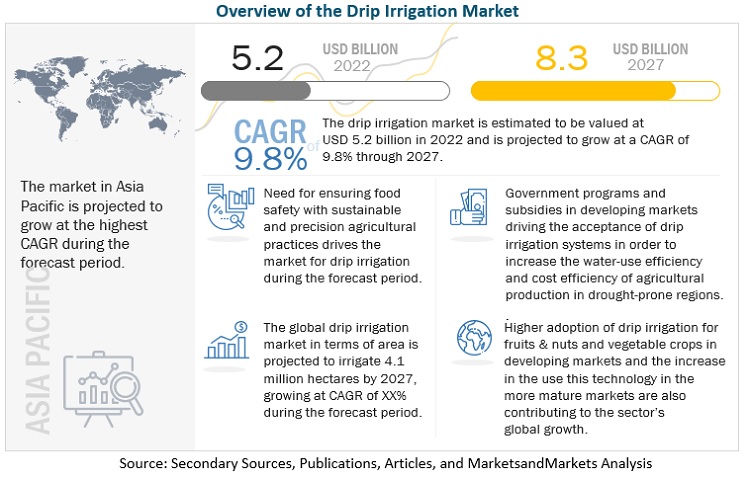


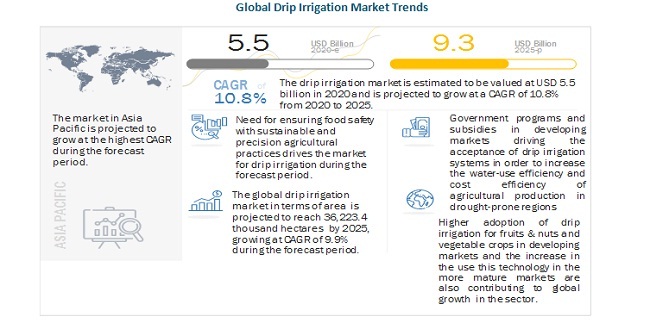
The Drip Irrigation Market is estimated to be valued at USD 9.3 billion by 2025, from USD 5.5 billion in 2020, at a CAGR of 10.8% during the forecast period. The market is driven by factors such as enhanced crop yields, optimum utilization of resources, reduced agricultural input costs and improved efficiency in agricultural production.
Driver: Government programs and subsidies driving acceptance of drip irrigation systems
Developing countries such as India and China are among the major countries adopting drip irrigation systems, and the key driver is the support from government agencies and public-private partnerships through prominent industry participants. Government programs such as India’s Pradhan Mantri Krishi Sinchayee Yojana (PMKSY) seeks to extend the coverage of micro-irrigation in the country through subsidies on kits and systems to improve acceptance among farmers. State-sponsored projects are another factor that continues to drive the growth of drip irrigation systems in developing countries.
Constraint: High initial cost of large-scale drip irrigation systems
The cost of the initial investment is high, which makes the use of drip irrigations systems uneconomical for low-value crops. The cost of drip irrigation equipment varies with crop type, region, soil, water conditions, fertigation equipment, and filtration equipment. This type of irrigation is considered to be feasible for horticultural crops and cash crops such as grapes, sugarcane, tomatoes, and onions, based on their high economic value. Drip irrigation is expensive due to the requirement of large quantities of piping & filtration equipment.
Opportunity: Increasing adoption of precision agriculture and sustainable practices
Commercial horticulturalists have been consistently trying to use resources to maximize profits, of which precision farming and sustainable agriculture plays a key role. Considering the rising production cost, farmers are trying to implement drip irrigation to increase irrigation efficiency and crop productivity. There is an emerging trend for an increase in greenhouse vegetable production. An increase in acreage under protected farming systems is expected to drive the drip irrigation systems market. The use of drip irrigation reduces environmental degradation and minimizes groundwater table depletion. It is considered sustainable, as the water usage rate is at gallons per hour instead of gallons per minute, which also reduces evaporation and runoff. Growing awareness, regulatory reforms, and agricultural policy for sustainably produced foods would contribute to the growth of the drip irrigation market.
Challenge: Soil salinity hazards and bio clogging in drip irrigation systems
Drip irrigation systems are often limited by the presence of high saline content in water, which poses a threat to the crops being grown. The excess of salt content is one of the major concerns with water used for irrigation. A high salt concentration present in the water and soil would negatively affect the crop yields, degrade the land, and pollute groundwater. The use of drip irrigation systems causes no foliar accumulation of salts; however, the salt accumulates near the periphery of the wetted area. This salt accumulation is a cause for concern when the emitter placement does not coincide with the location of the plant row, particularly for crops that are sensitive to soil salinity.
The Asia Pacific drip irrigation market is anticipated to witness significant growth during the forecast period due to the high agricultural production, government initiatives incentivizing the adoption of drip irrigation systems, and increase in irrigable areas in the region which has resulted in water scarcity across multiple countries in the region. Asia Pacific was the largest consumer of drip irrigation and is a key exporter of agricultural products. The region is mainly dominated by large-scale operations, primarily exports, with an organized distribution chain.
The key drip irrigation manufacturers in this market include Jain Irrigation Systems Ltd. (India), Lindsay Corporation (US), The Toro Company (US), Netafim Limited (Israel), Rain Bird Corporation (US), Chinadrip Irrigation Equipment Co. Ltd. (China), Elgo Irrigation Ltd. (Israel), Shanghai Huawei Water Saving Irrigation Corp. (China), Antelco Pty Ltd. (Australia), EPC Industries (India), Microjet Irrigation (South Africa), KSNM Drip (India), Sistema Azud (Italy), Metzer Group (Israel), Grupo Chamartin Chamsa (Italy), and Dripworks Inc. (US).