

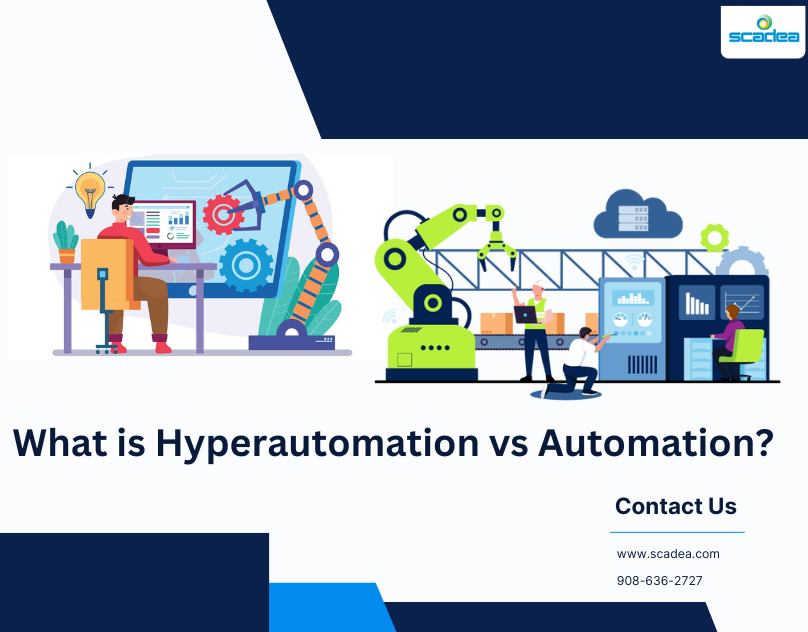
Hyperautomation and automation are related concepts in the field of technology and business process management, but they differ in their scope and capabilities. Here's an overview of both terms:
- Automation:
- Automation refers to the use of technology to perform tasks or processes with minimal human intervention. It typically involves the use of software, scripts, or robotic systems to execute repetitive and rule-based tasks.
- Examples of automation include email filtering, data entry, report generation, and workflow automation in business processes.
- Automation can help improve efficiency, reduce errors, and save time by allowing machines to handle routine tasks, freeing up human workers for more complex and creative work.
- Hyperautomation:
- Hyperautomation is an advanced form of automation that goes beyond simple task automation. It combines various automation technologies and tools, such as robotic process automation (RPA), artificial intelligence (AI), machine learning (ML), process mining, and analytics.
- The goal of hyper-automation is to automate end-to-end business processes, including not only routine tasks but also decision-making processes and complex workflows.
- It often involves the use of bots, chatbots, cognitive automation, natural language processing (NLP), and other AI-driven technologies to mimic human intelligence and decision-making.
- Hyperautomation aims to create a more intelligent and adaptive automation ecosystem where machines can learn, make decisions, and continuously optimize processes.
- It can result in significant improvements in efficiency, accuracy, and agility across an organization, as it automates not just tasks but entire processes and can adapt to changing conditions.
Best Hyperautomation Service Company
What is Hyperautomation used for?
Hyperautomation is used for a wide range of purposes across various industries and business sectors. Its primary goal is to streamline and optimize business processes by automating not only routine tasks but also decision-making processes and complex workflows.
Here are some common use cases for hyper-automation:
- Business Process Automation: Hyperautomation can automate end-to-end business processes, from data entry and document handling to decision-making steps. This is valuable in areas such as finance, human resources, supply chain management, and customer service.
- Customer Service and Support: Chatbots and virtual assistants powered by natural language processing (NLP) and machine learning can provide instant responses to customer inquiries, resolve common issues, and escalate complex cases to human agents when necessary.
- Data Entry and Data Extraction: Hyperautomation can automatically extract data from documents, emails, forms, or websites and populate databases, reducing the need for manual data entry.
- Document Processing: It can automate the processing and categorization of documents, such as invoices, contracts, and legal documents, leading to faster and more accurate handling of paperwork.
- Supply Chain Management: Hyperautomation can optimize supply chain processes, including demand forecasting, inventory management, and order fulfillment, by automating routine tasks and providing real-time visibility into the supply chain.
- Financial Processes: Automation can be applied to financial tasks such as invoice processing, expense management, payroll processing, and fraud detection.
- Healthcare: In the healthcare industry, hyper-automation can be used to automate administrative tasks like appointment scheduling, insurance claims processing, and medical billing, allowing healthcare professionals to focus on patient care.
Conclusion
while automation involves the mechanization of specific tasks, hyper-automation is a more comprehensive approach that leverages advanced technologies to automate entire processes, including decision-making. Hyperautomation is often seen as a strategic initiative for organizations looking to achieve higher levels of operational efficiency and agility by harnessing the full potential of automation technologies and AI-driven capabilities.