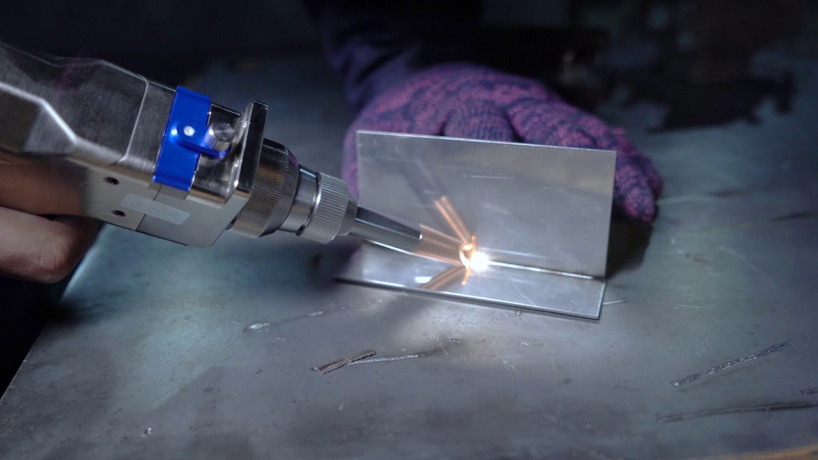


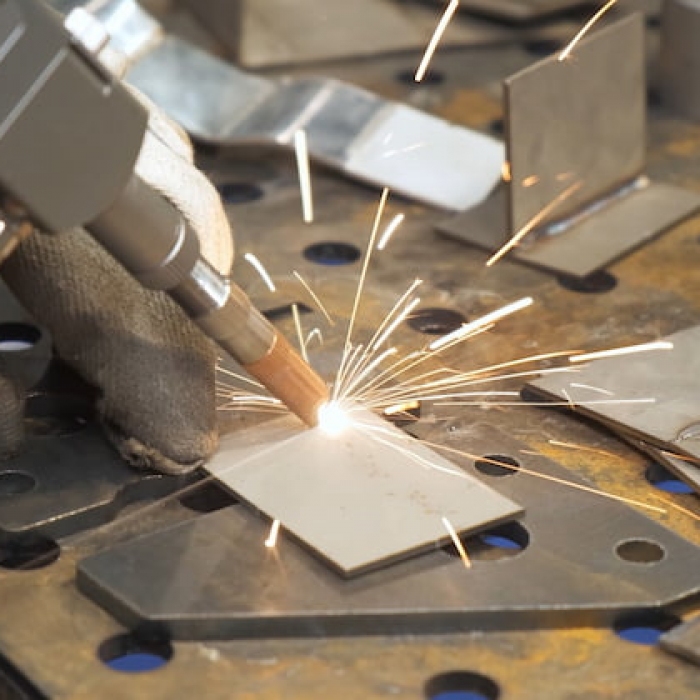
Handheld laser welding is a modern method of joining metal parts, which has a number of advantages over other welding technologies. It is based on the use of a powerful laser beam to melt and join metal surfaces.
One of the main advantages of handheld laser welding is its precision. Thanks to unique optical systems, such welding allows a high degree of control over the process, which in turn ensures high quality of welded joints. In addition, the ability to continuously adjust the power and focal length of the laser beam makes this method ideal for working with different metal thicknesses.
Another advantage of handheld laser welding is its safety. Since the welding process takes place without contact with the work surface, the risk of smoke, dust and toxic fumes is reduced, making it more environmentally friendly and safer for the operator. In addition, the use of the laser beam also minimizes the risk of damage to surrounding materials.
Thus, handheld laser welding is an efficient and convenient method of joining metals that has several advantages over other welding methods. Its high precision and safety make this process an excellent choice for various industrial and manufacturing applications.
With a laser beam welding machine, you can produce a high quality final product with an invisible weld. All work can be done quickly, comfortable, and accessible even for a beginner.
Operating principle of laser beam welding
Laser beam welding is performed with special equipment. Such a method allows producing items with a high quality joint at high speed.
Welding occurs due to heating and melting of the processed metal. A laser beam that penetrates the metal causes these processes. The equipment creates a light flux with uniform wavelength. A focus is achieved by guide mirrors. The energy flow is controlled by focus lenses.
The laser welding process is performed in the following order:
- Parts connection. Parts are pressed tightly together and fixed at several points on the worktable of the machine.
- Laser installation. The machine’s head is pointed at the area of the future welding seam.
- Switching on the generator. The machine is actuated by an operator. After that, the process of heating, melting, and evaporating of particles is activated.
The laser beam has a small cross-section. This allows you to fill the smallest cavities and unevenness of the material and ensures the most even and smooth joint seam. This advantage is unique to laser beam welding. Also, due to the high speed of laser beam travelling, there is not enough time for metal to oxidize.
With the laser beam welding, it possible to get two types of connecting seams:
- Full penetrated weld. It is used to weld stainless steel pipes.
- Intermittent weld. It is used when welding small parts with surface damages.