


AI in healthcare examples
Welcome to the fascinating world of artificial intelligence (AI) in healthcare! Over the past few years, AI has emerged as a transformative technology with the potential to revolutionize the healthcare industry. Today, we will explore some remarkable examples of AI applications in healthcare that have proven to be effective in improving patient outcomes, optimizing medical treatments, and enhancing overall healthcare delivery. Prepare to be amazed as we delve into the world of AI-powered healthcare advancements!
Transforming healthcare with AI
From diagnosing diseases to predicting patient outcomes, AI has the capability to transform healthcare as we know it. Gone are the days when doctors had to rely solely on their expertise and experience to make critical decisions. With the integration of AI into healthcare systems, medical professionals can now leverage the vast amount of data available to them and gain valuable insights that can significantly improve patient care.
Proven applications of Generative AI
One specific area of AI that has gained significant attention in healthcare is Generative AI. This branch of AI focuses on generating new content, such as images, text, or even software, based on patterns and input data. Generative AI algorithms are trained to learn from existing data and generate new, unique content that closely resembles the input data.
Let's explore 12 proven use cases of Generative AI in healthcare that have shown tremendous potential in advancing medical research, diagnosis, and treatment.
1. AI-assisted radiology
Radiology is a critical field in healthcare, where accurate interpretation of medical images plays a vital role in diagnosis. Generative AI algorithms can analyze medical images and provide automated assistance to radiologists in detecting potential abnormalities. This technology has shown promising results in improving accuracy and speed of diagnoses, ultimately leading to better patient outcomes.
2. Drug discovery and development
Discovering and developing new drugs is a complex and time-consuming process. Generative AI can streamline this process by analyzing vast amounts of existing data to identify potential drug candidates. By considering various molecular attributes and simulating drug-target interactions, Generative AI algorithms can generate novel drug structures that have the potential to treat a range of diseases.
3. Personalized medicine
Every individual is unique, and so are their healthcare needs. Generative AI can assist in developing personalized treatment plans by analyzing patient data such as medical history, genetic makeup, and response to previous treatments. By considering individual characteristics, Generative AI algorithms can generate tailored treatment recommendations that can optimize patient outcomes.
4. Virtual assistants for patient care
Generative AI can power virtual assistants that interact with patients and provide personalized healthcare support. These virtual assistants can answer common medical questions, assist in medication management, and provide reminders for follow-up appointments. By leveraging natural language processing and machine learning, virtual assistants powered by Generative AI can enhance patient engagement and improve the overall experience of healthcare delivery.
5. Disease prediction and prevention
Generative AI algorithms can analyze large sets of patient data and identify patterns that may indicate the risk of developing certain diseases. By analyzing factors such as genetics, lifestyle choices, and environmental factors, Generative AI can assist in predicting disease susceptibility and enable proactive preventive measures. This can have a significant impact on reducing the burden of diseases on individuals and healthcare systems.
6. Medical image synthesis
Generative AI can synthesize realistic medical images based on limited input data. This capability can be particularly useful in scenarios where obtaining a large dataset of medical images is challenging or expensive. Medical image synthesis powered by Generative AI can provide additional training data for AI algorithms and enable more accurate and robust analysis of medical images.
7. Behavioral analysis and mental health assessment
Generative AI can analyze patterns in patient behavior and assist in mental health assessments. By analyzing language patterns, facial expressions, and other behavioral cues, Generative AI algorithms can help identify individuals at risk of mental health conditions such as depression or anxiety. This early identification can enable timely interventions and support for individuals in need.
8. Robotic surgery assistance
Generative AI can enhance robotic surgery by providing real-time assistance to surgeons. By analyzing surgical data, Generative AI algorithms can identify potential areas of concern, provide guidance on optimal surgical techniques, and even help in performing complex procedures. This collaboration between AI and human surgeons can improve surgical precision and patient safety.
9. Predictive analytics for patient outcomes
Generative AI can analyze large healthcare datasets and predict patient outcomes based on various factors such as demographics, medical history, and treatment plans. By identifying patterns and correlations, Generative AI algorithms can assist healthcare providers in making informed decisions and optimizing patient care. This predictive analytics capability can help healthcare organizations allocate resources effectively and identify high-risk patients who may require additional support.
10. Fraud detection and prevention
Generative AI algorithms can analyze healthcare data to detect patterns indicative of fraudulent activities. By identifying irregular billing patterns, suspicious claims, and anomalies in data, Generative AI can help healthcare organizations prevent fraud and ensure that resources are utilized efficiently. This can have a significant impact on reducing healthcare costs and improving the overall integrity of the healthcare system.
11. Real-time monitoring and alert systems
Generative AI can power real-time monitoring systems that analyze patient data and generate alerts for healthcare providers. By continuously monitoring vital signs, lab results, and other relevant data, Generative AI algorithms can detect early warning signs of complications and alert healthcare professionals in a timely manner. This proactive monitoring can help prevent adverse events and improve patient safety.
12. Patient satisfaction and experience
Generative AI can contribute to enhancing patient satisfaction and experience by personalizing healthcare interactions. By analyzing patient preferences, feedback, and historical data, Generative AI algorithms can tailor healthcare services to individual needs, resulting in a more patient-centric approach to care. From appointment scheduling to personalized treatment recommendations, Generative AI can revolutionize the way patients experience healthcare.
Future of AI in healthcare
The applications of AI in healthcare are expanding at a rapid pace, and the future looks incredibly promising. With ongoing advancements in AI algorithms, increased data availability, and improved computing power, we can expect AI to play an even more significant role in transforming healthcare in the coming years.
Benefits of Generative AI in healthcare
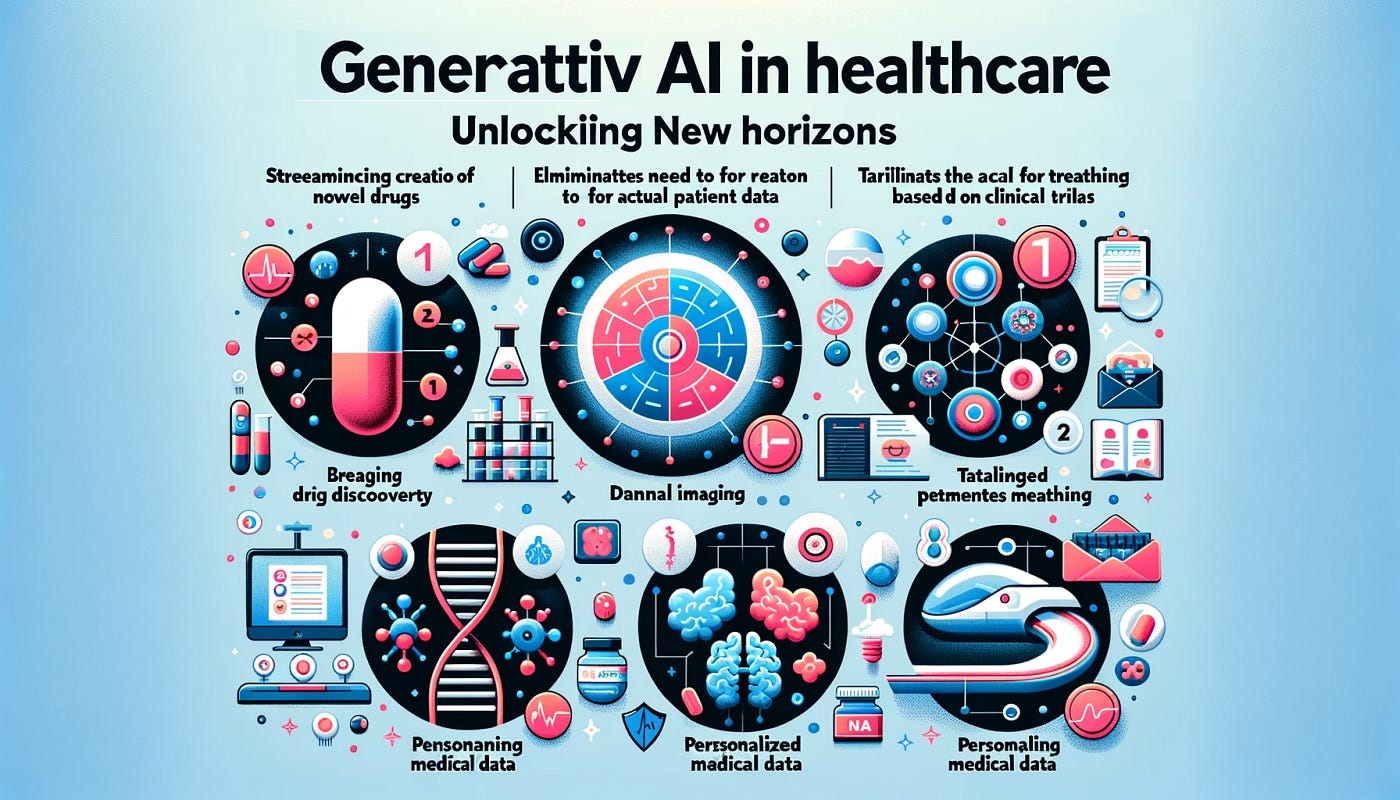
Generative AI has the potential to revolutionize healthcare by improving patient outcomes, enabling personalized medicine, and optimizing healthcare delivery. Some of the key benefits of Generative AI in healthcare include:
- Enhanced accuracy and speed of diagnoses
- Streamlined drug discovery and development processes
- Tailored treatment plans based on individual characteristics
- Improved patient engagement and experience
- Proactive disease prediction and prevention
- Improved surgical precision and patient safety
- Optimized resource allocation and cost savings
- Early detection of fraudulent activities
- Real-time monitoring and alert systems for timely interventions
- Personalized healthcare services for improved patient satisfaction
As we continue to harness the power of AI in healthcare, it is crucial to address concerns such as data privacy, ethical considerations, and ensuring the responsible use of AI technologies. The integration of AI into healthcare must be guided by regulatory frameworks and ethical principles to ensure that the potential benefits are maximized while minimizing risks.
In conclusion, the use cases of Generative AI in healthcare are vast and diverse. From assisting radiologists in accurate diagnoses to enhancing patient satisfaction and experience, Generative AI is transforming the healthcare landscape. As we look ahead to the future, it is clear that AI will continue to play a pivotal role in improving patient outcomes, advancing medical research, and revolutionizing healthcare delivery.