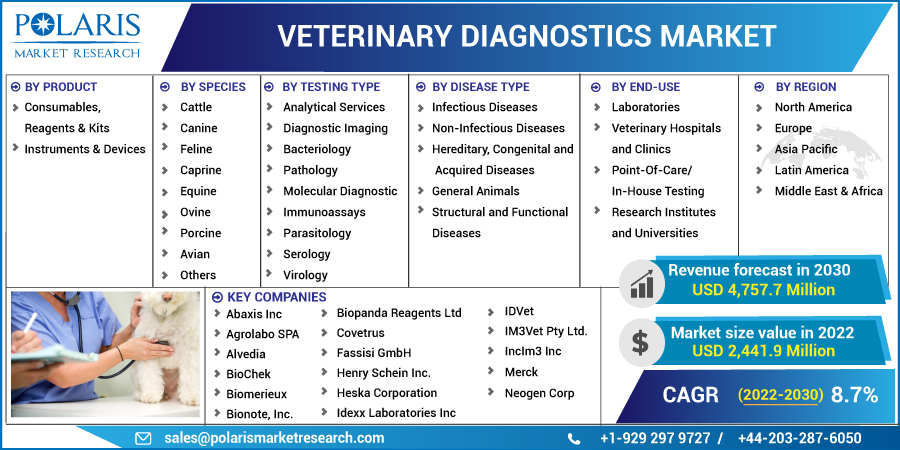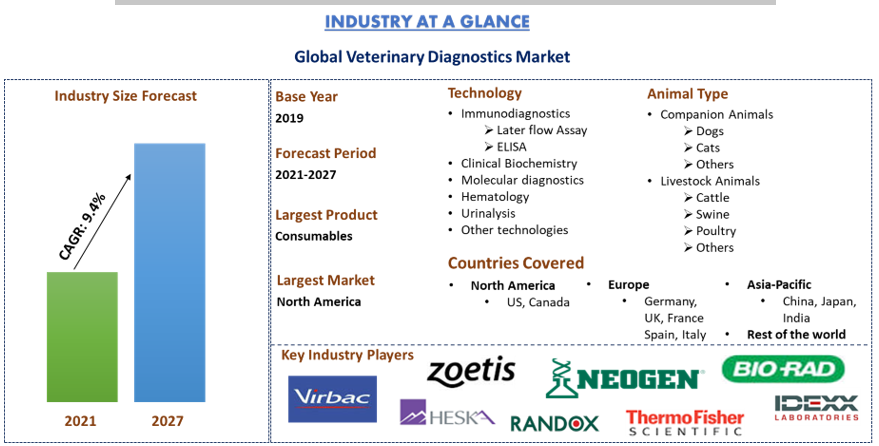
The Global Veterinary Diagnostics Market is projected to reach a valuation of US$ 6.14 billion by 2027, expanding at a robust CAGR of 9.4% from its 2020 value of US$ 3.25 billion. Veterinary diagnostics involve screening for underlying diseases in healthy animals and aiding veterinarians in monitoring disease progression or treatment response.
Several factors are propelling the growth of the Global veterinary diagnostics market, notably the increasing global pet population. In 2021, there were over 900 million dogs and approximately 600 million cats worldwide, with these numbers continually rising. The trend of pet adoption is driven by rapid urbanization and the shift toward nuclear families. The United Nations projects that by 2050, 68% of the world’s population will live in urban areas, up from 55% in 2018.
The rise in per capita income, leading to higher disposable income and improved living standards, is another key factor driving market growth. Increased spending on pet health, combined with rising disposable incomes, further boosts the market. For example, India's per capita income increased from Rs 72,805 in FY15 to Rs 94,954 in FY19, marking a 30% rise over six years.
Additionally, the growing demand for animal-derived food and the rising incidence of zoonoses worldwide are significant contributors to market growth. In India, 816 out of 1407 human pathogens are zoonotic. Major zoonotic diseases include rabies, brucellosis, Japanese Encephalitis, plague, leptospirosis, Scrub typhus, Nipah, trypanosomiasis, Kyasanur forest disease, and Crimean-Congo hemorrhagic fever. In 2018, India reported 110 cases of rabies, 1674 cases of JE, and 14971 cases of H1N1. Regular monitoring and testing of animals are essential to prevent these diseases, thereby augmenting the veterinary diagnostics market.
For a detailed analysis of the veterinary diagnostics market, browse through – https://univdatos.com/report/veterinary-diagnostics-market
The COVID-19 pandemic has had a positive impact on the veterinary diagnostics market globally, with an increase in pet ownership due to lockdown restrictions. According to the European Pet Food Federation, spending on pet services and products rose by 7.6% to 21.2 billion during the pandemic. Additionally, the pandemic has increased testing volumes for both animals and humans, further driving market growth.
Major players in the market include Idexx Laboratories, Thermo Fisher Scientific, Zoetis Inc, Virbac, Randox, Qiagen, Neogen, Heska Corporation, Abaxis, and Bio-rad Laboratories. These companies are engaging in mergers, acquisitions, and partnerships to strengthen their presence in various regions.
The market is segmented by product into consumables and instruments. The consumables segment dominated the global veterinary diagnostics market, while the instruments segment is also expected to grow significantly, driven by increased R&D expenditure and the launch of advanced diagnostics instruments. For instance, in September 2020, Zoetis launched Vetscan Imagyst, a diagnostic platform combining image recognition technology, algorithms, and cloud-based AI to deliver accurate testing results.
Request a sample of the report through – https://univdatos.com/request_form/form/432
Based on technology, the market is divided into immunodiagnostics, clinical biochemistry, molecular diagnostics, hematology, urinalysis, and other technologies. The immunodiagnostics segment dominated the market in 2020 and is expected to grow rapidly due to the increasing prevalence of animal-borne diseases like rabies, Zika virus, and coronavirus.
The report also provides a regional analysis of the global veterinary diagnostics market, including North America (United States, Canada, and the Rest of North America), Europe (Germany, France, Italy, Spain, United Kingdom, and Rest of Europe), Asia-Pacific (China, Japan, India, Australia, South Korea, and Rest of APAC), and Rest of the World. North America led the market, generating substantial revenue in 2020, driven by a high number of pet owners and a high degree of urbanization. Asia-Pacific is also identified as a high-growth market with significant opportunities for major players in veterinary diagnostics.