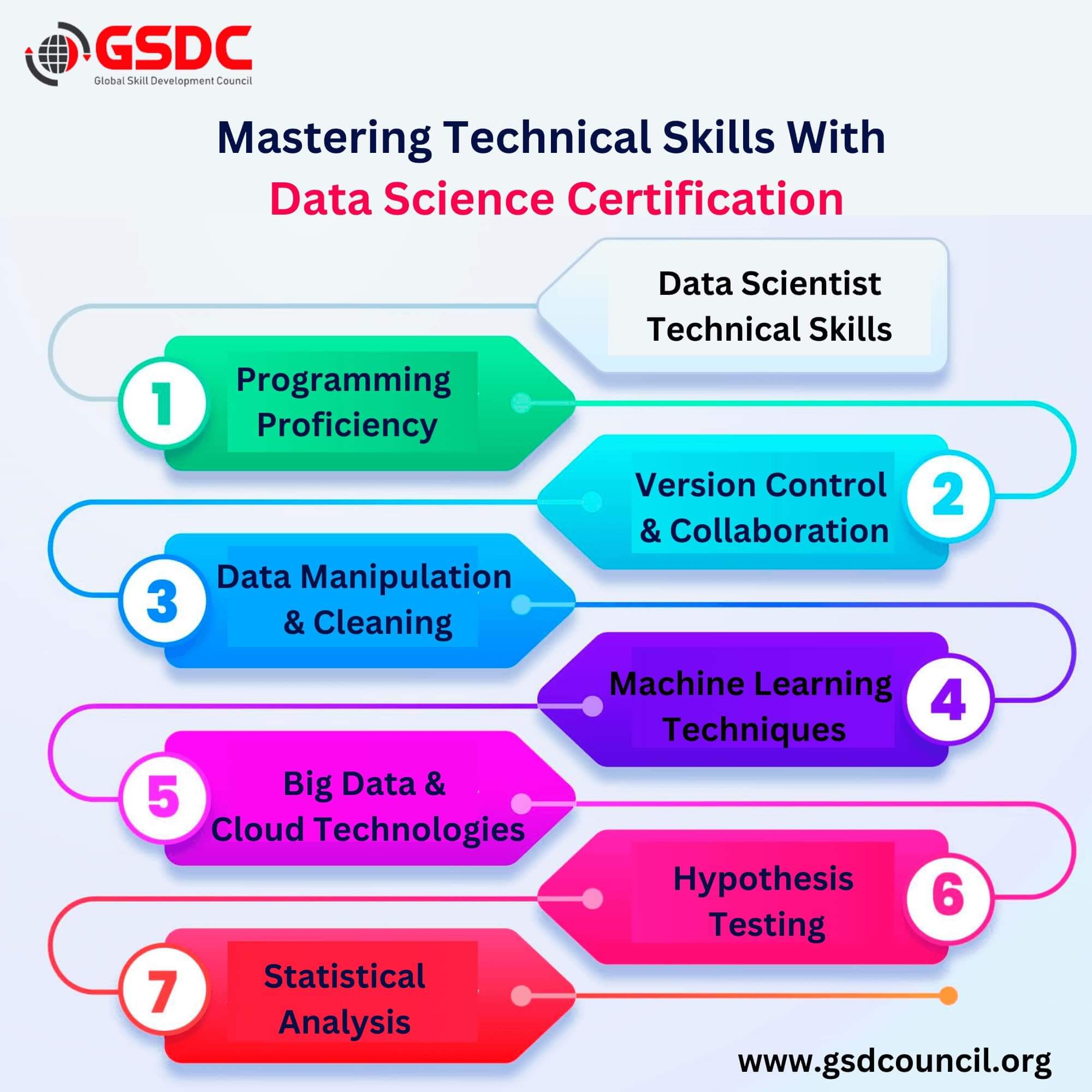



Obtaining a Data Science Certification equips professionals with a diverse set of skills that are essential for tackling complex data problems and driving insights. Here’s a detailed explanation of the key skill sets typically developed through a data science certification:
1. Programming Skills
Python: Widely used in data science for its simplicity and extensive libraries (e.g., pandas, NumPy, scikit-learn, TensorFlow, Keras).
R: Popular for statistical analysis and data visualization, with packages like ggplot2, dplyr, and caret.
SQL: Essential for querying and managing relational databases to retrieve and manipulate data.
2. Statistical and Mathematical Skills
Descriptive Statistics: Understanding measures of central tendency, variability, and data distributions.
Inferential Statistics: Conducting hypothesis testing, confidence intervals, and regression analysis to draw conclusions from data.
Linear Algebra and Calculus: Fundamental for understanding algorithms in machine learning and data transformations.
3. Data Manipulation and Cleaning
Data Wrangling: Techniques for cleaning, transforming, and preparing data for analysis. This includes handling missing values, outliers, and data inconsistencies.
Data Munging: Process of converting raw data into a more suitable format for analysis.
4. Exploratory Data Analysis (EDA)
Data Visualization: Creating visual representations of data using tools like Matplotlib, Seaborn, and Tableau to uncover patterns, trends, and insights.
Summary Statistics: Calculating key metrics to understand data characteristics and distributions.
5. Machine Learning
Supervised Learning: Algorithms like linear regression, logistic regression, decision trees, random forests, and support vector machines for predictive modeling.
Unsupervised Learning: Techniques like clustering (e.g., K-means, hierarchical clustering) and dimensionality reduction (e.g., PCA) for discovering hidden patterns in data.
Reinforcement Learning: Learning models that make decisions by rewarding desired behaviors and punishing undesired ones.
6. Deep Learning
Neural Networks: Understanding the architecture of neural networks and training models using frameworks like TensorFlow and Keras.
Convolutional Neural Networks (CNNs): Specialized for image processing tasks.
Recurrent Neural Networks (RNNs): Used for sequence data analysis, such as time-series forecasting and natural language processing (NLP).
7. Big Data Technologies
Hadoop: Framework for distributed storage and processing of large data sets.
Spark: Fast, in-memory data processing engine suitable for big data analytics.
8. Data Engineering
ETL Processes: Extracting, transforming, and loading data from various sources into data warehouses or lakes.
Data Pipeline Management: Designing and managing data pipelines to ensure smooth data flow and integration.
9. Cloud Computing
Cloud Platforms: Utilizing services from AWS, Azure, and Google Cloud for scalable data storage, processing, and machine learning model deployment.
Server less Computing: Leveraging server less architectures to run data processing tasks without managing underlying infrastructure.
10. Soft Skills
Problem-Solving: Critical thinking and analytical skills to approach and solve complex data-related problems.
Communication: Effectively communicating findings and insights through written reports, presentations, and visualizations.
Collaboration: Working in cross-functional teams and collaborating with stakeholders from different domains.
11. Domain Knowledge
Industry-Specific Insights: Applying data science techniques within specific industry contexts, such as finance, healthcare, marketing, or e-commerce.
12. Ethics and Data Privacy
Data Governance: Understanding and implementing data governance policies to ensure data quality, privacy, and security.
Ethical Considerations: Being aware of the ethical implications of data analysis and machine learning, such as bias, fairness, and transparency.
A data science certification provides a structured learning path to develop these diverse skill sets, making you a well-rounded professional capable of addressing various data challenges. By mastering these skills, certified data scientists can drive meaningful insights, contribute to data-driven decision-making, and add significant value to their organizations.