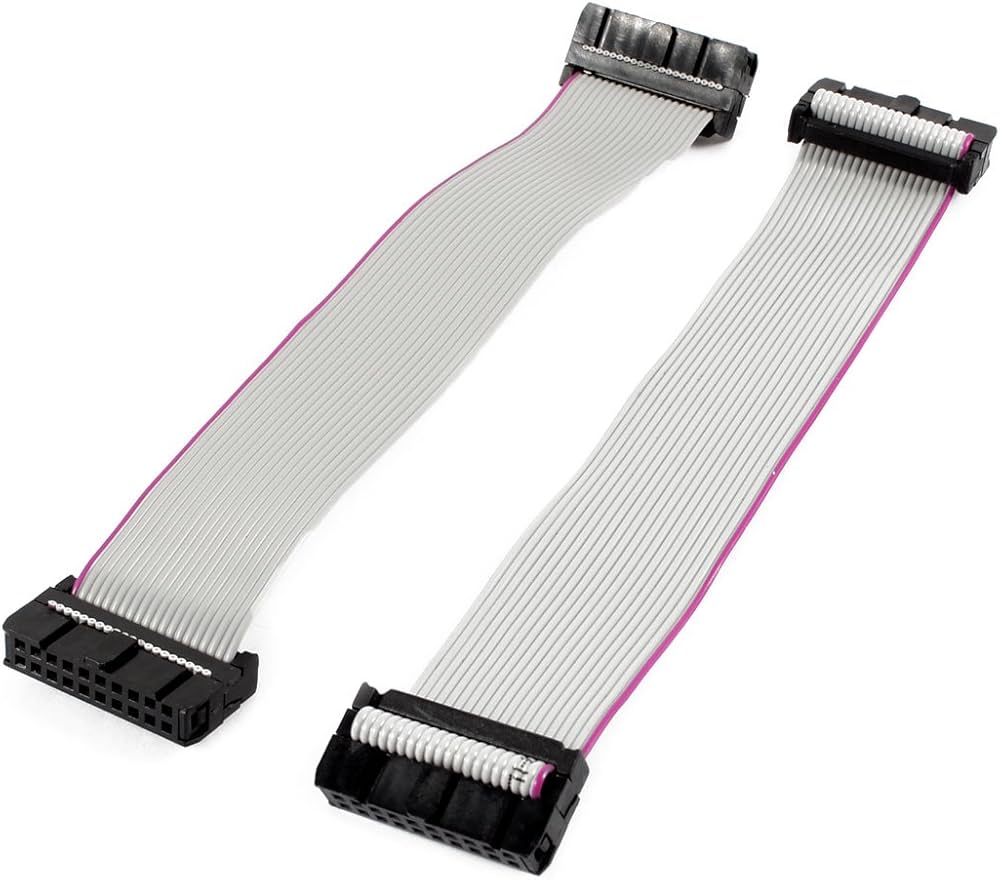
History of Ribbon Cable Ribbon cable was invented in the late 1960s as a solution to carry large number of signal paths in a tightly packed bundle. The earliest ribbon connectors contained 7, 14, 26, 34 or 50 individual wires arranged side by side and laminated between layers of flexible plastic. This design allowed transferring multiple electronic signals using a single cable assembly which was much more compact compared to using individual wires. Early applications included connecting peripheral devices to main computer systems. Types of Ribbon Cable Based on number of conductors: Ribbon cables vary widely based on number of individual conductors or wires enclosed within. Common configurations include 7-conductor, 14-conductor, 26-conductor, 34-conductor, 50-conductor and 84-conductor cables. Higher conductor counts enable transfer of more signals through a single ribbon. Based on wire size: Standard Ribbon Cable connectors contain 30 AWG (American Wire Gauge) wires which have diameter around 0.2515 mm. For applications requiring greater current handling, lower AWG sizes like 28 AWG or 26 AWG may be used. Wires of different diameters are available to meet specific electrical needs. Based on insulator material: PVC (Polyvinyl chloride) and flexible PVC are commonly used insulator materials that provide mechanical protection to the contained wires. Other materials like Teflon, Kapton and silicone offer higher temperature tolerance, chemical resistance or flexibility. Selection depends on environmental factors. Common Applications of Ribbon Cable Connecting computer peripherals: Ribbon connectors continue finding widespread usage in connecting computer input/output (I/O) devices like printers, scanners and external drives to the main system unit. Flat flexible form factor enables tight bundling of interface signals. Flat panel display connections: Ribbon connectors deliver video, power and control signals from the graphics card or controller board inside a PC to the liquid crystal display (LCD) or plasma panel. The thin profile allows routing through tight spaces inside display units. Telecommunications equipment: Backplane cabling, circuit board connections and motherboard extensions utilize ribbon connectors within telephone switching systems, network routers and other telecom gear due to their space-saving design. Automotive applications: Control systems, entertainment units and instrumentation modules in cars depend on ribbon connectors to route electrical connections throughout the vehicle interior in a neat fashion. Military and aviation grade variants are also available. Advantages of Ribbon Cables Space efficiency: Compared to individual wires bundled together, ribbon connectors take up much less space due to their extremely compact rectangular cross-section. This proves vital in applications with tight packing constraints. Easy termination: A ribbon connector doesn't require individual crimping or soldering of each wire like in multi-wire harnesses. Header connectors crimped to the entire cable provide fast, error-free terminating to circuit boards or panels. Reliability: The enclosed wire construction protects against physical damage, pinches, cuts or fraying arising from handling or routing over long periods. This leads to better reliability and longer service life. Precise signal control: Each precisely aligned wire can carry low-level analog or digital signals with low noise and crosstalk interference between them due to closely controlled impedance properties. Challenges with Ribbon Cable Usage Durability issues: Excess flexing, stress or sharp bending loads applied to ribbon connectors can potentially damage internal wire insulation over time. Headers at the cable ends also endure repeated connector mating loads. Termination complexity: Manufacturing the specialized header connectors to precisely align and grip each tiny wire adds to the per-unit costs of ribbon connectors compared to other cable types. Repair difficulties: A damaged wire within an intact ribbon connector is difficult to access and replace or repair. In some cases, repair may not be economically viable, necessitating replacement of the entire assembly. Ribbon connector proved to be an enabling technology for tightly packing high speed, multiple electrical connections in a space-constrained manner. With designers continually evolving new variants, ribbon connectors will remain critical for high density board-to-board and device interconnectivity in the foreseeable future across many industrial sectors. Careful selection based on specific usage requirements and environmental factors helps optimize ribbon connector deployments.
For More Insights Discover the Report In language that Resonates with you
French German Italian Russian Japanese Chinese Korean Portuguese
About Author:
Ravina Pandya, Content Writer, has a strong foothold in the market research industry. She specializes in writing well-researched articles from different industries, including food and beverages, information and technology, healthcare, chemical and materials, etc. (https://www.linkedin.com/in/ravina-pandya-1a3984191)




Do you have a medical project that requires engineering and/or manufacturing to bring it to life?
Do you know how to choose a partner to support you as you move to bring your product to market?