


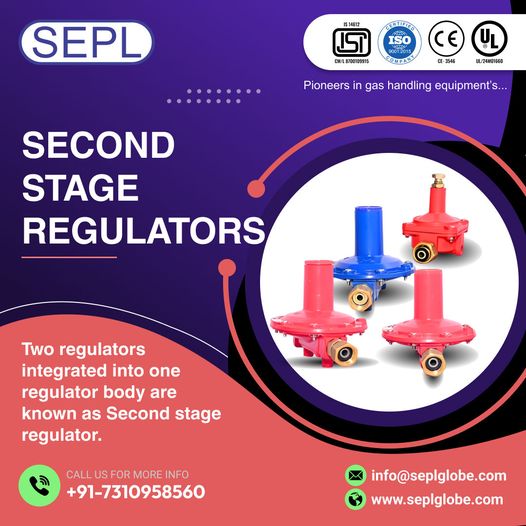
In numerous industries, regulating gas pressure is important. It ensures that everything functions properly and safely. In this regulating process, a second-stage regulator helps. For a range of uses, they provide exact control over gas pressure. This article will discuss some of the many situations where you need a second-stage regulator. Read on to learn them.
1. High-Pressure Cylinder Applications
In many industries, high-pressure cylinders are used widely. They hold gases at extremely great pressures. Such pressures are usually too high for direct application. A second-stage regulator helps here. It minimises the pressure in two steps. This makes the gas useful and safe. The first stage results in lowering the cylinder pressure. It creates an intermediate pressure. The second stage then adjusts this to the required level. It's more precise to follow this two-step process. It responds more effectively to variations in cylinder pressure. This is essential for a consistent flow of LPG/PNG.
2. Sudden Power Loss Protection
Some equipment is affected by differences in pressure. Even small fluctuations can lead to a variety of issues. In such situations, second-stage regulators are perfect. They deliver a stable output pressure. This stability protects sensitive equipment. This two-stage design absorbs inlet pressure variations. It has steady outlet pressure. This is important in laboratory settings, where medical diagnosis equipment is used and in industries where high accuracy is required. It ensures reliable findings and lessens the likelihood of errors.
3. Remote or Hard-to-Monitor Locations
Gas systems in remote areas need special attention. More often than not, it is not possible to check and fine-tune regulators periodically. Second-stage regulators come in handy in such situations. They need fewer adjustments over time. These regulators do not differ in pressure even if there is a change in the cylinder pressure. As such, there is less demand for monitoring. It is perfect for significant industrial locations, distant research stations and offshore platforms. With little supervision, it assures a steady, dependable supply of gas.
4. Critical Pressure-Dependent Processes
Some processes depend heavily on precise gas pressure. It finds minute pressure variations that might affect both quality and safety. Second-stage regulators are particularly required in such situations. They offer the required steadiness and accuracy. These regulators make sure that gas pressure and flow are constant. This is important for food packing as well as several chemical operations. It supports the preservation of product quality and process effectiveness. In crucial applications, it also improves safety.
5. Long-Duration Gas Supply Needs
Second-stage regulators are excellent when a gas supply needs to last for long periods. They do a good job of managing the gas cylinders' slow pressure decline. That's important for continued operations. In a cylinder that is emptying, pressure drops. Single-stage regulators need regular adjustments made. Automatically responding to these modifications are second-stage regulators. A continuous flow is thus ensured until the cylinder is nearly empty. To conclude, second-stage regulators are important in a variety of situations. In terms of gas pressure regulation, they provide precision, stability, and dependability. They are necessary for important processes, sensitive equipment, and high-pressure applications. They are excellent for long-term gas supply requirements. While looking for second-stage regulators, it's best to order from Saraswat Engineers Pvt. Ltd. today. They offer second-stage regulators suitable for standard use -20°C to +60°C. They even provide first-stage regulators and adjustable regulators for the user's convenience.


A mental health counselor is a professional who uses different psychotherapy methods and techniques to help people experiencing psychological distress.
In the United States, one in four adults is experiencing a mental illness at some point, and research suggests that approximately 50% of adults will have at least one mental illness in their lifetime.
But now that mental illnesses are taking their toll not just in the United States but all over the world, the prevalence of mental health problems highlights the demand and need for qualified professionals(therapists or psychiatrists) to diagnose, treat, and prevent mental health issues.Read more at - https://tinyurl.com/hwj5m3wt

When you start a crowdfunding campaign you may find yourself in a situation where your inbox is swamped with emails from people who claim they can turn the campaign into a success.
These emails are not just from donors who want to help you out, writers and bloggers who want to write about it, or something like that.
They also come from Kickstarter consultants.
Click here to know more about us!

Shoe Bags are very popular these days.
Everyone likes to wear new and classy shoes, but along with wear, care of your shoes is also required.
As a result, it attracts lots of dust, dirt, germs, stains, spills, stains and more.
Shoe Bags are available in various colors and comes in a set of there.
Bag’s FabricThese bags are made of non-woven fabric and have anti-skid properties.
Also, it has a PVC layer at the front side which help you for the clear visibility of the footwear.