


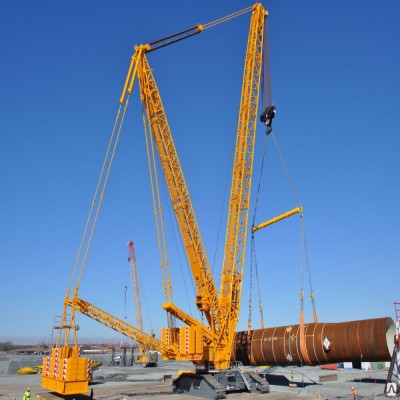
Crawler cranes are large capacity mobile cranes that use tracks instead of wheels. The tracks provide better mobility over rough terrain and the ability to traverse soft ground with minimal ground pressure compared to wheeled cranes. Additionally, crawler cranes have a larger lifting capacity than wheeled cranes of similar size and reach.
Basic Components and Design
Like all mobile cranes, Crawler Cranes consist of a heavy duty steel framework called the undercarriage that supports the superstructure, counterweight, cab, and boom. The main difference is that crawler cranes have two continuous tracks, one on each side, that are used for mobility rather than wheels. Hydraulic motors power the tracks which can move the crane in any direction, including sideways. This allows crawler cranes to operate independently of prepared roadways. The counterweight provides stability when lifting heavy loads by offsetting the forward tipping moment caused by the boom, load line, and load. Counterweights are adjustable to maximize lifting capacity for different load radii. Crawler cranes also feature a telescoping or lattice boom of various lengths to reach different heights depending on application needs. Controls in the cab allow the operator to precisely maneuver the tracks, boom, and attachments.
Applications and Job Sites
Due to their ability to traverse difficult terrain, crawler cranes are commonly used for heavy construction projects such as building power plants, oil rigs, bridges, tunnels, and large industrial facilities. They can crawl over rocky or swampy ground to easily access job sites that wheeled mobile cranes cannot reach. Crawler cranes are also used extensively at mining sites, quarries, and other locations where ground conditions are challenging. Their maneuverability and stability make crawler cranes well-suited for demolitions where pieces must be precisely positioned and lifted from awkward angles. Lifting prefabricated building sections, turbine components for wind farms, and other large structural elements is another common application that benefits from crawler cranes' ability to move nimbly around a work area. Transporting the crane between job sites usually requires special permitting due to their large size and weight.
Specifications and Capacities
Crawler cranes are classified based on their maximum lifting capacity, which can range from around 50 US tons up to over 1000 US tons (over 907 metric tons) for the largest models. Boom lengths start at about 40 feet and extend up to 350 feet or more, allowing these cranes to work on extremely tall structures and bridges. Track widths vary but are usually between 8 to 16 feet to provide stability at maximum load capacities. Counterweight options allow crawler cranes to be tailored for different applications and load moment specifications. Fuel capacities for on-board power and hydraulic systems permit mobile operations between refueling. Engineering standards such as ANSI, EN, ISO, or JIS apply depending on the manufacturer and intended market. Overall transport dimensions, crawlers length, and maximum ground pressures are also important specifications to consider for job site access.
Advantages and Drawbacks
Some key benefits of crawler cranes include their versatility over rough terrain, ability to support heavy lifting capacities closer to the machine's body, and precise maneuverability through hydraulically powered tracks. However, these mobile cranes also have higher initial costs than wheeled counterparts, require specialized transport between sites, and leave more ground disturbance tracks than wheel-mounted cranes. Operators must also understand track and crawler functions in addition to standard crane operations. Overall though, crawler cranes enable contractors to take on heavy construction projects in locations that other equipment cannot readily access.
Operator Considerations
Safely operating a crawler crane takes skill and demands the operator's full focus and attention. Controls require deliberate inputs to maneuver tracks, booms, and attachments with millimeter precision near workers and structures. Safety features like load charts, anti-two block systems, and boom angle indicators help prevent accidents, but the operator remains responsible for hazard awareness, pre-lift planning, and complying with rated capacity limits. Training programs cover not just crane functions and safety devices, but also topics like rigging, signal person direction, site hazard evaluation, and applicable regulations. Certification through accredited programs demonstrates an operator understands these responsibilities and can competently handle a crawler crane on demanding jobsites. With proper training, experience, focus on safety practices, and adherence to rated capacities, these cranes become powerful tools that allow crucial construction and infrastructure projects to move forward. Overall, crawler cranes demonstrate the versatility of mobile cranes through their ability to confidently handle the most challenging lifting jobs over rough or soft terrain. Contractors rely on these machines to construct large industrial and civil projects that expand society's infrastructure and capabilities. With conscientious operation and adherence to safety practices, crawler cranes will continue delivering their massive power and precision to accomplish installations not otherwise possible.
Get This Report in Japanese Language: クローラークレーン
Get This Report in Korean Language: 크롤러 크레인
About Author:
Vaagisha brings over three years of expertise as a content editor in the market research domain. Originally a creative writer, she discovered her passion for editing, combining her flair for writing with a meticulous eye for detail. Her ability to craft and refine compelling content makes her an invaluable asset in delivering polished and engaging write-ups.
(LinkedIn: https://www.linkedin.com/in/vaagisha-singh-8080b91)



With a multi-disciplinary approach, Fact.MR elaborates an extensive analysis of the historical, current and future outlook of the global crawler cranes market as well as the factors responsible for such a growth.
Our highly dedicated professionals have inputted critical and accurate insights associated with every industry, and region by doing thorough primary and secondary research.The crawler cranes market is projected to expand at a modest pace with global sales of crawler cranes crossing US$ 3,400 Mn by end of 2018, according to a new report by Fact.MR.
Growth in new construction projects coupled with rising urbanization remain instrumental in driving the demand for crawler cranes worldwide.Substantial growth in the power distribution industry coupled with increasing port maintenance activities are likely to influence the sales of crawler cranes in the forthcoming years.
In wind farms, demand for large crawler cranes has been witnessed which is expected to fuel growth of the overall crawler cranes market, says the report.The demand for lattice boom type crawler cranes is projected to expand at a significant rate during the period of forecast, 2018-2028.
Lattice boom type crawler cranes offer various advantages including higher stability, greater lifting capacity (more than 300 tons) and safe movement of crawler cranes.
In addition, convenient self assembling system and cost efficient transport provided by lattice boom type crawler cranes is further enhancing their sales worldwide.Competitive Assessment The crawler cranes market report includes global as well as emerging players:Terex CorporationTadano LtdZoomlion Heavy Industry Science and Technology Co., Ltd.XCMG Construction Machinery Co., Ltd.Sany Heavy Industry Co., LtdKATO WORKS CO.,LTD.Kobelco Construction Machinery Co., Ltd.Hitachi Sumitomo Heavy Industries Construction Crane Co., Ltd.The Manitowoc Company, Inc.Request for the Sample of the Report: https://www.factmr.com/connectus/sample?flag=S_id=2236The insights for each vendor consists of:Company profileSWOT analysisMain market informationMarket shareRevenue, pricing and gross marginRegional Analysis Important regions covered in the crawler cranes market report include:North AmericaLatin AmericaEuropeEast AsiaSouth AsiaOceaniaMiddle East & Africa (MEA)The crawler cranes market report also provides data regarding the key countries in the defined regions.The demand for crawler cranes in construction industry is projected to expand at a significant pace throughout the period of assessment, 2018-2028.