






When bringing a new product to market, one of the earliest and most consequential decisions you'll make isn't about marketing strategy or pricing—it's about your design approach. The methodology you choose fundamentally impacts everything from production costs and timelines to your product's ultimate quality and performance.
Today's manufacturing landscape presents two primary design philosophies: traditional Design for Manufacturing (DfM) and the newer, increasingly important Design for Additive Manufacturing (DfAM). These approaches represent fundamentally different ways of thinking about how your product will come to life.
For companies seeking design for manufacturing solutions, understanding the distinction between these methodologies isn't just academic—it's essential to your bottom line. Choose incorrectly, and you might face unnecessary costs, production delays, or even design compromises that affect your product's functionality.
In this comprehensive guide, we'll explore:
Whether you're developing consumer products, medical devices, industrial equipment, or specialized components, understanding these design approaches will empower you to make informed decisions that optimize both production efficiency and product performance. Let's dive into the details that matter.
Ready to optimize your product design process? Schedule a consultation call with our engineering team to identify the ideal design approach for your specific needs.
What is Design for Manufacturing (DfM)?
Design for Manufacturing (DfM) represents a traditional but highly refined approach to product development that focuses on optimizing designs for efficient, cost-effective production using conventional manufacturing methods. This methodology has been the backbone of industrial production for decades, evolving alongside manufacturing technologies to create increasingly sophisticated products.
Core Principles of DfM
At its heart, DfM involves anticipating and addressing manufacturing requirements during the earliest stages of product design. Rather than creating a design and then figuring out how to manufacture it (often leading to costly redesigns), DfM integrates manufacturing considerations from day one.
The fundamental principles of design for manufacturing services include:
When implemented properly, design for manufacturing solutions lead to products that not only perform as intended but can be efficiently produced at scale with consistent quality.
DfM for Traditional Manufacturing Methods
Different manufacturing processes come with their own design requirements and constraints. Let's explore how DfM principles apply to common production methods:
Injection Molding
Design for Injection Molding requires specific considerations like:
These considerations are particularly important for high-volume production, where minor design inefficiencies can multiply into significant costs across thousands or millions of units.
CNC Machining
DfM for machined parts focuses on:
Here's the thing: while these traditional manufacturing methods have significant limitations, they've been refined over decades to achieve remarkable efficiency when designs properly accommodate their constraints.
DfM in Medical Device Development
One area where traditional DfM remains particularly crucial is in DFM for medical devices. The medical device industry faces unique challenges that make thoughtful design for manufacturing essential:
For medical device manufacturers, integrating DfM principles early in development helps navigate these challenges while controlling costs. The structured approach of traditional DfM aligns well with the documentation requirements and validation protocols common in regulated industries.
Now let's dive into how additive manufacturing is changing this landscape.
Understanding Design for Additive Manufacturing (DfAM)
While traditional manufacturing methods subtract material (cutting, drilling) or reshape it (molding, forming), additive manufacturing builds objects layer by layer. This fundamental difference requires an entirely different design approach: Design for Additive Manufacturing (DfAM).
Breaking Free from Traditional Constraints
DfAM represents a paradigm shift in how we think about product design. Rather than designing around the limitations of conventional manufacturing processes, DfAM embraces the unique capabilities of additive technologies. This approach offers extraordinary freedom to create previously impossible geometries.
The core advantages of DfAM include:
What does this mean for you? The ability to reimagine products entirely rather than simply adapting existing designs to manufacturing constraints.
DfAM Principles and Methodologies
Effective DfAM requires understanding both the capabilities and limitations of various additive technologies. Each 3D printing process—whether powder bed fusion, material extrusion, vat photopolymerization, or others—comes with its own design considerations.
Topology Optimization
One of the most powerful DfAM approaches is topology optimization, which uses computational algorithms to determine the optimal material distribution within a design space. This data-driven approach creates structures that:
Support Structure Considerations
Unlike traditional manufacturing, many additive processes require support structures for overhangs and other challenging geometries. Effective DfAM addresses this by:
When DfAM Excels
Design for Additive Manufacturing offers particular advantages in certain scenarios:
Now that we've explored both approaches individually, let's examine how to determine which one best suits your specific project needs.
Choosing the Right Approach: Decision Factors
Selecting between DfM and DfAM isn't a matter of which approach is universally "better"—it's about identifying which methodology aligns with your specific product requirements, production volumes, and business objectives. Here's a systematic framework to guide your decision.
Production Volume Considerations
One of the most significant factors in your design approach decision is the anticipated production volume:
High-Volume Production
For products produced in thousands or millions of units, traditional design for manufacturing solutions often remain the most cost-effective approach. While initial tooling costs for processes like injection molding can be substantial, these costs amortize across large production runs, resulting in very low per-unit manufacturing costs.
DfM excels here because:
Low-Volume Production
For products with annual volumes in the dozens or hundreds, DfAM often provides compelling advantages:
Geometric Complexity Requirements
The complexity of your product's geometry should heavily influence your design approach:
Simple Geometries
Products with relatively simple geometries—those made primarily of prismatic shapes, uniform wall thicknesses, and limited internal features—often benefit from traditional DfM approaches. These designs readily accommodate conventional manufacturing processes without significant compromise.
Complex Geometries
When your product requires:
DfAM provides capabilities that traditional manufacturing simply cannot match, or can only achieve at prohibitive cost.
Material Requirements
Your material selection requirements play a crucial role in determining the appropriate design approach:
Wide Material Selection
Traditional manufacturing offers access to thousands of material formulations with well-documented properties, certifications, and performance histories. If your product requires specific:
Traditional design for manufacturing services may provide advantages due to the broader material ecosystem.
Specialized Material Properties
Conversely, additive manufacturing excels with:
Time-to-Market Pressures
Market timing often drives design methodology decisions:
For rapid product development where beating competitors to market represents significant value, DfAM often enables faster development cycles by:
For products entering established markets where cost optimization matters more than speed, traditional DfM's focus on production efficiency may deliver greater long-term value.
Here's a comparison table summarizing key decision factors:
Hybrid Approaches: Combining DfM and DfAM
The decision between DfM and DfAM isn't always binary. Many successful product development strategies leverage hybrid approaches that combine the strengths of both methodologies. This integration can create powerful synergies that optimize both design performance and manufacturing efficiency.
Strategic Integration Strategies
Effective hybrid approaches typically implement one of several integration strategies:
1. Component-Based Hybridization
In this approach, different components within the same product use different design methodologies based on their specific requirements:
This strategic allocation of design approaches optimizes the overall product while respecting the strengths and limitations of each methodology.
2. Development Phase Hybridization
Another effective approach uses different methodologies at different stages of product development:
This progression allows teams to maintain agility early while ensuring manufacturability as the design matures.
Case Study: Medical Device Development
The medical device industry provides excellent examples of successful hybrid approaches. Consider a complex surgical instrument development program:
This integrated approach delivers a superior product faster than either methodology could achieve independently.
Now let's dive deeper into real-world applications of both approaches.
Real-World Applications and Case Studies
Understanding how DfM and DfAM principles apply in practice helps clarify when each approach delivers optimal results. Let's examine specific applications across different industries.
DfM Success Stories
Consumer Electronics
A leading consumer electronics manufacturer implemented comprehensive design for manufacturing solutions when developing a new portable device. Their approach included:
The result? Production costs decreased by 22% compared to the previous generation while maintaining premium build quality and reducing assembly defects by over 60%.
Medical Device Manufacturing
A medical diagnostics company applied DFM for medical devices when developing a new point-of-care testing platform:
These efforts reduced their production ramp-up time from 9 months to just 7 weeks while maintaining 100% compliance with regulatory requirements.
DfAM Transformations
Aerospace Component Redesign
An aerospace manufacturer redesigned a critical ducting component using DfAM principles:
The redesigned component not only performed better but eliminated tooling costs and simplified supply chain management.
Customized Medical Implants
A medical device company implemented DfAM to create patient-specific implants:
This application demonstrates how DfAM enables entirely new product categories that would be impossible with traditional manufacturing approaches.
What does this mean for you? The right design approach depends entirely on what you're trying to accomplish—mass production efficiency or design innovation—and sometimes, the best answer involves elements of both.
Future Trends: The Evolving Landscape of Manufacturing Design
The boundary between DfM and DfAM continues to evolve as manufacturing technologies advance and design tools become more sophisticated. Understanding emerging trends helps companies stay ahead of the curve and make forward-looking design decisions.
Artificial Intelligence in Design
AI is transforming both traditional design for manufacturing services and additive approaches:
These technologies are breaking down the traditional barriers between design and manufacturing, creating more integrated processes regardless of manufacturing method.
Materials Innovation
Novel materials are expanding the capabilities of both traditional and additive manufacturing:
As material options expand, the decision factors between DfM and DfAM shift from "can it be made?" to "what's the most efficient way to make it?"
Sustainability Considerations
Sustainability is becoming a critical design factor across all manufacturing approaches:
Forward-thinking companies are finding that sustainable design practices often align with manufacturing efficiency, creating business and environmental benefits simultaneously.
Convergence of Technologies
Perhaps the most significant trend is the gradual convergence of traditional and additive technologies:
This convergence suggests that the future won't be about choosing between DfM and DfAM but rather about seamlessly integrating the right approach for each specific design challenge.
Conclusion: Making the Right Choice for Your Product
The choice between Design for Manufacturing (DfM) and Design for Additive Manufacturing (DfAM) represents more than just a technical decision—it's a strategic choice that impacts your product's performance, cost structure, and time-to-market. As we've explored throughout this article, each approach offers distinct advantages for different scenarios.
Traditional DfM continues to excel for high-volume production where cost efficiency and proven materials are paramount. Its structured methodology aligns perfectly with industries requiring regulatory compliance, consistent quality, and established supply chains. For many products, particularly those produced in large quantities, design for manufacturing solutions remain the optimal approach.
Conversely, DfAM unlocks unprecedented design freedom, enabling complex geometries, part consolidation, and customization that traditional methods simply cannot achieve. For low-volume, high-complexity applications or products requiring rapid development, DfAM provides compelling advantages that can transform your approach to innovation.
Many leading companies are discovering that integrating both methodologies—applying each where it delivers the greatest value—creates the optimal development strategy. This hybrid approach harnesses the efficiency of traditional manufacturing alongside the design freedom of additive technologies.
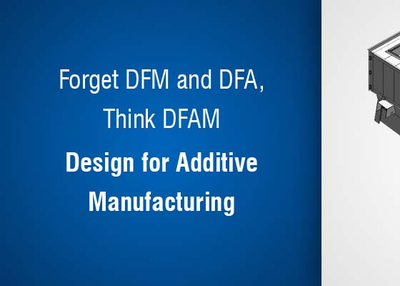
As an example, NASA’s rocket fuel injector which required 200 parts were reduced to just two parts using 3D printing.
They required completely re-designing the injector from scratch, using the DFAM strategy.
Here are few important tips to develop a product using DFAM:
Since additive manufacturing is totally different from conventional injection molding and CNC machining, you will have to think fresh about the design and forget everything about DFM or DFA.
Thus, old design concepts developed considering these factors must be eliminated.
Read more at: https://goo.gl/UN0HqU