In today’s fast-paced manufacturing landscape, ensuring product quality is more important than ever. Quality control (QC) not only safeguards the reputation of a brand but also ensures compliance with regulatory standards and customer expectations. Traditional QC methods, however, have significant limitations that can affect efficiency, accuracy, and scalability. With increasing production demands, manufacturers face challenges such as human error, slow processing times, high operational costs, and fragmented data systems.
Fortunately, Artificial Intelligence (AI), particularly AI-powered image recognition and data analytics, is revolutionizing quality control practices in manufacturing. By leveraging these technologies, manufacturers can automate inspections, improve defect detection, and optimize production efficiency. The global AI-powered image recognition market is projected to reach $15.37 billion by 2025, highlighting the growing adoption and effectiveness of AI in transforming manufacturing processes.
Traditional QC Challenges and the Need for Innovation
Traditional quality control processes, which rely on human inspectors and manual checks, are prone to errors due to fatigue, subjective judgment, and lack of consistency. The consequences can be significant: defects may go undetected, leading to costly recalls, customer dissatisfaction, or damage to a company’s brand. Moreover, slow inspection times can create bottlenecks, delaying production and limiting throughput. As demand increases, manual QC methods become less effective and harder to scale.
In response to these challenges, AI image recognition and data analytics offer transformative solutions that not only automate defect detection but also streamline production lines, enhance decision-making, and boost overall efficiency. At AQe Digital, we are leading the way in applying AI and advanced analytics to manufacturing quality control, helping manufacturers overcome traditional QC barriers.
Solving QC Challenges with AI Image Recognition and Data Analytics
AI image recognition and data analytics are fundamentally changing how manufacturers approach quality control. These technologies can address a range of challenges, from human error to high operational costs. Below, we highlight the key areas where AI solutions from AQe Digital are transforming quality control practices:
1. AI-Powered Defect Detection with Computer Vision
Challenge Addressed: Human Error
Human inspections, while essential, are subject to inconsistencies and errors. Factors such as fatigue, distractions, or subjective decision-making can cause defects to be missed. AI image recognition, powered by computer vision, removes this human factor, offering more reliable and precise inspections.
AQe Digital’s AI solutions use high-speed cameras combined with IoT-enabled sensors to detect defects in real time. From scratches and cracks to misalignments and surface deformities, our AI-powered systems identify even the smallest defects with unmatched accuracy. By automating the detection process, manufacturers can ensure every product meets quality standards consistently without the risks associated with human inspection errors.
2. Predictive Analytics for Early Defect Prevention
Challenge Addressed: Slow Processing Times
Traditional QC processes often operate reactively, detecting defects only after they occur. This can slow down production and result in costly rework or downtime. With AI-driven predictive analytics, manufacturers can anticipate defects before they occur, enabling proactive process adjustments that optimize production and minimize delays.
At AQe Digital, our predictive analytics platform uses historical production data, machine learning algorithms, and real-time data to detect patterns and predict potential defects. This allows manufacturers to make timely adjustments, reducing the likelihood of defects and improving overall process efficiency. The result is faster decision-making, minimized downtime, and a smoother production flow.
3. Automated Product Classification and Sorting
Challenge Addressed: Limited Scalability
Scaling traditional QC methods to meet increased production demands is a major challenge. Manual inspection and sorting of products become bottlenecks as production volumes rise. AI-driven automation offers a scalable solution that can keep pace with growing demand without sacrificing quality.
AQe Digital’s AI-powered classification systems automatically sort products based on quality standards, separating defective items for rework or rejection. This enables manufacturers to ramp up production without worrying about QC limitations. The automated process ensures that only the best products move forward in the production line, increasing overall throughput while maintaining high-quality standards.
4. Real-Time Monitoring and Reporting Dashboards
Challenge Addressed: High Operational Costs
When defects are not detected in real time, they can result in expensive fixes, rework, or recalls. These costs can accumulate quickly, affecting the bottom line. By providing manufacturers with real-time quality monitoring and reporting dashboards, AQe Digital enables timely intervention to prevent costly errors.
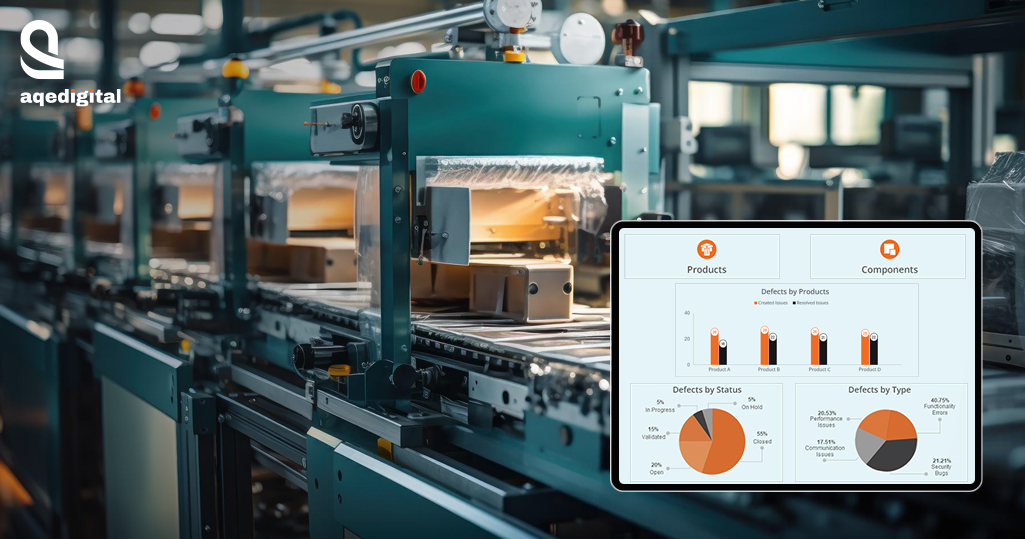
Our real-time dashboards offer manufacturers immediate access to production data, defect alerts, and process optimization recommendations. These interactive insights allow manufacturers to quickly identify issues, address them before they escalate, and minimize the impact of defects on production. With this technology, manufacturers can achieve better cost control, reduce waste, and enhance overall operational efficiency.
5. AI-Integrated IoT Sensors for Data-Driven Decision Making
Challenge Addressed: Data Silos
In traditional manufacturing systems, data is often scattered across different departments and systems, making it difficult to gain a comprehensive view of production performance. AI-integrated IoT sensors offer a solution by collecting real-time data from across the production line, creating a unified and actionable dataset for decision-makers.