





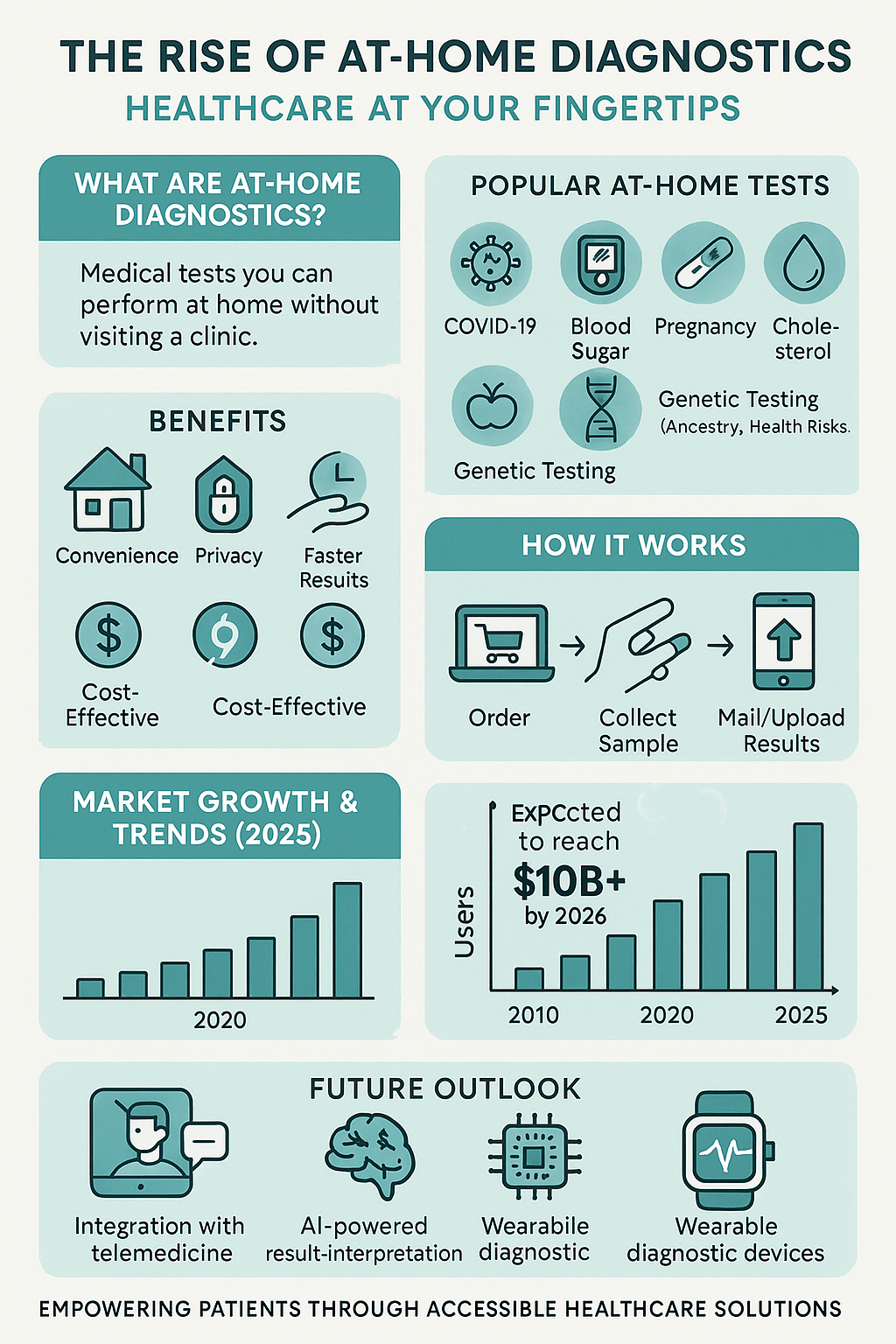
The healthcare industry is experiencing a profound shift, with at-home diagnostics at the forefront, revolutionizing medical testing by making it more accessible, convenient, and patient-centered. This growing market signals a move away from traditional healthcare models, empowering individuals to proactively manage their health using reliable and user-friendly diagnostic tools in their own homes. Market Growth and Key Drivers The at-home diagnostics market is on a significant upward trajectory. Valued at US$ 6.1 billion in 2023, it's projected to reach US$ 9.5 billion by 2031, demonstrating a robust Compound Annual Growth Rate (CAGR) of 6%. This expansion is fueled by several factors: Increased Consumer Demand: A rising preference for convenient healthcare solutions. Technological Advancements: Innovations in diagnostic devices are making them more accurate and easier to use. Emphasis on Preventive Care: A growing focus on early disease detection and prevention. COVID-19 Pandemic Impact: The pandemic significantly accelerated the adoption of home testing, proving its value in public health and reducing strain on healthcare systems. Rising Healthcare Costs: Consumers are seeking more affordable diagnostic alternatives. Aging Global Population: An increasing demographic requires regular health monitoring, especially for chronic conditions like diabetes and cardiovascular diseases. Leading Players in the At-Home Diagnostics Market The market is home to both established healthcare giants and specialized diagnostic companies, as well as emerging regional players. These companies are actively innovating and expanding their reach through distribution networks and strategic partnerships. Established Healthcare Giants: Abbott Laboratories F. Hoffmann-La Roche Ltd Becton, Dickinson & Co. Siemens Healthcare Cardinal Health, Inc
Specialized Diagnostic Companies: Chembio Diagnostics, Inc. Quidel Corp OraSure Technologies Nova Biomedical Lifescan Inc
Regional and Emerging Players: Nectar Lifesciences Ltd (Rapikit) Bionime Corp PRIMA Lab Atlas Medical UK B. Braun Melsungen AG Troge Medical Gmbh EmsiG GmbH Co Acon Laboratories Inc. Trividia Health, Inc. TaiDoc Technology Corporation
Market Segmentation The at-home diagnostics market is diverse, catering to various health needs and preferences: By Test Type: Glucose Tests: A major segment driven by the global diabetes epidemic, enabling regular blood sugar monitoring. Pregnancy Tests: Offering privacy and immediate results for family planning. Infectious Disease Tests: Including HIV and urinary/genital infection tests for early detection and disease control. Drug Abuse Tests: For personal and professional screening. Ovulation Predictor Tests: Supporting reproductive health with ovulation-LH, menopause-FSH, and sperm tests. Cholesterol and Triglycerides Tests: For cardiovascular health monitoring.
By Type (Diagnostic Format): Cassette tests: Enclosed for accurate results. Strip tests: Simple and cost-effective. Midstream tests: Popular for pregnancy and ovulation. Test panels: For simultaneous multi-parameter testing. Dip cards: Convenient for liquid-based testing.
By Sample Type: Blood testing: For glucose, cholesterol, and various biomarkers. Urine testing: For pregnancy, drug screening, and infection detection. Saliva testing: For hormone levels and certain infections. Serum testing: For specialized applications.
By Distribution Channel: Retail Pharmacies: Primary points of sale with professional guidance. Drug Stores: Convenient community access. Supermarkets/Hypermarkets: Increased accessibility through everyday shopping. Online Pharmacies: Offering privacy, convenience, and competitive pricing.
Regional Dynamics The global at-home diagnostics market exhibits distinct growth patterns across regions: North America: Leads due to high healthcare awareness, advanced infrastructure, and favorable regulations. Europe: A mature market with strong regulatory frameworks and growing acceptance of home-based care. Asia-Pacific: Shows the highest growth potential, driven by large populations, increasing healthcare awareness, and improving economic conditions in countries like China, India, and Japan. Latin America, Middle East, and Africa: Represent emerging markets with significant growth opportunities, albeit from a smaller base.
Technological Advancements and Challenges Ongoing technological innovations are enhancing the accuracy, ease of use, and interpretation of at-home diagnostic tests. Digital connectivity, smartphone integration, biosensor technology, and the emerging roles of Artificial Intelligence (AI) and Machine Learning (ML) are paving the way for more sophisticated at-home capabilities, including remote monitoring and consultation. However, challenges persist. Accuracy concerns and the potential for user error are critical factors. The limited complexity of tests available at home, coupled with regulatory hurdles, can slow product development. Additionally, the need for follow-up consultations with healthcare providers for many positive results can impact the perceived value of at-home testing. Future Outlook The future of at-home diagnostics is bright. Continued innovation is expected to overcome current limitations and expand testing capabilities. The convergence of at-home testing with telemedicine platforms promises comprehensive remote healthcare delivery. Emerging areas include personalized medicine, mental health screening, and advanced chronic disease monitoring systems. The development of multi-parameter testing devices will further enhance the utility of these tools. As global healthcare systems increasingly prioritize prevention and early intervention, at-home diagnostics are set to play an even more vital role in public health strategies. The projected market growth to US$ 9.5 billion by 2031 underscores not just growing demand, but also the ongoing evolution towards more patient-centric, accessible, and cost-effective healthcare solutions. Conclusion The at-home diagnostics market is undeniably a transformative force in healthcare. With robust market fundamentals, continuous technological innovation, and increasing acceptance from both consumers and healthcare providers, this sector is poised for sustained growth and evolution. Future success will hinge on companies' ability to deliver accurate, user-friendly products while navigating complex regulatory landscapes and building unwavering consumer trust. The seamless integration of digital health technologies with diagnostic approaches will unlock even more sophisticated and valuable at-home health monitoring solutions in the years to come. Do you have any specific areas of at-home diagnostics you'd like to explore further, such as specific test types or regional market trends?





The prominent reason for this growth can be attributed to the novel coronavirus outbreak.Request Brochure – https://www.transparencymarketresearch.com/sample/sample.php?flag=B_id=78341The COVID-19 outbreak has spread its feathers of destruction around the globe with high infected caseloads and a large number of fatalities.
The report covers components like competitive landscape, key players, regional analysis, and ongoing trends.
Novel product launches and thorough research and development activities have led to a good boost in sales, thus bringing great growth across the home diagnostics market.
Some key players in the home diagnostics market are ACON Laboratories, Bionime Corporation, Trinity Biotech PLC, Becton Dickinson and Company, ARKRAY Inc., and Siemens AG.Request Customization on Home Diagnostics Market Report – https://www.transparencymarketresearch.com/sample/sample.php?flag=CR_id=78341Home Diagnostics Market: InvestmentsInvestments enable various startups and players in the home diagnostics market to inculcate novel technologies and conduct expansive research and development activities.
Here are some major initiatives and subscription plans that may propel the growth of the home diagnostics market.AccessMatters, a nonprofit organization, recently partnered with Philadelphia Government for offering free OraQuick, the first FDA-approved oral swab in-house test for HIV; such initiatives bring great growth and raise awareness about home diagnostics productsReperio Health, a Portland-based startup, recently commenced its subscription service which will deliver a kit consisting devices for diagnosing various problems at home; the kit will contain varied FDA approved home diagnostics devices including a phonocardiogram, a blood test device, and othersPre Book Home Diagnostics Market Report – https://www.transparencymarketresearch.com/checkout.php?rep_id=78341=S Home Diagnostics Market: Regional DimensionsThe home diagnostics market can be geographically segmented into North America, the Middle East and Africa, South America, Europe, and Asia Pacific.
Asia Pacific may also bring tremendous growth for the home diagnostics market due to the growing influence of home diagnostics across densely populated countries like India and China.About Us Transparency Market Research is a global market intelligence company providing global business information reports and services.