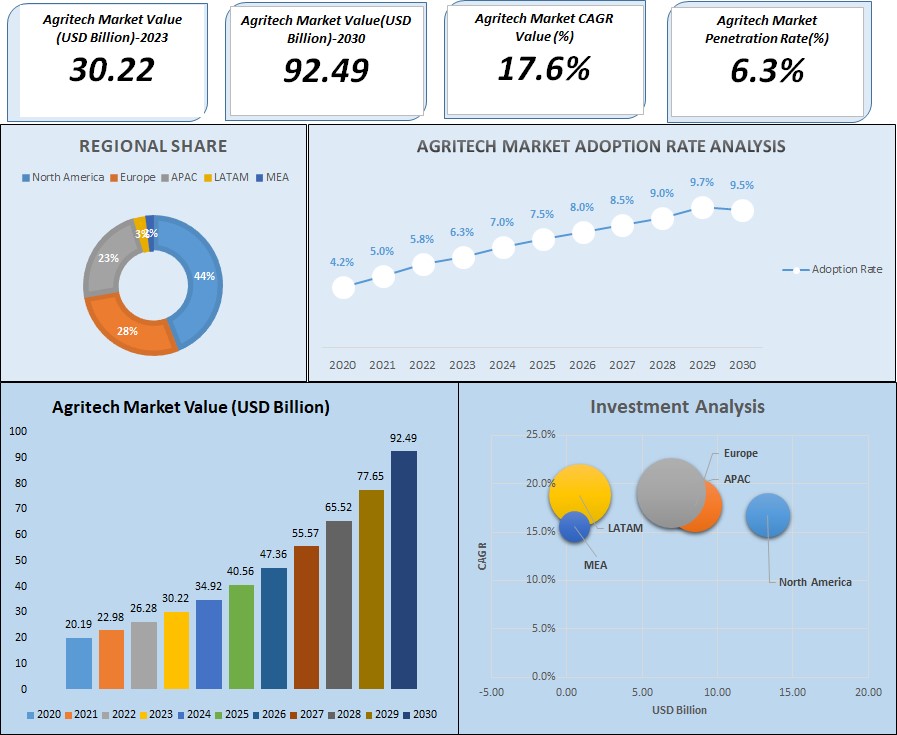
The world is entering a new era of agriculture—one where data is as vital as water and software is just as critical as soil. The Agritech Market is witnessing a digital transformation that is redefining how food is grown, managed, and delivered. With a market valuation of USD 30.22 Billion in 2023 and projected growth to USD 92.49 Billion by 2030, this industry is expanding at a robust CAGR of 17.6% from 2024 to 2030.
This remarkable growth reflects a global need for efficient, intelligent, and sustainable farming solutions. Technology is no longer an accessory in agriculture—it's becoming the backbone of modern farm operations.
The Shift from Traditional to Smart Farming
For centuries, agriculture depended heavily on intuition, manual labor, and seasonal patterns. However, the digital revolution is transforming this age-old industry. Today, farmers are equipped with precision agriculture tools that rely on GPS, cloud computing, and big data analytics. These tools offer real-time insights into soil conditions, crop health, and pest management.
Farm management software platforms now allow growers to oversee entire operations from their smartphones or tablets. Whether it's tracking crop progress, controlling irrigation systems remotely, or scheduling fertilizer use, software is optimizing every part of the value chain.
This transition to tech-enabled farming is one of the key drivers of the growing Agritech Market Size, especially in regions like Asia-Pacific where both food demand and tech adoption are on the rise.
Key Technologies Fueling Market Growth
- IoT and Smart Sensors: Internet of Things (IoT) devices collect data from soil, crops, and weather patterns, enabling data-driven decisions. Farmers can act proactively to increase yield and efficiency.
- Artificial Intelligence: AI algorithms forecast yield, detect plant diseases early, and offer automated recommendations for treatment. This reduces waste and increases productivity.
- Drones and Satellite Imaging: High-resolution images help monitor crop health, irrigation levels, and potential problem areas. This remote sensing technology is especially valuable for large-scale farms.
- Blockchain for Traceability: Blockchain ensures transparency in the supply chain, allowing producers and consumers to track food origin, quality, and distribution in real-time.
- Farm Management Software (FMS): Centralized platforms that offer analytics dashboards, financial management, resource planning, and labor tracking are becoming essential to modern farming operations.
Asia-Pacific: A Hotbed of Agritech Innovation
The Agritech Market Size is expanding rapidly in Asia-Pacific, where population growth, urbanization, and climate change are challenging traditional farming models. Countries like India, China, and Singapore are making large-scale investments in vertical farming, precision irrigation, and agricultural drones.
Governments are supporting this growth through subsidies, smart farming pilot programs, and public-private partnerships. Startups in the region are leveraging AI, robotics, and remote sensing to create scalable, affordable Agritech solutions.
Challenges and the Road Ahead
Despite its potential, the digital transformation of the Agritech Market comes with challenges. Rural connectivity, high initial investment costs, and lack of digital literacy can slow adoption, especially in developing countries.
However, these challenges present opportunities. Bridging the digital divide through education, government policies, and infrastructure development will be crucial to unlocking the market’s full potential.
Conclusion
The Agritech Market is no longer just about growing more food—it’s about growing smarter. From soil to software, the digital revolution is making agriculture more productive, sustainable, and resilient.
As the industry continues to innovate and integrate emerging technologies, the future of food production looks not only secure but also smarter than ever. With a projected market size of USD 92.49 Billion by 2030, this is the beginning of a high-tech agricultural renaissance.