


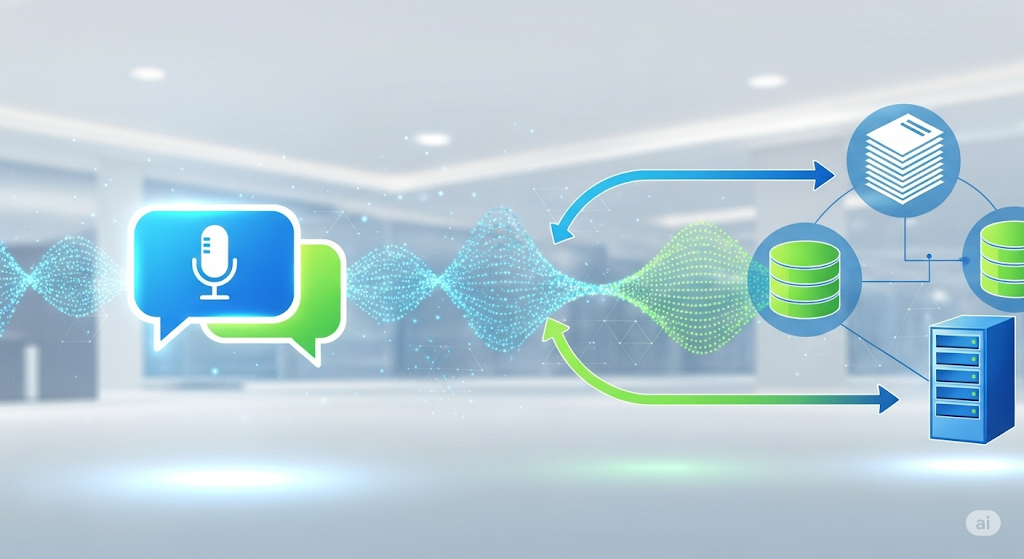
Imagine asking your company’s AI assistant, “What’s our current hybrid work policy?”
Instead of guessing or relying on outdated information, the assistant instantly pulls the latest policy from your internal database and explains it in plain language.
This isn’t magic — it’s Retrieval-Augmented Generation (RAG) at work, the same technology that powers a modern RAG chatbot.
While large language models (LLMs) like GPT-4 are incredibly powerful, they have a major limitation: they only know what they were trained on. That means they might not have the most recent or organization-specific data — and in some cases, they may provide incorrect answers altogether.
RAG solves this by giving your AI “real-time memory,” enabling it to look up accurate information before generating a response.
Why LLMs Alone Aren’t Enough?
Traditional LLMs can produce fluent, human-like text, but they operate with a fixed knowledge cutoff. This can lead to hallucinations — confidently stated but false answers — which is risky in fields like healthcare, finance, or law.
Updating a model with new data is possible, but retraining is costly, time-intensive, and hard to scale. That’s why many businesses partner with an AI integration company to implement RAG as a more efficient and reliable solution.
What Is Retrieval-Augmented Generation?
RAG is a method that blends two strengths:
- The creative fluency of a large language model
- The fact-finding precision of a retriever that searches your internal and external data sources
Think of it like pairing an excellent writer with an expert researcher. Instead of relying solely on memory, the AI searches your organization’s documents, policies, or databases in real time before answering.
The RAG Architecture Explained
RAG systems typically involve five core components:
1. Vector Database
Before retrieval can happen, your data — such as reports, manuals, or customer FAQs — must be stored in a way the AI can search. Instead of saving it as plain text, it’s transformed into vectors, numerical representations of meaning.
This enables semantic search, so the system finds relevant answers even if the exact words differ from the question. Popular vector databases include Pinecone, Weaviate, and FAISS.
2. Retriever
When a user asks a question, the system converts that query into a vector and compares it to stored document vectors. Using similarity scoring (like cosine similarity), it retrieves the most relevant snippets — often just 3–5 text chunks — for the next step.
3. Augmented Prompt
The retrieved content and the original user question are packaged together into a prompt for the LLM, along with an instruction to only use the given data.
4. Generator (LLM)
The language model — such as GPT-4 or Claude — uses this augmented prompt to produce a natural, accurate answer. Because it’s based on real, retrieved content, the AI avoids hallucinating and delivers trustworthy results.
5. Orchestrator
Behind the scenes, the orchestrator coordinates the workflow: receiving the query, calling the retriever, building the prompt, sending it to the LLM, and returning the final answer. Tools like LangChain, LlamaIndex, and Haystack can help build these flows.
How RAG Works — Step by Step
- User asks a question → “What are our cybersecurity protocols for remote staff?”
- Query is embedded → The question is converted into a semantic vector.
- Retriever searches the vector database → Finds the closest matching text chunks.
- System builds an augmented prompt → Combines retrieved data with the original question.
- LLM generates a response → Produces a contextually accurate answer.
- Post-processing → Filters noise, summarizes long content, and adds source references if needed.
Why RAG Matters for Enterprise AI?
1. Real-Time Knowledge Access
Unlike static LLMs, a RAG chatbot can pull updated information instantly — whether that’s HR guidelines, compliance rules, or product catalogs.
2. Controlled and Auditable Answers
You choose which sources are used, reducing risk and ensuring compliance — critical for industries with strict data governance.
3. Lower Costs, Higher Efficiency
Instead of retraining models every time your data changes, just update your vector database. This approach works well with cloud-hosted LLM APIs and keeps your infrastructure lean.
4. Personalized Interactions at Scale
By integrating customer histories, department-specific policies, or user activity, RAG enables context-aware conversations that improve both support and productivity.
5. Scalability Without Accuracy Loss
With RAG, enterprises can deploy AI solutions across HR, sales, legal, and customer service without sacrificing factual reliability.
Final Thoughts
Generative AI is impressive — but when it guesses, it can mislead. RAG changes that, making your AI both smart and reliable.
If you want to implement a RAG chatbot for your business, partner with an AI integration company that works with expert software developers experienced in building scalable, high-performance AI systems. The right team will design a solution that keeps your AI grounded in real-time, business-approved information — building trust, improving decision-making, and driving efficiency.

The application of artificial intelligence in eCommerce allows using business and customer data for making predictions that are not so obvious to the naked eye of customers looking for a specific product on a website and business owners planning the strategy of promoting goods and services.
Please read the article Turning Your Marketplace Into a Magnet for Buyers With Artificial Intelligence know how adoption of AI can help your eCommerce business.