

Wearable injectors (WIs) are delivery systems that adhere to the body to administer large volumes (more than 2 mL) of drug subcutaneously over an extended period. Wearable injectors release drugs throughout the set period at specific time intervals. Patients can self-inject medication through wearable injectors, which reduces burden from doctors and healthcare workers. Wearable injectors play a key role in therapy of diabetes and several chronic diseases such as cancer, respiratory diseases, and arthritis. Wearable injectors are less expensive than IV infusions since they do not require additional equipment or a skilled person to administer medications. However, the less patient acceptance and high cost associated with manufacturing of devices in under developed countries can limit its usage.
► Don't Miss Out “Download Your Exclusive Sample PDF Report” Now: https://www.alliedmarketresearch.com/wearable-injectors-market
Factors that drive growth of the wearable injector market include rise in prevalence of chronic diseases, rise in approach toward novel drug delivery systems, and advancements in development of wearable injectors. For instance, according to Centers for Disease Control and Prevention (CDC) in 2018, 129 million of civilian, non-institutionalized adults were diagnosed with at least 1 chronic condition. Furthermore, rise in concerns among people immunological disease contributes toward growth of the wearable injector market. Furthermore, increase in demand for effective, fast, and accurate treatment results have led to the development of advanced wearable injectors, thereby propelling the growth of the market.
The World Health Organization (WHO) on January 30, 2020 declared COVID-19 outbreak a public health emergency of international concern. COVID-19 has affected around 210 countries across the globe. The COVID-19 pandemic is an unprecedented global public health challenge and is anticipated to have a positive impact on the wearable injectors market. The COVID-19 pandemic influences entire health care sector to shift towards home-based treatment to avoids the further spread of COVID-19 infection. In addition, recognition of the urgent requirements of global market has encouraged the development of wearable injector device. Thus, COVID-19 infection propels growth and rises opportunities for key players of wearable injectors during the forecast period.
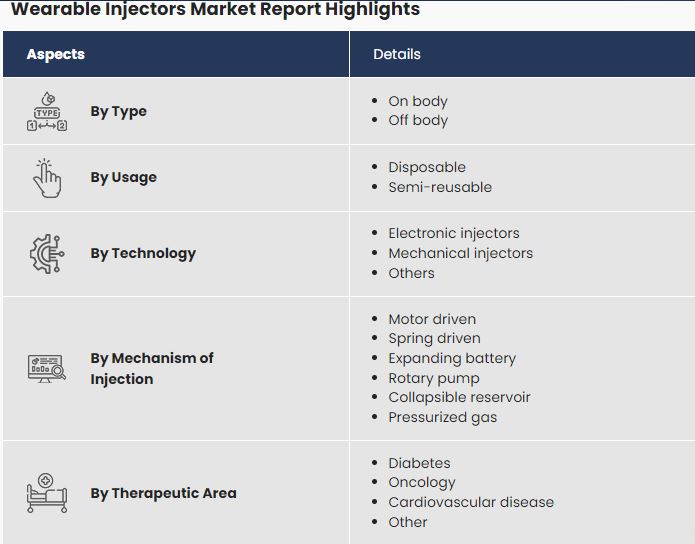
The wearable injector market is segmented into type, usage, technology, mechanism of injection, therapeutic area, end users and region.
On the basis of type, the market is divided into on-body, and off-body. The on-body injectors segment dominated the market in 2020, and this trend is expected to continue during the forecast period, owing to simple application procedure and do not require additional equipment. By usage, it is classified into disposable and semi-reusable. The semi-reusable segment dominated the market in 2020, owing to its reusability and production of low medical wastes. On the basis of technology, it is classified into electronic injectors, mechanical injectors, and others. The mechanical injectors segment dominated the market in 2020, and this trend is expected to continue during the forecast period, owing to its cost effectiveness and smaller device size.