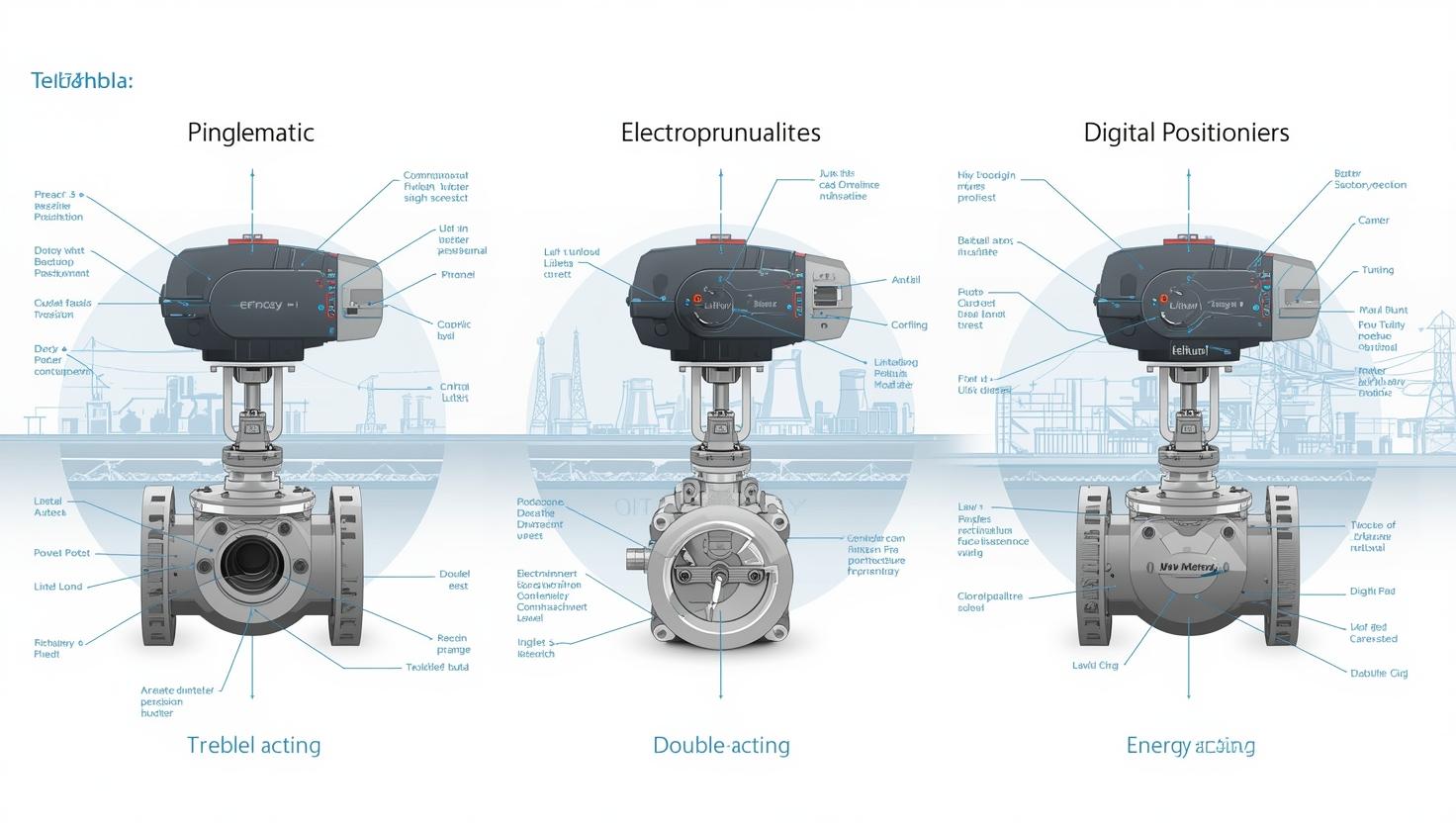
The valve positioner market is undergoing a significant transformation, fueled by the global shift toward intelligent process automation. Traditionally viewed as auxiliary devices within flow control systems, valve positioners are now central to the modernization of industrial infrastructure. With growing emphasis on efficiency, safety, and environmental compliance, these devices have become strategic assets in industrial automation. As a result, the global market is attracting fresh investments from leading automation companies, technology innovators, and even venture capital firms.
Valve Positioners and Their Evolving Role
At a basic level, valve positioners control the exact position of a valve actuator to ensure it responds accurately to control signals. While this has been the primary function for decades, recent advancements in digital electronics, sensors, and connectivity have dramatically expanded their capabilities. Modern valve positioners are equipped with diagnostics, self-calibration, remote access, and communication protocols that make them integral to smart manufacturing systems. They can detect valve wear, signal anomalies, and contribute to predictive maintenance strategies—all of which improve uptime and reduce operational risks.
The evolution from analog to digital valve positioners has not only increased functionality but has also aligned them with the broader goals of Industry 4.0 and IIoT (Industrial Internet of Things). These smart positioners now serve as data-generating endpoints in connected plants, feeding critical information into control systems and enterprise resource planning platforms.
Industrial Automation as a Market Catalyst
The global valve positioner market is projected to grow from USD 2.07 billion in 2025 to USD 2.56 billion by 2030, registering a CAGR of 4.4 % during the forecast period. The industrial automation boom is one of the primary catalysts behind the growing investment in valve positioner technologies. Across sectors such as oil and gas, power generation, water treatment, and chemicals, plant operators are seeking solutions that can maximize throughput while minimizing human intervention and error. Valve positioners have become indispensable in this context because they serve as the interface between control logic and mechanical valve movement.
Automation initiatives now prioritize components that can support dynamic process control, digital feedback, and real-time system optimization. Investors are increasingly drawn to this segment because valve positioners are not only high-utility devices but also represent a gateway for more advanced automation rollouts. In many cases, upgrading positioners is a cost-effective entry point for plants aiming to digitize operations without fully overhauling legacy systems.
Download PDF Brochure @ https://www.marketsandmarkets.com/pdfdownloadNew.asp?id=138950854
Integration with Predictive Maintenance and Asset Management
As industrial facilities shift from reactive to predictive maintenance models, the demand for smart valve positioners has surged. These devices provide detailed diagnostics related to valve performance, actuator response, and environmental conditions. By continuously monitoring these parameters, valve positioners enable maintenance teams to identify issues such as hysteresis, stiction, or actuator lag before they escalate into failures.
Predictive maintenance is now a key area of interest for both plant managers and technology investors, as it directly correlates with cost savings and operational reliability. Valve positioners that integrate seamlessly with asset management platforms offer immediate value by extending the life of critical components and reducing unplanned downtime. This has created an investment opportunity for companies developing software-enhanced or cloud-compatible valve positioner solutions.
Energy Efficiency and Environmental Regulations
Another driving force behind increased investment in the valve positioner market is the global emphasis on energy efficiency and emissions control. In industries where precise flow regulation impacts fuel consumption, product quality, or pollutant output, valve positioners contribute to real-time optimization that ensures compliance with regulatory standards.
By enhancing the accuracy of control valves, these devices reduce over- or under-supply of gases and liquids, leading to more stable processes and less waste. In power plants, for example, accurate valve positioning supports efficient boiler operation and minimizes fuel losses. In chemical manufacturing, it ensures correct dosing and mixing, improving product consistency while minimizing harmful emissions. These efficiency gains not only appeal to operators but also make valve positioner technologies attractive to sustainability-focused investors.
Geographic Trends and Emerging Markets
Regionally, Asia-Pacific dominates the valve positioner market, with China, India, and Southeast Asian countries rapidly expanding their industrial sectors. These nations are investing heavily in petrochemicals, refining, pharmaceuticals, and water infrastructure, all of which rely on accurate flow control systems. As local manufacturers scale operations, the demand for smart, reliable, and efficient valve positioners continues to grow.
In North America and Europe, the market is characterized more by modernization than greenfield expansion. Here, the emphasis is on replacing aging analog systems with digital, smart valve positioners that can integrate into existing SCADA and DCS systems. European countries, in particular, are driven by sustainability mandates, making precision flow control a regulatory necessity.
Meanwhile, emerging markets in the Middle East and Africa are becoming hotspots for investment as they develop new industrial corridors and energy diversification projects. These initiatives often begin with high-efficiency, automated infrastructure—providing fertile ground for valve positioner adoption.
Competitive Landscape and Innovation
Major companies operating in the valve positioner market are Emerson Electric Co. (US), ABB (Switzerland), Siemens (Germany), Flowserve Corporation (US), and Schneider Electric (France).
. They are focusing on innovations such as wireless communication, AI-based diagnostics, and hybrid analog-digital systems to bridge compatibility gaps in plants that straddle old and new technologies.
Startups and niche automation companies are also entering the market with compact, retrofit-friendly digital positioners. These devices are designed to be more affordable and easier to deploy in small or mid-sized facilities that may not have the resources for full-scale automation but still want the benefits of smart control and monitoring.
Strategic partnerships between hardware manufacturers and software companies are also reshaping the industry. By integrating valve positioners with cloud-based asset management and control systems, these collaborations are creating end-to-end solutions that deliver both physical control and data intelligence.
Challenges and Outlook
Despite the optimistic growth trajectory, the valve positioner market is not without challenges. High upfront costs and technical complexity can deter adoption, particularly in cost-sensitive regions or industries. Integration with legacy systems remains a technical barrier, and a shortage of skilled workers to configure and maintain digital systems may limit deployment in certain markets.
However, as more companies recognize the long-term ROI of smart positioners—particularly in reducing downtime and enhancing process reliability—adoption is expected to accelerate. The development of more user-friendly interfaces, modular designs, and interoperable platforms is also making it easier for a broader range of industries to invest in this technology.
Looking ahead to 2030, the valve positioner market is expected to not only expand in size but also deepen in strategic importance. These devices will play a central role in bridging traditional industrial practices with the digital future, making them an attractive investment segment within the wider industrial automation ecosystem.
About MarketsandMarkets™
MarketsandMarkets™ has been recognized as one of America's Best Management Consulting Firms by Forbes, as per their recent report.
MarketsandMarkets™ is a blue ocean alternative in growth consulting and program management, leveraging a man-machine offering to drive supernormal growth for progressive organizations in the B2B space. With the widest lens on emerging technologies, we are proficient in co-creating supernormal growth for clients across the globe.
Today, 80% of Fortune 2000 companies rely on MarketsandMarkets, and 90 of the top 100 companies in each sector trust us to accelerate their revenue growth. With a global clientele of over 13,000 organizations, we help businesses thrive in a disruptive ecosystem.
The B2B economy is witnessing the emergence of $25 trillion in new revenue streams that are replacing existing ones within this decade. We work with clients on growth programs, helping them monetize this $25 trillion opportunity through our service lines – TAM Expansion, Go-to-Market (GTM) Strategy to Execution, Market Share Gain, Account Enablement, and Thought Leadership Marketing.
Built on the 'GIVE Growth' principle, we collaborate with several Forbes Global 2000 B2B companies to keep them future-ready. Our insights and strategies are powered by industry experts, cutting-edge AI, and our Market Intelligence Cloud, KnowledgeStore™, which integrates research and provides ecosystem-wide visibility into revenue shifts.
To find out more, visit www.MarketsandMarkets™.com or follow us on Twitter , LinkedIn and Facebook .
Contact:
Mr. Rohan Salgarkar
MarketsandMarkets™ INC.
1615 South Congress Ave.
Suite 103, Delray Beach, FL 33445
USA: +1-888-600-6441
Visit Our Website: https://www.marketsandmarkets.com/