Managing educational institutions has always been a complex task. From handling student records and attendance to managing staff, finances, and parent communication, administrators often face multiple challenges. Traditional systems, mostly paper-based or semi-digital, struggle to keep up with the fast-growing needs of schools, colleges, and universities.
With the rise of technology, the education sector is undergoing a major shift. Institutions are now looking for smarter ways to improve efficiency, accuracy, and collaboration. This is where ERP software comes into play. By unifying all processes into a single platform, ERP enables educational institutions to streamline operations, enhance transparency, and make better decisions.
The purpose of this blog is to explore why ERP software is emerging as the future of education management systems, its benefits, features, and how it is transforming institutions for the digital age.
Challenges in Traditional Education Management Systems
Despite being widely used for decades, traditional management systems in education face several limitations:
- Manual processes and inefficiencies: Paper-based record keeping and manual updates are slow and prone to errors.
- Difficulty in data management and analysis: Storing and analyzing vast amounts of student, academic, and financial data is often disorganized.
- Limited visibility and transparency: Administrators struggle to track overall performance in real time.
- Ineffective communication and collaboration: Lack of proper channels leads to gaps between teachers, students, and parents.
These challenges highlight the urgent need for advanced business software solutions that can handle education management more effectively.
Benefits of ERP Software in Education Management
Adopting ERP software addresses these limitations and offers multiple benefits:
- Streamlined processes and automation: Tasks like attendance, admissions, and fee collection can be automated, saving staff time.
- Improved data management and analysis: With tools like ERPNext software, institutions can store, track, and analyze student and academic data more effectively.
- Enhanced visibility and transparency: Administrators gain real-time access to performance reports, financial records, and student activities.
- Better decision-making and strategic planning: ERP provides actionable insights through analytics, enabling institutions to make informed, future-focused decisions.
For schools, colleges, and universities seeking the best business software, ERP delivers unmatched efficiency and clarity.
Key Features of ERP Software for Education Management
An effective ERP solution comes with several essential features designed specifically for education:
- Student information management: Centralized profiles for enrollment, attendance, grades, and progress tracking.
- Academic management: Tools for managing examinations, grading systems, and timetables.
- Financial management: Modules for handling fee payments, budgeting, and expenses.
- Human resource management: Streamlined payroll, staff attendance, and recruitment management.
- Integration with other systems and modules: Flexibility to connect with learning management systems (LMS), library databases, and more.
By integrating these modules, ERP serves as an all-in-one business solution tailored for educational institutions.
How ERP Software Can Transform Education Institutions
The impact of ERP is not just operational—it transforms the entire education ecosystem:
- Improved student experience and engagement: Students benefit from easy access to academic records, schedules, and online resources.
- Enhanced teacher productivity and efficiency: Teachers spend less time on administrative tasks and more time on teaching.
- Better parent-teacher communication and involvement: Parents receive real-time updates on their child’s performance and attendance.
- Data-driven decision-making and strategic planning: Institutions can identify trends and plan for growth with confidence.
With ERP, education management becomes smarter, student-centered, and future-ready.
Future of Education Management with ERP Software
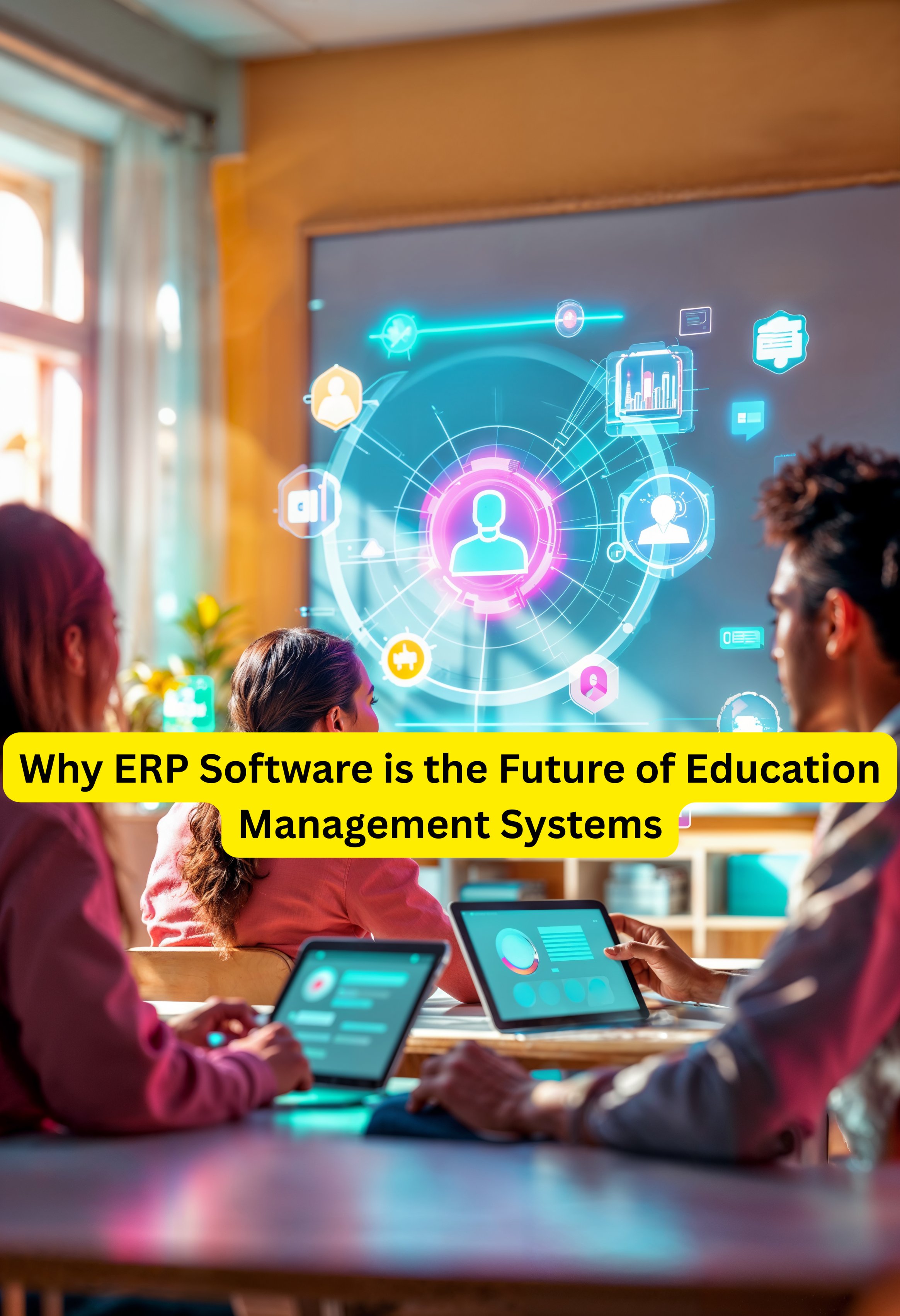
The future of education is digital, and ERP is at the heart of this transformation. Emerging technologies like artificial intelligence, machine learning, and cloud computing are making ERP systems smarter and more adaptive.
Potential applications include predictive analytics for student performance, AI-driven scheduling, and enhanced virtual collaboration tools. By embracing ERP today, institutions are not just upgrading their systems—they are future-proofing themselves against the evolving demands of the education sector.
As the demand for best business software grows, ERP will continue to be the foundation of modern education management systems.
Conclusion
In summary, ERP software is redefining how schools, colleges, and universities manage their operations. By streamlining processes, improving transparency, and enabling data-driven decisions, ERP ensures education institutions are better equipped for the future.
For administrators looking to modernize, choosing the right ERP is crucial. Kyle Solutions, one of the leading business solution providers in Calicut and across Kerala, offers tailored ERP solutions, including ERPNext software, designed to meet the unique needs of the education sector. Now is the time for institutions to embrace ERP and step confidently into the future of education management.