





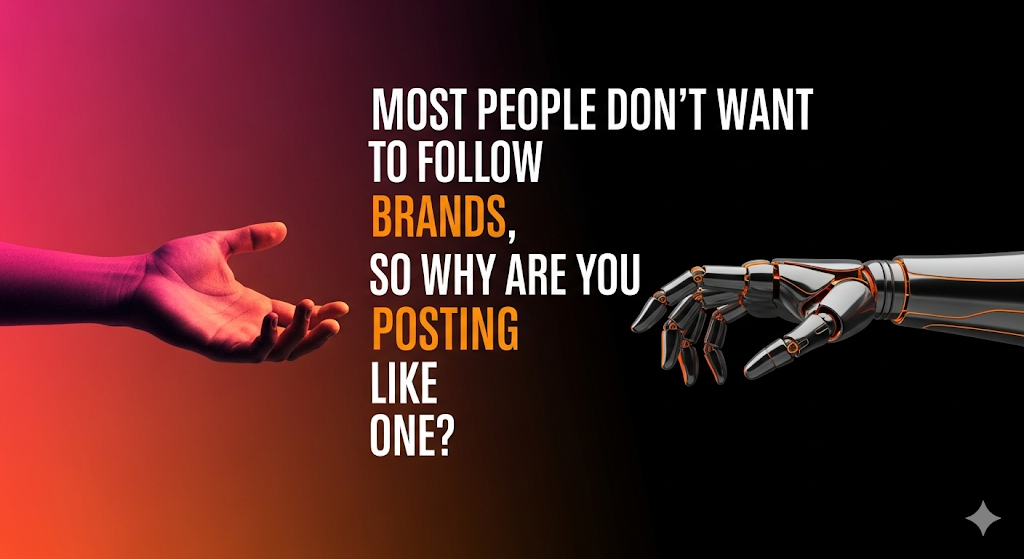
Is Brand Posting Dead? Or Just Misunderstood?
The notion that brand posting is “dead” has circulated for years. Yet what has actually died is not the practice itself, but the audience’s patience with formulaic, lifeless output. Social media users once followed brands out of novelty. Today, the landscape is saturated, and the audience is sophisticated enough to distinguish between genuine contribution and performative presence.
Framing this sociologically, audiences no longer derive identity from passive affiliation with logos. They seek interactive alignment with ideas, communities, and individuals. A “brand” account that posts polished but detached messages misses this shift. The platform architecture itself, feeds optimized for engagement signals, reinforces this rejection. If the brand acts like a broadcast station, it becomes invisible.
Thus, the problem is not whether posting works. The problem is how posting is executed, and whether it respects evolving digital behaviors.
What the Data Really Says About Brand Follower Fatigue
The numbers confirm what intuition suggests. Across major platforms, branded accounts are experiencing higher mute rates, declining organic reach, and diminishing follower growth. Studies from firms like Rival IQ and Hootsuite report year-over-year decreases in average engagement per follower for corporate accounts.
Consider Instagram: while personal creators in niches maintain engagement rates between 3–5%, most brand accounts hover below 1%. Twitter (or X) shows a similar collapse, where corporate content generates interactions at a fraction of the rate seen by individuals. On LinkedIn, engagement disparities are less severe, but even there, personal profiles consistently outperform company pages.
This is not anecdote; it is systemic. Users scroll past content they perceive as advertising, even when technically it is not. Algorithms detect this behavior and quietly demote brand posts in feeds. The feedback loop accelerates: lower engagement leads to lower reach, which further depresses engagement. In essence, brand follower fatigue is both behavioral and algorithmic.
Why Most Brand Accounts Feel Like Billboards, Not Conversations
The creative crime lies in treating social media as a digital out-of-home channel. Too many companies rely on static templates, rotating slogans, and product announcements. The cadence may be consistent, but the resonance is absent.
When an account looks like a slideshow of branded graphics, users instinctively disengage. There is no voice, no narrative arc, no unpredictability. From a communication theory perspective, the signal-to-noise ratio collapses: audiences perceive the output as noise because it contributes nothing new to the dialogue.
Moreover, templated posting often removes human nuance. Emojis appear formulaic. Captions sound rehearsed. Designs emphasize brand guidelines over relatability. The result is billboard aesthetics inside a conversational ecosystem, a fundamental mismatch of medium and message.
The ‘Post Like a Brand’ Trap And How It Kills Organic Reach
Algorithms reward authenticity because authenticity generates longer dwell times and higher interaction probabilities. By contrast, content that resembles corporate advertising is deprioritized. The trap is that many businesses, imitating “best practices,” polish their posts into corporate sterility, thereby signaling to the algorithm that the material is low-interest.
From a structural standpoint, this is algorithmic suppression through behavioral inference. The platform assumes: if users repeatedly skip a certain type of post, then all posts of that archetype should be distributed less. Unfortunately, branded templates fall squarely into this punished category.
This means the act of “posting like a brand” doesn’t merely fail to grow your audience, it actively reduces your organic reach over time. Businesses then believe the platform is broken or “pay-to-play,” when in fact, their own posting style has eroded their discoverability.
The lesson is severe but liberating: stop imitating brand orthodoxy if you want algorithms to amplify you.
Do People Actually Want to Engage With Businesses? Yes But Not “Brands”
The paradox is clear: while people claim they do not want to follow brands, they willingly engage with businesses when the presence feels human, accessible, and conversational. The distinction is psychological.
A “brand” is often perceived as a faceless construct, logos, stock slogans, templated visuals. A business, however, can present itself as a group of real people solving real problems. When a SaaS company shares an engineer’s candid breakdown of a new feature, or when a bakery posts a behind-the-scenes clip of morning prep, the content ceases to be “branded” in the negative sense. It becomes participatory.
From a communications theory perspective, this transition converts symbolic capital into relational capital. Users are not aligning with an abstract identity but with a social actor they can trust. And algorithms respond favorably because authentic human signals drive longer attention spans and richer engagement.
That’s why at Stado, we often advise businesses to integrate leadership and team voices into their social media strategy. A founder’s authentic perspective, or even behind-the-scenes contributions from employees, consistently outperforms templated brand posts. It’s not theory, it’s what the data across client campaigns has shown us repeatedly.
Why Mimicking Big Brand Social Doesn’t Work for Small Businesses
Large corporations can afford to treat social media like an extension of traditional advertising. Starbucks posts a glossy product shot; Nike drops a cinematic clip; Zomato recycles witty quips. These brands command attention through sheer scale and pre-established equity.
But when a small or mid-sized business attempts the same tactic, it backfires. Without an existing base of cultural significance, the templated post looks like imitation. The algorithm sees low engagement, and the audience sees irrelevance.
This is why a local digital marketing agency or boutique clothing store must not mimic the cadence of corporate giants. What works for Nike works because Nike has decades of narrative embedded in the public consciousness. A bakery in Jaipur, a gym in Lucknow, or a B2B SaaS startup cannot lean on that reservoir. They must earn attention through proximity, personality, and participation.
In blunt terms: copying global brand social strategy is an act of self-sabotage for small businesses.
The Rise of Founder-Led Content & Why It’s Crushing Branded Pages
Scroll through LinkedIn or Instagram, and a pattern emerges: posts authored by founders or executives vastly outperform official brand handles. The reason is not mysterious. People connect with people, not logos.
Founder-led content introduces face, tone, and lived perspective into the feed. A founder discussing the struggle of hiring, sharing a failed experiment, or offering a contrarian view generates genuine conversation. Such posts trigger curiosity loops and comment debates, far surpassing what a corporate “We’re excited to announce…” ever achieves.
Even in high-competition industries, digital marketing agencies, software development firms, creative studios, founder accounts outperform official pages in reach and credibility. The asymmetry is structural: algorithms are designed to prioritize perceived authenticity, and individual accounts inherently deliver it.
One could phrase this academically as a disintermediation of voice: platforms collapse the gap between the producer and the audience, rendering intermediaries (like brand pages) obsolete unless re-humanized.
Should You Still Have a Brand Voice? Yes, But Not That Kind
Abandoning the old form of brand voice does not mean abandoning voice altogether. It means re-defining it. The goal is not sterile consistency but living adaptability.
A modern brand voice is:
Conversational yet authoritative, firm enough to inspire trust, flexible enough to sound real.
Multi-voiced, drawing from employees, customers, and leadership, not a single polished script.
Platform-sensitive, what works on TikTok is not identical to what performs on LinkedIn.
The mistake is assuming that uniformity equals professionalism. In fact, uniformity often signals automation. The better approach is coherence: a recognizable ethos that tolerates variation. This way, the audience perceives a real presence rather than an artificial mask.
From a rhetorical standpoint, it is the difference between speaking with authentic plurality versus broadcasting synthetic singularity.
What to Post Instead: Content That Doesn’t Feel Like Marketing
The practical question is obvious: if not brand-styled posts, then what? The answer is content that resembles conversation, reaction, or participation, not performance.
Examples include:
Conversation starters. Ask provocative questions tied to your domain (“What’s one marketing tactic you wish agencies would stop selling?”).
Reactions to industry shifts. Respond quickly to platform changes, cultural moments, or competitor moves.
Problem statements. Frame challenges your customers face and outline thought processes rather than polished solutions.
Unpolished formats. Behind-the-scenes videos, casual phone-shot clips, text-only posts, formats that feel immediate rather than manufactured.
These approaches work because they mimic peer-to-peer communication. They invite responses instead of broadcasting messages. They respect the architecture of the feed, which privileges immediacy and relatability over perfection.
In practice, this shift often feels uncomfortable for businesses conditioned to polish. Yet the discomfort is the signal you are moving in the right direction.
At Stado, we help businesses stop performing and start participating, building strategies where people engage with you not because you look like a brand, but because you act like a business worth knowing.
How to Measure the Right Metrics (Hint: It’s Not Likes or Shares)
The obsession with vanity metrics has trapped countless businesses. A surge of likes on a polished post feels gratifying, but it does not necessarily correlate with meaningful business outcomes. Engagement can be hollow; attention can be superficial.
Instead, the real indicators of social performance lie deeper in the funnel:
Follower quality. Are the right types of people following, potential buyers, decision-makers, local audiences, or is the account bloated with passive onlookers?
DM volume. Direct messages signal intent and trust. If people are contacting you privately, your content is provoking genuine interaction.
Profile visits. A rise in profile taps shows your content is sparking curiosity, a far stronger signal than passive likes.
Conversion paths. Are posts leading to website clicks, email sign-ups, or inquiries? These movements matter more than algorithm-friendly emojis.
This reframing aligns measurement with business reality. Social media strategy for small businesses, agencies, or service providers cannot afford to chase impressions divorced from outcomes. Precision, not applause, determines ROI.
Real Accounts Doing It Right: What You Can Learn
Across industries, small and mid-sized businesses are outperforming bigger competitors by abandoning “brand posting” and leaning into human presence.
A boutique café in Bangalore grew its reach not by glossy menu photos but by letting its barista record short rants about coffee myths. Those unscripted clips doubled engagement and pulled new walk-ins.
A SaaS founder in Delhi bypassed the sterile company page and posted weekly reflections on scaling challenges. The candor earned shares, backlinks, and inbound leads far exceeding what the brand page could achieve.
An artisanal clothing label in Jaipur stopped recycling catalog shots and instead let its designers talk about fabric sourcing and dyeing traditions. Followers became customers because they saw process, not polish.
The unifying factor: authenticity calibrated for platform architecture. These businesses did not post like brands. They participated as humans, which is precisely what the algorithm amplifies.
For agencies guiding clients, these examples dismantle the excuse that “we don’t have Nike’s budget.” In reality, not having that budget is an advantage, it forces relatability over performance art.
Conclusion
The fatal mistake is equating consistency with relevance. Posting like a brand may fill calendars and satisfy internal reporting, but it fails in the only arena that matters: attention. Audiences do not reject businesses. They reject performance masquerading as presence.
The path forward is not complicated, but it demands courage. Replace billboards with conversations, slogans with questions, templates with imperfect immediacy. Let founders, employees, and customers speak. Allow your feed to feel alive, not rehearsed.
Social media is no longer an exhibition hall for polished identity. It is a participatory arena where authenticity, reaction, and vulnerability win. For businesses willing to abandon the security blanket of corporate posting, the rewards are algorithmic reach, human trust, and measurable outcomes.
Most people will never line up to follow a logo. But they will pay attention to people who show up. That is the brutal reality, and the liberating opportunity.

Given that you ended up existing, you have been doing over your competitors-right?
With 30% of millennials indicating they have interaction having a brand on social at the very least once per month, your strategy just cannot be only about existence.
Instead, social media preparing should be checked out like cooking your favorite dish.
Not only is it critical to help you benchmark where you’re, but it also increases your odds of attaining them.
Investigate Your Social Media Viewers
Approximately 79% of older people use Facebook-but are your customers actively engaging along with your brand there?