

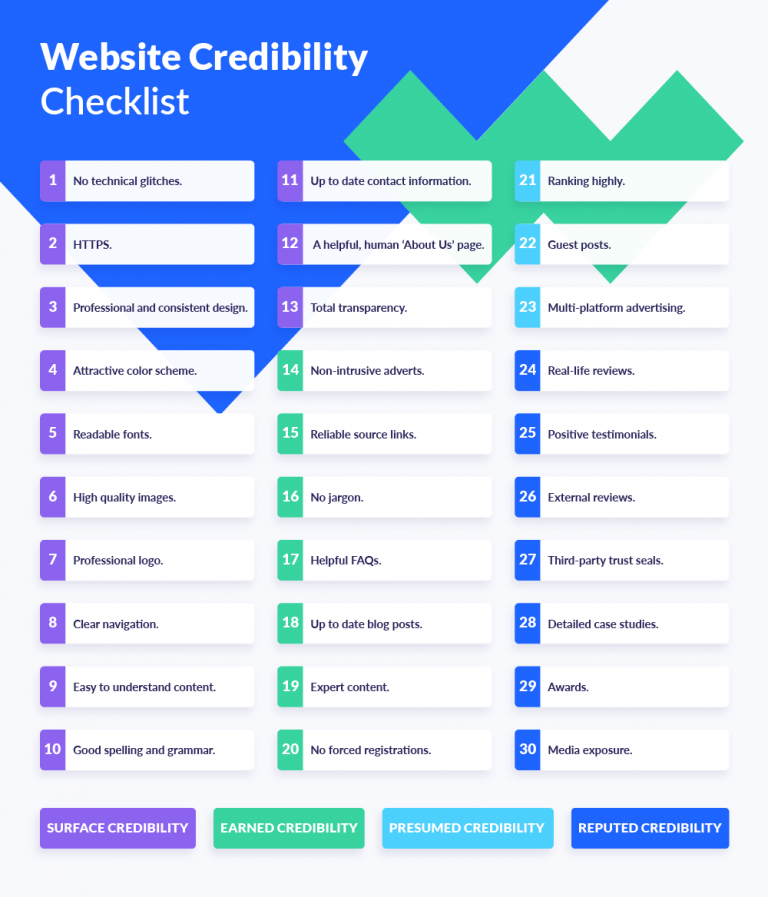
Intro:
When two websites both show up in search results, why do you trust one over the other? It’s more than just ranking. Below are 13 signals thought leaders look for when deciding which sites are credible — and which ones they skip
Design Clarity and Expert Content Build Website Trust
As a founder of a design agency I research and go through hundreds of websites. I trust a website when it is quite easy to use and also looks good. When the design is clean, the content is easy to read and it works well on my phone, I am more likely to believe what I'm reading. It shows the company cares about its customers.
Another thing is the source of the information. I look for who wrote the article and if they are an expert. I also check to see if they link to other credible sources. A website that is transparent about its information and provides evidence is more trustworthy. So, as a website owner you will need to show that you are a reliable authority rather than just saying it on your website.
Shantanu Pandey, Founder & CEO, Tenet
-------------------------------------------
Licenses and Professional Design Signal Trustworthy Real Estate
In real estate, I tend to trust a website more if it shows proof of licensing or MLS membership right up front, because that tells me they're operating by the rules. On the job, I always check for those details the same way I'd look for building permits before starting a renovation. I'll put it this way: if someone spent the time to set up clean photos, functional pages, and professional credentials, it tells me their business is worth taking seriously.
Mike Wall, Founder/CEO, We Buy Gulf Coast Houses
-------------------------------------------
Professional Sites Show Attention to Important Details
For me, I trust a site when it feels professional and transparent, like listing state licenses or certifications where I can see them easily. My old mentor swore by only working with businesses that not only presented information clearly but also had sites that actually worked properly on a phone, and she was right. Personally, if a company can't get their own online presence to function smoothly, I question how detail-oriented they are with bigger commitments.
Carl Fanaro, President, NOLA Buys Houses
-------------------------------------------
Industry Recognition Trumps Search Rankings for Credibility
When I see a company mentioned by respected sources in our industry, I generally place far more value on that source that I will by search rankings. In our industry, we build credibility over time through demonstrated competence and regulatory compliance, and if a site is mentioned by state licensing boards, contractor associations, or national insurance carriers, then I would assume that a group of professionals has already vetted the sites. Sites that professional organizations trust are more relevant to me than search engine rankings or a polished website, and I would rather trust the experienced recommendations of my peers over search engine rankings or a beautiful website.
Michael Benoit, Founder, Contractor Bond
-------------------------------------------
Named Professionals with Credentials Earn Reader Trust
I have confidence in a website that prominently shows the names, licences and qualifications of the content writers. That is because it shows that they are confident enough in their expertise to attach their reputation to the article they have written. If I were to read a mortgage article written by a person who has stated they have an Australian Credit License and that they have processed 500 loans over the past few years, then that means I am reading that article from direct experience.
On top of that, it helps me separate professional opinion from general synopsis. A named professional has value and has something to lose if they create something inaccurate or misleading. This makes me much more willing to accept their advice, especially on some complicated lending matters that could lead to significant confusion from a small mistake.
Austin Rulfs, Founder & SME Property Investor, Zanda Wealth
-------------------------------------------
Real Photos and Names Prove Authentic Expertise
When I see a website that has actual photos showing what the people are doing and includes names, I would automatically trust it more than a page that is filled with stock images and generic text. This shows the individuals who are sharing the information are the same people who are performing the jobs. It shows willingness to take accountability for what they are saying, which makes the advice feel more grounded and legitimate.
When I see a licensed plumber discussing how they installed a heat pump, or how they repaired a burst pipe beside the actual job, I feel as though the information is coming from an actual practitioner who works with these systems every single day. It is very easy to see the link between an experience and the words of the individual. Again, this holds so much greater reliability than content that comes from an anonymous page.
Caleb John, Director, Exceed Plumbing
-------------------------------------------
Specific Content and Accountability Outweigh Flashy Design
If I see two sites show up in search results, I don't regard them the same way. My trust is, first, to whatever site is showing accountability. Whenever a business or a professional attaches a real name or qualifications, or even just company details, I feel like there is someone standing behind what I read.
I also pay close attention to the specificness, the specificity of the content. A page that just repeats generalized advice doesn't persuade me. What persuades me is if I see more technical explanations or a step-by-step reasoning of the content or even clearer numbers. If someone is explaining how the 50-watt draw current is different than the 200-watt draw current, that puts my trust in them for understanding the field. The more specific the information, the more credibility I give them.
I also attend to the overall structure. If the information is easy to read (as in overall structure) the overall effort is worth more than a flashy presentation. I will prefer a somewhat boring plain website that explains the process to me than a visual site that includes vague promise statements. To me, content outweighs the container.
Jason Rowe, Director & Founder, Hello Electrical
-------------------------------------------
Transparency and Legal Credentials Create Website Trust
For me, trust usually comes down to transparency and credentials. If a site clearly lists their professional licenses or even their TREC registration number, I take that as a good sign because it shows accountability. I've seen too many sites share advice without disclosing that they're selling a service or making money off the information, which can lead people astray. For example, when I was comparing foreclosure resources, I picked the site that noted its financial affiliations and showed who was actually behind the contentI felt safer relying on that. Generally speaking, you're in good shape with a website that doesn't hide its motives and actually proves they're operating legally.
Brandi Simon, Owner, TX Home Buying Pros
-------------------------------------------
Clear Titles Signal Trustworthy Information Online
Whenever I am searching for something online and two websites show up side by side, I will always go with the one without clickbait titles, because a clear and direct title shows discipline in how the information is presented. A headline that is vague or sensational makes me wonder if the content on the other side of it is there to inform people or just to get traffic. But if a title accurately reflects the content and does not rely on exaggerations, the writer had enough confidence in what they wrote to not have to dress it up for a click.
Nicola Leiper, Director & Head of Project Management, Espresso Translations
-------------------------------------------
Expert Content Review Establishes Website Credibility
When a site shows it has a clear fact-checking history or a way of reviewing content, I have a reason to trust it. That is because if a site states right in the article that the content is reviewed by professionals, they are taking responsibility for what they publish.
Let's say I'm trying to research new data on website conversion optimization, and I come across two articles. The first article states, but does not cite source statistics. The second article has a small notation under the author's name that says 'Technical data in this article is verified by our senior analyst, Jane Doe.' While that statement might not sound much, that wording tells me that the information is not simply the opinion of one writer or a summary of other posts, but that it is accurate and has been reviewed by someone who has the right qualifications. For me, that small note communicates that the site is concerned about accurately reporting instead of simply writing up content.
Gor Gasparyan, Co-founder and CEO, Passionate Agency – Passionates
-------------------------------------------
Evidence-Based Technical Content Prevents Costly Mistakes
I also discovered the importance of credibility of websites in a negative way when an established gaming guide wiped out my Minecraft server in an online tournament of 40 players. The amount of setup time and the 40 frustrated players who were left with questions about my server management ability were the result of that one crash. The guide had professional appearance with elegant formatting and self-assured language, but it lacked the single element, which actually counts, actual demonstration that their practices were effective. That catastrophe has resulted in me having an excellent filtering mechanism of technical material that has saved me time and time again and helped avert numerous server outages.
I now only trust the sites that post the real performance screenshots, server console logs and quantifiable information that confirms that their methods are producing results. Last month when I compared the optimization tutorials on Counter-Strike I came across one that had an in-depth before-and-after measurement having tick rate variance reducing by 15ms to 3ms with real server monitoring data. The rival manual only enumerated generic instructions that had no indications that they would work in practice. I used the evidence-based approach and my server response times were almost immediately 60-percent better. This kind of filtering has saved me more than 200 hours of wastage in time spent in troubleshooting since I can identify trusted sources in the few seconds that I can read their contents.
Michael Pedrotti, Founder / Tech Entrepreneur, GhostCap
-------------------------------------------
E-E-A-T Principles Determine Website Trustworthiness
When viewing two websites in search results, I trust the one that has E-E-A-T (Experience, Expertise, Authoritativeness, and Trustworthiness). If one site shows who the author is, and suggests the author's background within their writings, or provides references to their claims, I trust the information. Author biographies and links to reputable sources inspire confidence that the content is based on real life experiences rather than cliches or generic writing. Without these elements, my trust in the website content decreases.
In addition, we should also check when the article was written. By checking the publication date of the information on the website, we can see if the article/news is up to date. A blog post from 3 years ago about an event can mislead readers. One day, I decided to attend a festival. On the official website, the date was listed only with the day and month, so I booked my flight and made the trip. When I arrived, I was surprised to see that the festival grounds were completely empty. Checking the website again, I realized that the blog post about the event lacked E-E-A-T principles. Most importantly, it didn't mention the year of publication. That small missing detail ruined my plans.
In the end, I trust sites that demonstrate proven expertise. They don't just provide information, they demonstrate why they're authorized to produce information, which is E-E-A-T.
Gianluca Ferruggia, General Manager, DesignRush
-------------------------------------------
Source Links Demonstrate Commitment to Accuracy
When I have two websites that are vying to win my trust, the one I will always go by is the one that openly quotes and gives direct links to its main sources. It is very common for business articles to say "studies show" or "experts say" without citing the source. But they are an instant red flag for me. That is because a credible website will not hesitate to point you to the original report, academic article or old government data that they researched or used in their own piece. This behavior represents a true commitment to accuracy and respect for the knowledge and intelligence of the reader. It shows that the author is confident in their conclusions and wants you to see the proof for yourself.
Baris Zeren, CEO, Bookyourdata
Conclusion
To win trust, your site must be more than pretty — it must show who you are, how you know it, and back your claims. Show credentials, be clear, expose your sources, and treat readers like adults who deserve honesty. Want help turning this into a slide or infographic too?