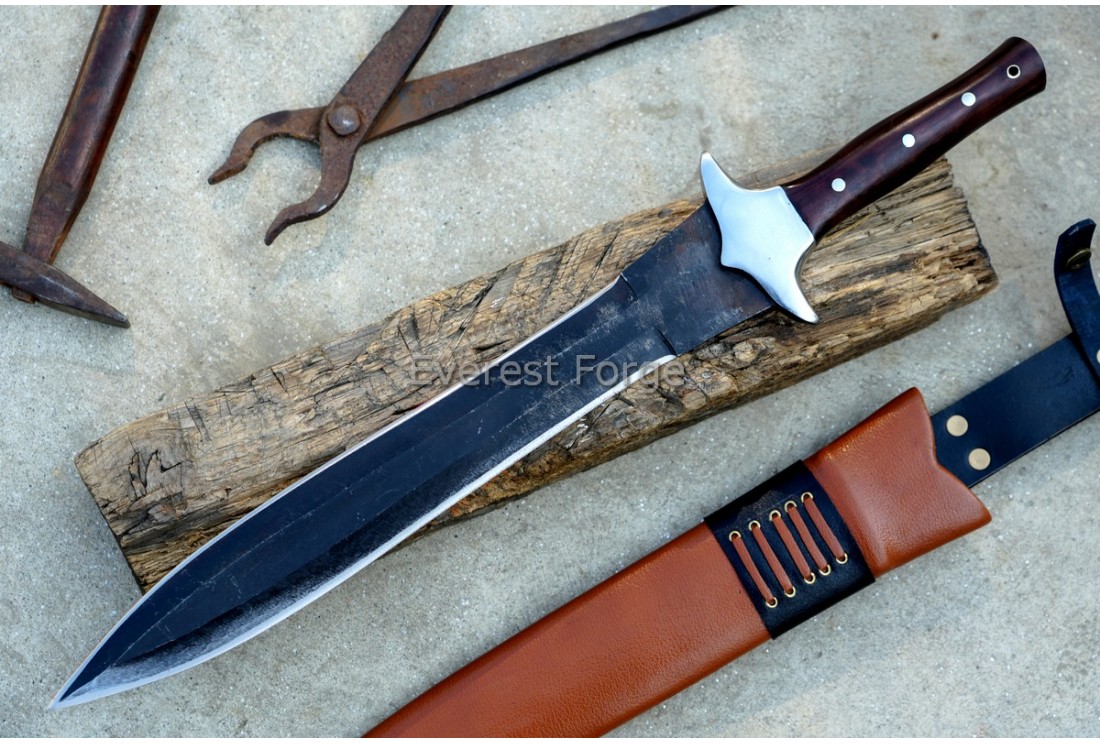
A Blade Born of Grace and Power
Few weapons in history blend elegance and efficiency like the Scimitar. Its smooth, sweeping curve has captured imaginations for centuries, defining not just the art of war but the art of craftsmanship itself.
Originally designed for agility and speed, the Scimitar became the signature blade of mounted warriors, noblemen, and emperors across Asia and the Middle East. Its balance between form and function made it both a masterpiece of engineering and a cultural treasure — one that continues to inspire blacksmiths and collectors around the world.
Today, through expert craftsmen and historic preservation, the Scimitar stands not as a relic, but as a living embodiment of legacy.
A Journey Through History
The Scimitar emerged more than a thousand years ago in the vast steppes of Central Asia and the Middle East. Its creators sought a weapon that could match the rhythm of cavalry combat — swift, sweeping, and precise.
The curved design allowed mounted warriors to strike while moving, delivering fast slashing attacks without losing control. Unlike straight swords that relied on thrusting, the Scimitar flowed naturally with motion, making it perfect for riders.
As it spread across regions, it evolved into several cultural interpretations:
The Persian Shamshir — long, deeply curved, and famous for its cutting finesse.
The Turkish Kilij — broader near the tip, offering extra weight for decisive strikes.
The Arabian Saif — elegant and balanced, reflecting craftsmanship and control.
Each variation preserved the soul of the Scimitar while reflecting the unique artistic spirit of its homeland.
Design: The Science Behind the Curve
At first glance, the Scimitar appears deceptively simple. Yet, its curvature is a marvel of design precision. The curve enhances cutting ability, distributing force along a wider surface area and increasing efficiency with every swing.
This geometry gives the Scimitar three key advantages:
Speed and Control – Its curved shape allows rapid movement, reducing resistance.
Cutting Efficiency – The blade slices cleanly, utilizing motion and momentum.
Balance and Reach – The slight curve provides better reach during horseback combat.
These features made it a preferred blade for light cavalry across centuries. To wield a Scimitar was to move with rhythm — every strike, a dance of balance and precision.
Cultural Significance: More Than a Weapon
The Scimitar carried not just military importance but immense cultural symbolism. Across empires, it represented power, wisdom, and spiritual balance.
In Persia, the Scimitar’s crescent-like form echoed the moon — a symbol of divinity and renewal. Ottoman leaders adorned their Scimitars with gold, gemstones, and intricate calligraphy, transforming them into royal artifacts.
In many traditions, gifting a Scimitar was a gesture of honor and alliance. The blade transcended its martial role to become a ceremonial symbol — worn by leaders, presented in rituals, and displayed as art.
Even today, its outline is found in national emblems and heraldry, symbolizing courage and heritage.
The Craftsmanship Behind the Blade
Forging a Scimitar has always been an art form reserved for the most skilled blacksmiths. Its unique curvature demands not only technical mastery but a deep understanding of balance and metallurgy.
At EverestForge, this ancient process continues with respect and precision. Every Scimitar crafted there is hand-forged, using time-honored methods passed down through generations.
The process includes:
Choosing high-carbon steel for strength and edge durability.
Hammer-forging the curve by hand, ensuring even distribution of weight.
Heat treatment and quenching for optimal flexibility and sharpness.
Detailed polishing and finishing to achieve mirror-like perfection.
Custom handle crafting with wood, horn, or bone, fitted for comfort and grip.
Each Scimitar from EverestForge tells a story — not only of history but of human dedication and artistry.
Scimitar in the Age of Collectors
For modern collectors, the Scimitar represents more than a weapon — it’s a gateway into history. Its design bridges eras, offering both aesthetic appeal and mechanical genius.
Collectors are drawn to the Scimitar’s:
Timeless silhouette, instantly recognizable across cultures.
Historical authenticity, linking it to legendary empires.
Exquisite craftsmanship, where every curve reflects human skill.
Cultural depth, symbolizing unity, honor, and artistry.
In homes, museums, and private collections, the Scimitar commands attention — a reminder that art and warfare once shared the same forge.
Influence on Modern Design
Even today, the Scimitar’s design principles inspire everything from modern cutlery to decorative art. Its curved geometry has influenced knife-making, sabers, and ceremonial blades across the world.
In popular culture, the Scimitar has become synonymous with exotic elegance — appearing in films, novels, and games as the weapon of noble warriors and skilled swordsmen. Its reputation endures not because of fantasy, but because of the truth behind its form: a blade born from logic, beauty, and innovation.
EverestForge: Reviving Ancient Perfection
At the heart of the modern Scimitar revival lies craftsmanship. Brands like EverestForge bridge ancient tradition with modern technique, ensuring that this legendary blade continues to thrive.
By combining authentic forging practices with custom forge design, EverestForge offers collectors a chance to own a piece of history — one that feels alive in the hand. Each blade carries the subtle imperfections and personality that only hand-forging can produce.
No two Scimitars are the same. Each one is a reflection of the blacksmith’s rhythm — forged through flame, sweat, and precision.
Why the Scimitar Endures
So why does the Scimitar continue to fascinate historians, craftsmen, and enthusiasts alike?
Because it’s not just a weapon — it’s a philosophy in steel. It embodies balance: between power and grace, function and form, human design and natural flow.
To hold a Scimitar is to hold a thousand years of innovation, artistry, and spirit. Its curve speaks a universal language — one of harmony and perfection.
Conclusion: The Eternal Curve
The Scimitar stands as one of humanity’s greatest artistic achievements in metal. From the dunes of ancient Arabia to the modern forge, it has carried with it the legacy of mastery and imagination.
Its curve is not only a symbol of craftsmanship but of human potential — the ability to turn raw steel into beauty and strength.
Thanks to dedicated artisans and historical passion, the Scimitar continues to shine — elegant, efficient, and eternal.
Through creators like EverestForge, this ancient design remains not just remembered, but reborn for a new generation of admirers.

What Are Pros and Cons of Article Forge?
Article Forge is an apparatus that utilizations profoundly modern profound understanding calculations to consequently compose articles similarly as people.
These canny calculations permit Article Forge to explore any subject point, very much like people.
It’s peruses a huge number of articles, picks up all you require to know to expound on any subject in its own words.Read more here: https://latestrags.com/what-is-article-forge-what-are-pros-and-cons-of-article-forge/