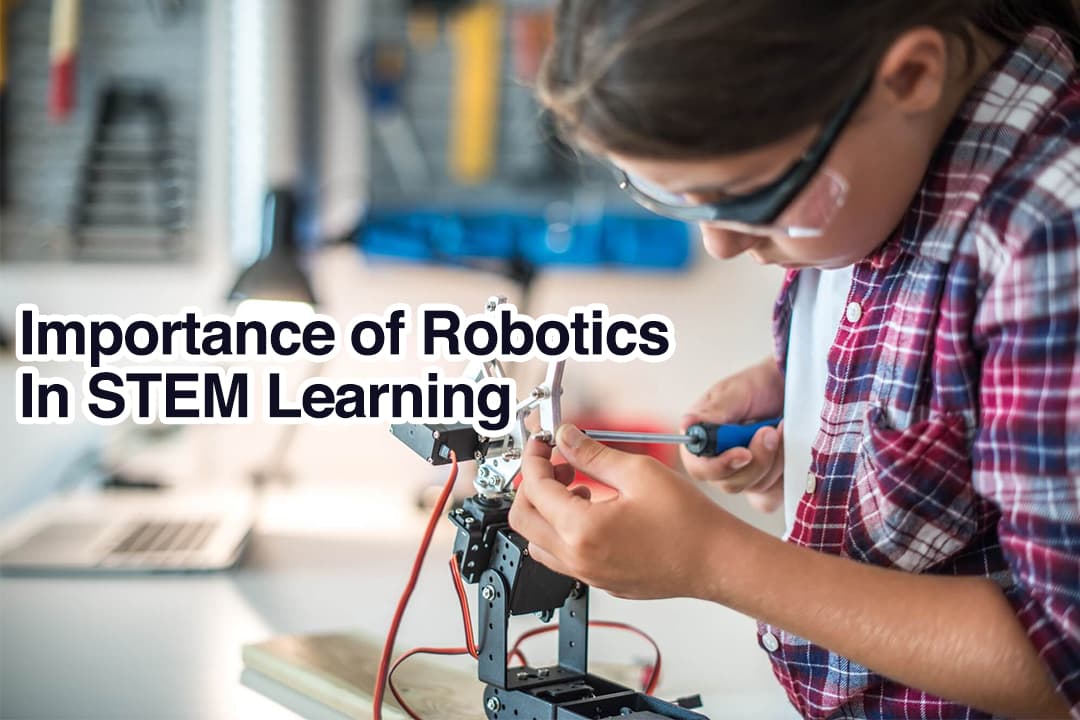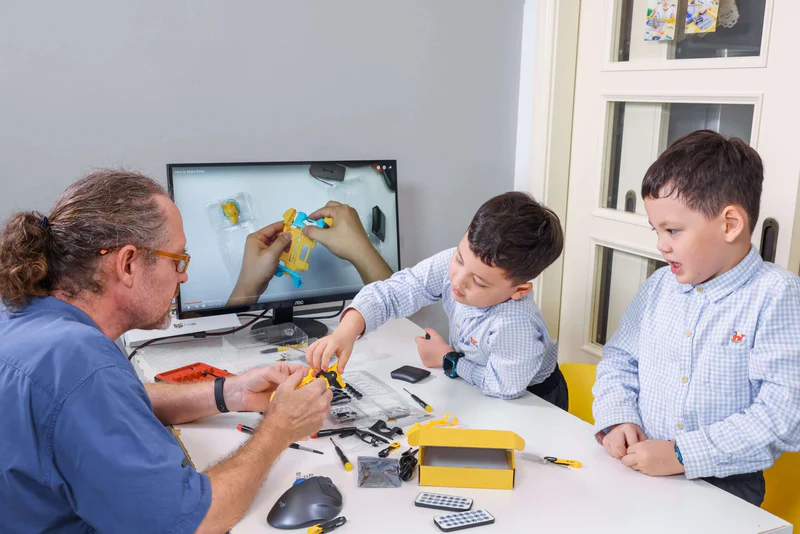
Robotics STEM (science, technology, engineering, and mathematics) education gives students a dynamic, hands-on experience. Additionally, it encourages curiosity and creative thinking, getting learners ready for future challenges in a world where technology is changing rapidly.
What Is Robotics STEM Education?
Robotics STEM education teaches students how to design, construct, and program robots by combining mechanical systems, coding, electronics, and sensors. As compared to just learning about theory, students use what they learn in science and engineering to solve problems in the real world. As a result, they see how abstract concepts can be turned into functional creations.
What Students Can Learn in Robotics STEM Education
Robotics STEM education teaches technical and soft skills for lifetime learning and creativity. Moreover, this method promotes resilience, teamwork, and creative problem-solving. However, the main things that students will learn are listed below:
• Critical Thinking and Problem Solving
Students learn about discovering problems in robot design or behaviour, analyse underlying causes, and then test different ways to resolve them. Through iterating on samples, they get better at thinking. Consequently, they also gain confidence in troubleshooting and debugging.
• Coding and Computational Thinking
Students learn about algorithms, reasoning, and data structures by programming robot behaviours. To make things easier to handle, they break down complex tasks into more manageable ones, and conduct testing to enhance their code. As a result, their skills improve in both block-based and text-based programming.
• Engineering Design and Systems Thinking
Students use engineering concepts like force, motors, sensors, and energy to build machines that function properly. They observe how components interact inside a system and optimise overall performance, efficiency, and dependability. They learn the trade-offs that are part of real engineering through iteration.
• Creativity and Innovation
Robotics STEM education pushes students to come up with new ideas and ways to solve problems. They try new things without any limits, fail, and try again, often finding solutions they didn't expect. In this way, they develop an attitude of constantly discovering inventive methods to improve things.
• Mathematics and Physics Application
Robotics lets students use geometry, measurements, motions, and forces. They see how mathematical models and theoretical rules affect planning. As a result, they get a better, more natural understanding of basic STEM concepts that go beyond what they learn in school.
• Collaboration, Communication, and Teamwork
Students learn to coordinate, debate, and share responsibility since projects are generally done in groups. Thus, it helps people to communicate and synthesise multiple perspectives into a successful approach. In turn, this helps them learn the organisational and social skills they will need for future careers.
• Resilience and Growth Mindset
Trial and error and reworking help students learn to keep going even when the first tries fail. They begin to perceive errors as chances for learning and progress. As a result, they develop the patience and determination that are needed in researching and engineering.
Conclusion
Robotics dramatically enriches steam experiential learning, providing students with a bridge between theory and practice. Ultimately, robotics STEM education gives students the technical and social skills they will need for an innovative future.