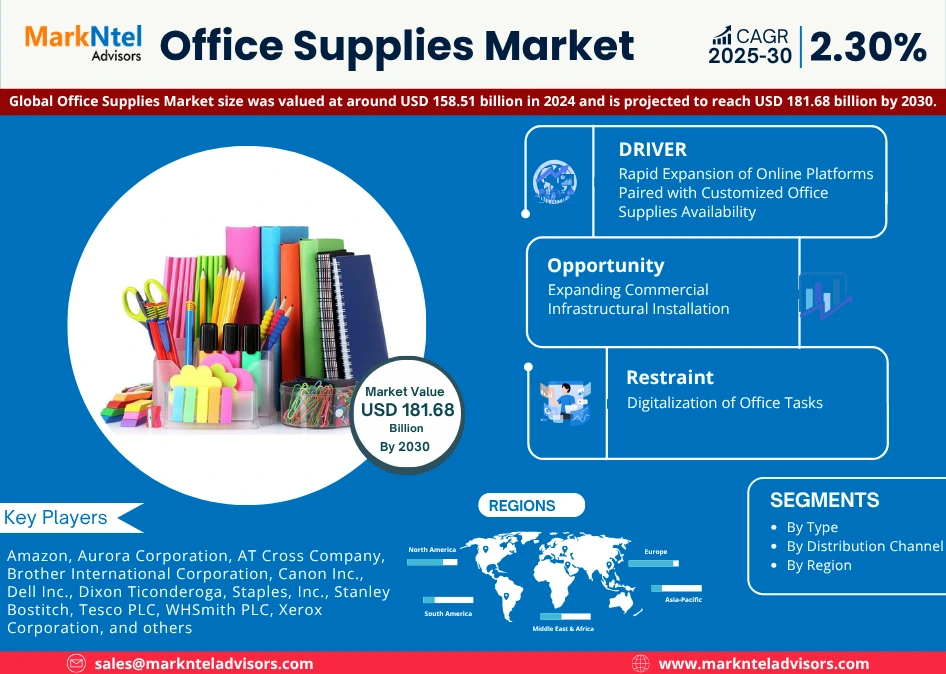
The Germany office supplies market size was estimated at USD 4.00 billion in 2024 and is projected to reach USD 4.53 billion by 2033, growing at a CAGR of 1.4% from 2025 to 2033. The demand for office supplies in Germany is driven by the steady growth of the service sector, a strong base of SMEs, and consistent procurement from government offices and educational institutions. Germany's office supplies market maintains stable growth due to the country’s structured work culture, high levels of administrative and operational organization, and the continued relevance of physical documentation and stationery in corporate and institutional workflows. Despite digitalization, many German workplaces retain hybrid systems that require traditional supplies, particularly in compliance-heavy sectors. In addition, the rise in home offices and hybrid work setups has sustained individual-level purchases, reinforcing baseline demand even as office footprints evolve.
According to the Federal Ministry of Education and Research, nearly 3.4 million companies in Germany are classified as small and medium-sized enterprises (SMEs) based on the European Commission's definition, accounting for over 99% of all businesses in the country’s business sector. These SMEs, particularly in manufacturing hubs such as Bavaria and North Rhine-Westphalia, heavily rely on traditional office supplies such as paper, pens, and filing systems for daily administrative tasks, contracts, and record keeping. Many still prioritize physical documentation due to strict regulatory and compliance standards in industries like automotive and engineering.
The public sector also plays a significant role in driving demand. Federal and local government offices and Germany’s extensive education system-from primary schools (Grundschule) to universities in cities such as Berlin and Munich-consistently procure traditional supplies such as notebooks, folders, and writing tools. These purchases are often secured through long-term contracts, ensuring stable stock levels across departments and reflecting the country’s strong focus on efficient public administration.
Culturally, German workplaces emphasize order, precision, and thorough planning, which sustains steady demand for organizing tools such as binders, filing cabinets, and planners. This is particularly evident in business centers such as Frankfurt and Hamburg, where offices continue to depend on physical materials for meetings, project tracking, and compliance documentation. Despite the rise of hybrid work, many employees maintain well-equipped home offices stocked with traditional supplies, upholding the high organizational standards typical of German work culture.
For More Details or Sample Copy please visit link @: Germany Office Supplies Market Report
Consumer Demographic Insights
The demographic breakdown of traditional office supply users in Germany shows a nearly equal distribution between genders, with men accounting for 50% and women making up 48% of users. This balance reflects the equal participation of both genders in office-based professions, education, and administrative roles where traditional supplies such as pens, paper, and folders are still regularly used.
In terms of age, the largest user groups fall within the 25-34 and 35-44 age brackets, which include early to mid-career professionals who rely heavily on office supplies in daily work. The 18-24 group also has notable usage, likely driven by university students and young professionals. Usage gradually declines in the 45-55 and 55+ age groups, though these segments still contribute meaningfully, particularly in roles involving documentation, compliance, and education. Overall, demand is strong across all working-age populations.
Consumers in the Germany office supplies market face several pain points that affect their purchasing experience and satisfaction. Common issues include poor transparency in pricing and product sourcing, which makes it difficult for buyers to make informed decisions. Many also report inconsistent product quality, particularly with bulk or low-cost items. Stock availability can be unreliable, causing disruptions for businesses and schools that depend on a steady supply.
In addition, limited options for product customization pose challenges for organizations seeking branded or tailored solutions. Moreover, slow or inc.
Research Methodology
We employ a comprehensive and iterative research methodology focused on minimizing deviance in order to provide the most accurate estimates and forecasts possible. We utilize a combination of bottom-up and top-down approaches for segmenting and estimating quantitative aspects of the market. Data is continuously filtered to ensure that only validated and authenticated sources are considered. In addition, data is also mined from a host of reports in our repository, as well as a number of reputed paid databases. Our market estimates and forecasts are derived through simulation models. A unique model is created and customized for each study. Gathered information for market dynamics, technology landscape, application development, and pricing trends are fed into the model and analyzed simultaneously.
About Grand View Research
Grand View Research provides syndicated as well as customized research reports and consulting services on 46 industries across 25 major countries worldwide. This U.S. based market research and consulting company is registered in California and headquartered in San Francisco. Comprising over 425 analysts and consultants, the company adds 1200+ market research reports to its extensive database each year. Supported by an interactive market intelligence platform, the team at Grand View Research guides Fortune 500 companies and prominent academic institutes in comprehending the global and regional business environment and carefully identifying future opportunities.
#GermanyOfficeSuppliesMarket #OfficeSupplies #StationeryMarket #WorkplaceProducts #OfficeEquipment#SustainableOfficeProducts #HybridWorkTrend