QKS Group’s latest End-User Experience Management (EUEM) platforms market research provides an extensive and insightful exploration of the evolving global landscape. As digital transformation accelerates and hybrid work environments become standard, the importance of continuously measuring, monitoring, and optimizing end-user experience has grown exponentially. EUEM platforms play a critical role in helping enterprises gain real-time visibility into user interactions with devices, networks, and applications, enabling organizations to identify root-cause performance issues, improve service delivery, enhance digital employee experience (DEX), and drive business productivity. The research also highlights strategic insights that allow technology vendors to position themselves for growth, differentiate technologically, and align solutions with emerging enterprise priorities.
Market Dynamics and Overview
The global EUEM market is witnessing strong momentum fueled by hybrid workforces, increased reliance on SaaS applications, cloud migration, and digital workplace modernization. Enterprises are prioritizing digital experience as a strategic KPI that impacts operational efficiency, employee productivity, and user satisfaction. The shift from reactive IT support to proactive and predictive Digital Experience Monitoring (DEM) models is redefining the market’s direction.
Key trends driving the market include the integration of AI-based anomaly detection, real-user monitoring, automated root cause analysis, performance analytics, and self-healing capabilities. The adoption of unified endpoint management (UEM), Zero Trust frameworks, and expanded observability across distributed ecosystems is also propelling innovation. Additionally, the rising need for compliance, security intelligence, and contextual analytics across complex multi-cloud environments contributes to increasing EUEM platform adoption.
Competition Landscape and Analysis
The EUEM market demonstrates strong competition with established IT monitoring, endpoint management, and DEX vendors expanding their solution capabilities. Providers are differentiating through AI-driven insights, automation, integrations with ITSM and ITOM ecosystems, and real-time telemetry data acquisition. Vendors such as Absolute Software, ControlUp, eG Innovations, HCLTech, Ivanti, 1E, Lakeside Software, ManageEngine, Microsoft, Nexthink, Omnissa, Raygun, Riverbed, Sematext, and Tanium are innovating aggressively to strengthen customer value propositions.
The market showcases a blend of traditional monitoring vendors evolving into DEX-focused platforms and new-age AI-driven companies reshaping the experience management paradigm. Strategic partnerships, M&A activities, cloud-native offerings, and expansion in HR-tech and employee experience domains are expected to influence the future competition landscape.
Key Competitive Factors and Technology Differentiators
To remain competitive, EUEM providers are focusing on capabilities that deliver measurable, proactive, and automated experience outcomes. Key differentiating factors include:
AI-enabled predictive analytics & intelligent automation
End-to-end visibility across endpoints, applications, and networks
Real-user experience monitoring with contextual event correlation
Self-healing bots and autonomous remediation
Seamless integration with ITSM, SIEM, UEM, VDI, and observability tools
Scalability, cloud-native deployment, and data governance features
Security-embedded experience and endpoint resilience layers
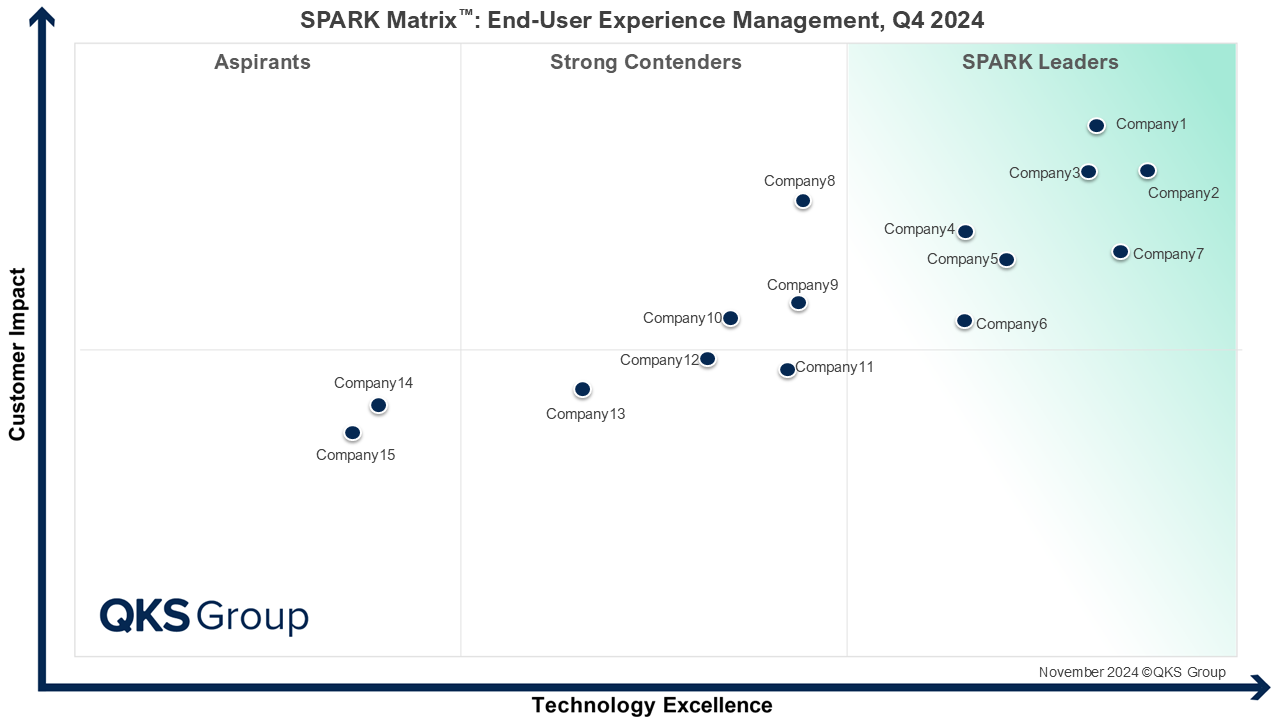
SPARK Matrix™: End-User Experience Management (EUEM) Platforms
QKS Group’s proprietary SPARK Matrix framework offers a detailed assessment and competitive ranking of leading EUEM platform vendors based on technology excellence and customer impact. This matrix visually positions vendors, providing both current-state insight and future strategic direction. It serves as a decision-making guide for enterprises evaluating digital workplace transformation investments and for vendors benchmarking market positioning.
Vendor Profiles
The research includes detailed vendor studies that showcase product capabilities, technology innovations, competitive strengths, and future roadmap analysis. Each vendor profile contains platform architecture insights, differentiating features, target enterprise segments, and strategic business investments that influence long-term market leadership.
Research Methodologies
QKS Group applies a rigorous research methodology combining primary interviews, proprietary data modeling, analyst evaluations, and market intelligence gathered from vendors, enterprises, and industry experts. This methodology ensures unbiased market insights, accurate competitive assessment, and data-driven forecasts.