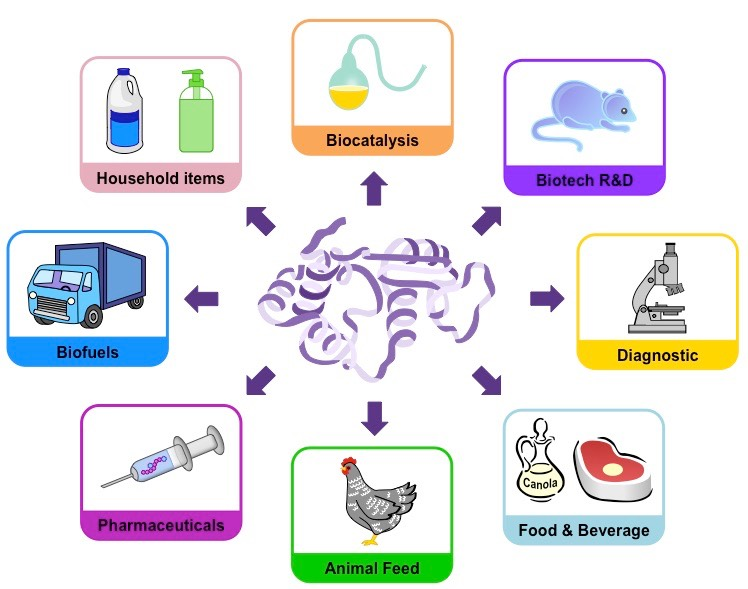



The global industrial enzymes market is poised for strong expansion over the next five years. Valued at USD 8.42 billion in 2025, the market is projected to reach USD 12.01 billion by 2030, growing at a CAGR of 7.3%. This steady rise reflects a broader industry shift toward sustainable, efficient, and cost-effective processing solutions across multiple manufacturing sectors.
As industries face stricter environmental regulations and increasing pressure to minimize resource consumption, enzymes are emerging as a powerful alternative to traditional chemical processes. Their ability to operate under mild conditions—using less energy and water—positions them as vital enablers of greener, cleaner production systems.
Why Industrial Enzymes Are Gaining Momentum
Industrial enzymes are becoming indispensable across sectors such as food & beverage, textiles, bioethanol, detergents, and wastewater treatment. Their adoption is being fueled by several convergence forces:
- Demand for sustainable processing: Enzymes offer biodegradable, eco-friendly solutions to reduce environmental impact.
- Efficiency improvements: Enzyme-driven processes enhance product quality and output while lowering operational costs.
- Technological advancements: Breakthroughs in enzyme engineering, fermentation techniques, and immobilization technologies are enabling better performance even under harsh industrial conditions.
- Supportive policy environment: Government-led bioeconomy initiatives in Europe, India, and Southeast Asia are accelerating the transition toward circular, bio-based value chains.
With industries prioritizing cleaner production, industrial enzymes are expected to play a pivotal role in future manufacturing ecosystems.
Download PDF Brochure: https://www.marketsandmarkets.com/pdfdownloadNew.asp?id=237327836
Market Insights by Segment
Microorganisms Lead the Source Segment
Enzymes derived from microorganisms—especially Bacillus and Aspergillus species—hold the largest share in the industrial enzymes market. Their dominance is attributed to:
- High efficiency across varying temperatures and pH ranges
- Scalability and cost-effective mass production via fermentation
- Ability to be genetically modified for enhanced stability, activity, and specificity
- Consistent quality with minimal supply chain disruptions
- Strong alignment with sustainability and regulatory compliance requirements
Microbial enzymes have become the preferred choice for industries seeking reliable, high-performance biotechnological solutions.
Wastewater Treatment: The Fastest-Growing Application
The wastewater treatment segment is emerging as the fastest-growing industrial enzyme application globally. Rising environmental concerns, stricter discharge norms, and a surge in municipal/industrial wastewater volumes are driving this trend.
Enzymes provide several advantages over chemical-based treatment methods:
- Biodegradable and eco-friendly
- Effective breakdown of fats, oils, organic pollutants, and complex contaminants
- Reduced sludge generation and lower operational costs
- Targeted action ensures compliance with stringent standards
Breakthrough Innovation: Sunlight-Driven Wastewater Treatment
In May 2025, researchers at NIT Rourkela introduced a groundbreaking treatment system using sunlight and reusable spherical concrete beads as photocatalysts. Key highlights:
- Achieved 82%+ COD reduction in simulated wastewater
- Maintained 90%+ efficiency after 15 reuse cycles
- Eliminated need for energy-intensive UV light
- Highly scalable for rural and resource-limited regions
This patented technology underscores the growing potential of enzyme-enabled and eco-friendly wastewater management solutions.
Request Sample Pages: https://www.marketsandmarkets.com/requestsampleNew.asp?id=237327836
Regional Analysis: Asia Pacific Leads the Global Market
The Asia Pacific region is projected to remain the dominant force in the industrial enzymes market through 2030. Factors driving this leadership include:
- Rapid industrialization and growth of enzyme-heavy sectors like food & beverage, textiles, and biofuels
- Rising urbanization and demand for sustainable wastewater solutions
- Strong government support for biotech and bioeconomy expansion
A notable initiative is India’s BioE3 Policy (launched in August 2024), which promotes bio-based manufacturing and innovation, boosting local enzyme development and commercialization.
Additionally, competitive labor markets, affordable raw material availability, and favorable investment climates have encouraged global players to expand production and R&D capabilities across Asia Pacific.
Industry Development Highlight
- In March 2024, Novus International, Inc. acquired BioResource International, Inc. (BRI), strengthening its enzymatic feed additive portfolio and expanding innovation capacity. This acquisition reinforces the rising strategic focus on enzyme technologies across high-growth sectors such as animal nutrition.
Make an Inquiry: https://www.marketsandmarkets.com/Enquiry_Before_BuyingNew.asp?id=237327836
Competitive Landscape:
The market features a strong mix of global biotechnology, chemical, and enzyme-focused companies. Key players include:
- BASF SE (Germany)
- International Flavors & Fragrances Inc. (US)
- DSM-Firmenich (Switzerland)
- Kerry Group plc. (Ireland)
- Dyadic International Inc (US)
- Advanced Enzyme Technologies (India)
- Aumgene Biosciences (India)
- Amano Enzyme Inc (Japan)
- Associated British Foods plc (England)
- Novozymes A/S (Denmark)
- F. Hoffmann-La Roche Ltd (Switzerland)
- Codexis, Inc. (US)
- Sanofi (France)
- Merck KGaA (Germany)
- Adisseo (China)
The industrial enzymes market is projected to grow at a CAGR of 6.6% from 2025 to 2030, supported by continuous R&D, strategic alliances, and rising global demand for sustainable manufacturing solutions.