

In an era defined by rapid change, complex value streams, and heightened competitive pressure, organizations are continually searching for proven methods to understand their operations more clearly and make smarter, faster decisions. Among the most effective yet often underutilized tools is the Brown Paper Exercise, a powerful, collaborative technique that visually maps end-to-end business processes in a simple, intuitive, and highly engaging format.
Widely adopted by operational excellence leaders, Lean practitioners, and strategic consultants, the Brown Paper Exercise creates a holistic view of workflows, handoffs, bottlenecks, redundancies, and opportunities for performance improvement. When applied with discipline and expert facilitation as demonstrated by Group50® Consulting this technique becomes the catalyst for uncovering hidden value, improving cross-functional alignment, and building a strong foundation for sustainable transformation.
This article explores the structure, purpose, and strategic value of the Brown Paper Exercise, and explains why it remains one of the most effective methods for analyzing complex business processes.
What Is a Brown Paper Exercise?
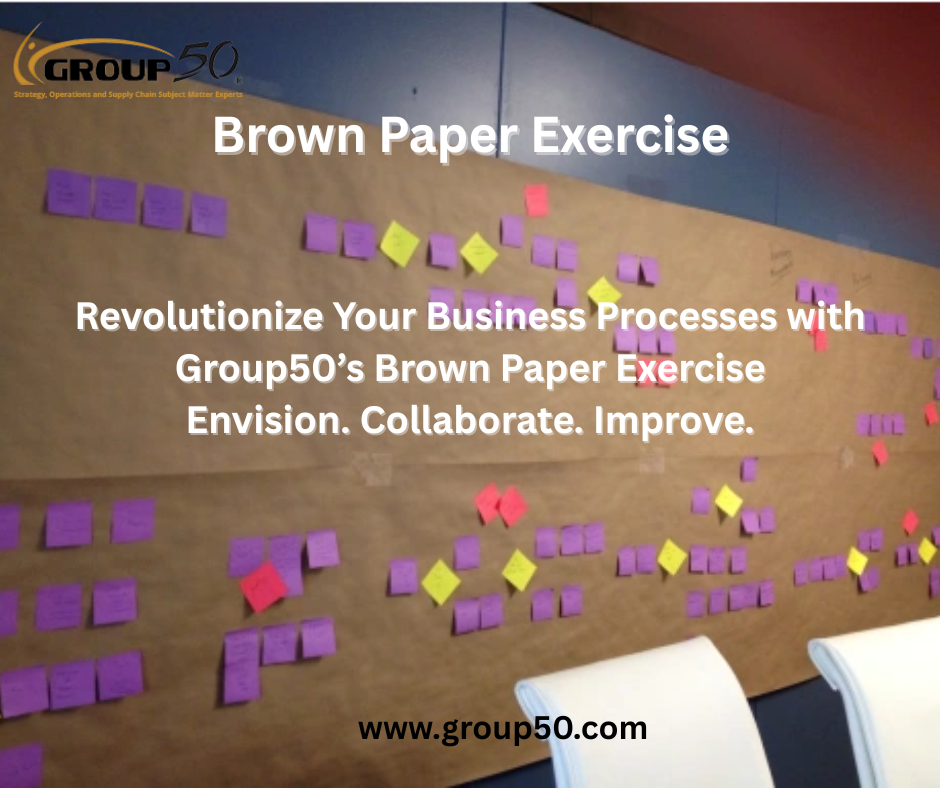
A Brown Paper Exercise is a facilitated workshop where cross-functional teams come together to map an entire process—typically on long sheets of brown craft paper—using visual elements such as sticky notes, timelines, symbols, metrics, and written descriptions. The goal is to document how a process actually works, not how leadership believes it works or how a process "should" work on paper.
Unlike digital workflows or static diagrams, a brown-paper format encourages real-time contributions, dynamic adjustments, and open conversations. It breaks down barriers by making the process visible, tangible, and accessible to everyone involved. The simplicity of the medium is what makes the exercise exceptionally powerful: it allows teams to focus on clarity, accuracy, and problem-solving rather than getting lost in technical tools or digital environments.
The result is a living, collaborative, and detailed visual narrative of a business process from beginning to end.
Why Organizations Use a Brown Paper Exercise
Organizations often turn to a Brown Paper Exercise when they need to:
Understand a process that spans multiple departments or functions
Identify bottlenecks and workflow inefficiencies
Document undocumented or tribal-knowledge-based processes
Improve cross-functional communication
Prepare for digital transformation or system upgrades
Lay the groundwork for Lean, Six Sigma, or continuous improvement initiatives
Build alignment before major transformation programs
The exercise reveals what is actually happening on the ground—the truth of current operations—rather than assumptions. This truth becomes the cornerstone of process improvement, redesign, automation, and transformation programs.
Key Components of a Brown Paper Exercise
1. Cross-Functional Team Participation
The success of the workshop depends on gathering individuals who actually perform, manage, and support the process being analyzed. Their practical knowledge ensures accuracy, and their participation builds ownership for future improvements.
2. End-to-End Visual Mapping
The brown paper serves as a horizontal canvas that shows the entire workflow, including:
Inputs and outputs
Tasks and decision points
Roles and handoffs
Systems and tools used
Pain points and opportunities
Seeing the whole process at once helps eliminate departmental silos.
3. Data and Metrics
The exercise incorporates relevant metrics such as cycle time, error rates, lead times, costs, and resource requirements. These data points help participants distinguish between perceived problems and measurable inefficiencies.
4. Identification of Issues and Opportunities
Participants mark issues—commonly with colored sticky notes—to highlight areas needing attention. These may include:
Bottlenecks
Delays
Redundant steps
Poor communication loops
Over-processing
Misalignment between teams
Compliance or quality risks
This visual clustering exposes systemic root causes rather than isolated issues.
5. Actionable Insights and Next Steps
The workshop concludes with a prioritized list of improvement opportunities, clarifying which actions provide the highest value in terms of efficiency, cost, risk reduction, or customer satisfaction.
The Brown Paper Exercise Process: Step-by-Step
Step 1: Define Scope and Objectives
Before any mapping begins, facilitators establish clear goals and boundaries. This ensures the exercise stays focused and productive.
Step 2: Gather the Right Participants
A mix of operators, supervisors, managers, and support personnel is essential. Their combined perspectives offer a balanced, accurate view of how the process functions day-to-day.
Step 3: Map the Current State
Participants collaboratively build the workflow on the brown paper, detailing every step, handoff, and decision. Facilitators ensure that the mapping reflects actual behavior—not idealized policies or outdated documentation.
Step 4: Validate with Stakeholders
Once the draft is complete, stakeholders review and verify every stage of the map to ensure its accuracy and completeness.
Step 5: Identify Problems and Improvement Opportunities
Pain points are visually tagged and discussed. The team evaluates root causes and practical implications.
Step 6: Prioritize Solutions
Facilitators help the group prioritize opportunities based on difficulty, cost, impact, and strategic value.
Step 7: Establish Next Steps
The workshop ends with a documented plan that includes:
Recommended improvements
Responsible owners
Expected outcomes
Estimated timelines
This ensures momentum and accountability.
Strategic Value of a Brown Paper Exercise
1. Unmatched Process Clarity
Many organizations struggle with siloed operations, undocumented workflows, and inconsistent practices. The Brown Paper Exercise provides clarity by making the entire process visible in one unified place.
2. Breaks Down Organizational Silos
Departments often optimize for their own goals without understanding the effects on others. A brown paper session fosters cross-functional understanding and collaboration.
3. Reveals Hidden Inefficiencies
Inefficiencies that never appear in traditional reports—such as long handoff delays, redundant approvals, and unnecessary manual tasks—become glaringly obvious.
4. Builds Employee Engagement and Ownership
Because employees actively map and analyze the process, they feel heard and valued. This increases buy-in for future changes and reduces resistance during implementation.
5. Foundation for Digital Transformation
Organizations often attempt automation before fully understanding their processes. The exercise ensures transformation begins with a clean, accurate baseline.
6. Accelerates Lean and Continuous Improvement Initiatives
The Brown Paper Exercise aligns perfectly with Lean principles by emphasizing waste elimination, workflow optimization, and value-stream visibility.
7. Reduces Risk and Improves Compliance
Mapping exposes compliance gaps, quality issues, and control failures, enabling preventive action before damage occurs.
8. Strengthens Strategic Decision-Making
Executives gain a holistic understanding of how a process works and where investments should be prioritized.
How Group50® Consulting Elevates the Brown Paper Experience
Group50® Consulting brings a structured, results-oriented methodology to the Brown Paper Exercise, integrating it within broader transformation frameworks such as Value Stream Mapping, the Business Hierarchy of Needs®, and the company’s proven Change Management methodology.
Their facilitation style is grounded in:
Deep operational expertise
Cross-industry experience
Data-driven improvement models
A focus on strategy, execution, and measurable impact
Group50® helps organizations turn insights into executable action plans that drive measurable improvements in cost, workflow efficiency, quality, and customer satisfaction.
Their approach ensures that the Brown Paper Exercise is not just a workshop—it becomes a pivotal moment in the organization’s transformation journey.
Conclusion
The Brown Paper Exercise is one of the most effective tools for gaining operational clarity, building cross-functional alignment, and uncovering high-value improvement opportunities. Its simplicity is its strength, enabling organizations to visualize, analyze, and optimize even the most complex business processes. By revealing the true state of operations, it empowers leaders to make informed decisions, fuels continuous improvement efforts, and establishes a solid foundation for sustainable transformation.
For organizations seeking to enhance performance, streamline workflows, or prepare for digital transformation, the Brown Paper Exercise—especially when facilitated by experts like Group50®—delivers indispensable clarity and direction. It is not just a tool but a catalyst for operational excellence and strategic success.