





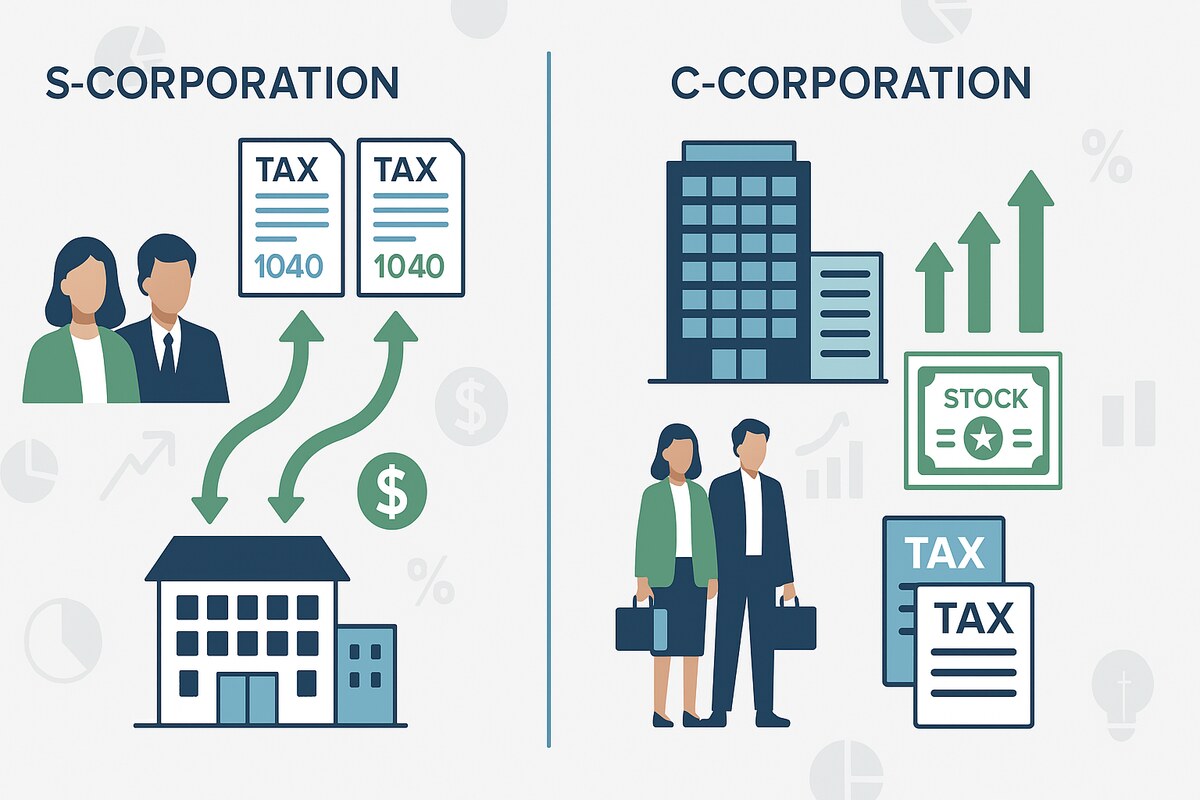
Choosing the right corporation type can shape your tax bill, cash flow, and long-term plans. Both S-Corps and C-Corps offer liability protection, but the way each structure is taxed is fundamentally different.
This decision typically comes up when forming a new business or considering a conversion from another entity type. Here's a clear breakdown to help business owners make the right call.
What Is an S-Corp?
An S-Corp is a corporation that elects "pass-through" taxation by filing Form 2553 with the IRS. Instead of paying federal income tax at the corporate level:
- Profits and losses pass through to the owners
- Owners report the income on their personal tax returns
- There is no corporate-level federal tax
This setup helps many small business owners reduce their overall tax burden. S-Corp owners may also qualify for the Qualified Business Income (QBI) deduction, which can reduce taxable income by up to 20%.
Who commonly uses it? Small and mid-size businesses with a limited number of U.S. shareholders who want tax efficiency without complexity.
What Is a C-Corp?
A C-Corp is the default corporate structure. It operates as a separate tax entity.
- The corporation pays federal income tax on its profits
- When owners receive dividends, they pay tax again on their personal returns
- This creates "double taxation"
The current federal corporate tax rate is a flat 21%.
Who commonly uses it? Businesses planning to raise capital, issue multiple classes of stock, or scale rapidly. This is the preferred structure for most venture-backed startups and publicly traded companies.
Who Can Own an S-Corp vs a C-Corp?
S-Corp ownership rules
- Up to 100 shareholders maximum
- Shareholders must be U.S. citizens or residents
- Only one class of stock allowed
- No foreign investors, LLCs, or corporations as owners
C-Corp ownership rules
- Unlimited shareholders
- No residency restrictions
- Multiple stock classes allowed (common, preferred, voting, non-voting)
- Ideal for investors, venture capital funds, and international ownership
Bottom line: If you want outside investors or plan to go public, a C-Corp is typically necessary. If you want simple ownership among a small group, an S-Corp is usually sufficient.
How Are S-Corps Taxed?
Pass-through income
All business income flows directly to the owners' personal tax returns at their individual tax rates.
Owner salary requirement
Owner-employees must take a reasonable salary, which is subject to payroll taxes (Social Security and Medicare). The IRS closely scrutinizes this, as some owners attempt to minimize salary to avoid payroll taxes. "Reasonable" typically means industry-standard compensation for similar roles and responsibilities.
Distributions
After paying a reasonable salary, owners can take distributions. These are not subject to self-employment tax, which often leads to significant savings.
No corporate-level federal tax
This is the major advantage. You avoid the first layer of taxation entirely.
Real-world example
An S-Corp generates $150,000 in profit. The owner takes a $70,000 salary (subject to payroll taxes) and a $80,000 distribution (not subject to self-employment tax). This typically saves $10,000-$12,000 compared to taking all income as salary or operating as a sole proprietor.
How Are C-Corps Taxed?
Corporate tax
The corporation pays federal tax at a flat 21% rate on its profits.
Dividend tax
When profits are distributed to shareholders, they pay tax again at their personal dividend rate (typically 15-20% for qualified dividends).
The double taxation impact
Here's what double taxation looks like in practice: A C-Corp earns $100,000 in profit and distributes it all as dividends. The corporation pays $21,000 in federal tax. The remaining $79,000 is distributed to owners who pay approximately $15,800 more in dividend taxes (at 20%). Total tax: $36,800, or 36.8% effective rate.
Compare this to an S-Corp: The same $100,000 passes through to owners who pay their personal rate—typically 24-32% for most small business owners, with no second layer of tax.
Retaining profits
A C-Corp can hold profits inside the business without passing them through to owners. This is useful for reinvestment, growth initiatives, and avoiding immediate personal tax liability.
Fringe benefits
C-Corps can offer certain benefits (like health insurance, life insurance, and education assistance) that are fully deductible to the corporation and tax-free to employees, including owner-employees.
Why Does Double Taxation Matter?
In a C-Corp:
- The corporation pays tax on profits (21% federal)
- Owners pay tax when dividends are issued (up to 20% more)
This can significantly increase the total tax paid if the company distributes earnings regularly. However, if the company reinvests most profits rather than distributing them, the immediate impact is lower. Many high-growth companies operate for years without paying dividends, deferring the second layer of tax.
Where Do S-Corps Save Taxes?
S-Corps can reduce the overall tax burden by:
- Avoiding corporate-level federal tax entirely
- Paying owner-employees a salary plus distributions
- Reducing self-employment taxes on distributions
- Passing losses to owners (particularly valuable during startup years)
- Potentially qualifying for the QBI deduction
For many small and mid-size businesses, these savings amount to $10,000-$50,000+ annually, depending on profit levels.
When Does a C-Corp Make More Sense?
A C-Corp is a strong fit when:
- Plan to raise fund from venture capital or angel investors
- Expect rapid growth and need flexible capital structures
- Want multiple stock classes (common, preferred, voting rights)
- Plan to reinvest most profits rather than distribute them
- Attract top talent with stock options and equity compensation
- Planning an eventual IPO or acquisition
- Have or expect international investors
It's the preferred structure for most tech startups, biotech companies, and businesses with institutional funding.
Which Structure Is Better for Tax Planning?
Choose an S-Corp if you want:
- Lower overall tax liability
- Simple ownership structure
- Pass-through reporting
- A strategic mix of salary and distributions
- Maximum tax efficiency for distributed profits
Choose a C-Corp if you want:
- Significant growth potential and scalability
- Flexible stock structures for investors
- Easy access to venture capital and institutional funding
- The ability to retain and reinvest profits
- No ownership restrictions
There is no universal "right" choice. The best structure depends entirely on your specific business goals, growth trajectory, and funding strategy.
What Questions Should You Ask Before Choosing?
- How many owners will we have now and in the future?
- Do we need outside investors or venture capital?
- Do we prefer pass-through income or retained earnings?
- Will owners work in the business full-time?
- Do we need more than one class of stock?
- Will we pay dividends regularly or reinvest cash?
- How important is tax simplicity versus growth flexibility?
- Are any owners non-U.S. residents?
- What are the state tax implications in our location?
These questions will guide you toward the clearer answer for your situation.
Important Considerations
State taxes matter
While S-Corps avoid federal corporate tax, many states don't recognize S-Corp status or impose additional entity-level taxes. Some states (like California) charge S-Corps annual fees or franchise taxes. Always check your state's specific rules.
Conversion complexity
Switching from one structure to another later can trigger significant tax consequences. Converting from C-Corp to S-Corp may involve built-in gains taxes. Converting from S-Corp to C-Corp is generally easier but still requires careful planning.
The IRS watches salary levels
If you're an S-Corp owner paying yourself a minimal salary and taking large distributions, the IRS may reclassify distributions as wages, resulting in penalties and back taxes. Professional guidance on reasonable compensation is essential.
Why Does Choosing the Right Structure Matter?
Your decision affects:
- Your yearly tax bill
- How you pay yourself as an owner
- Payroll and compliance costs
- Cash flow and reinvestment capacity
- Your ability to bring in investors
- Long-term exit and succession options
- IRS audit risk and compliance complexity
A smart choice saves money and prevents costly IRS issues down the road. The wrong structure can cost tens of thousands in unnecessary taxes or prevent you from accessing capital when you need it most.
Final Takeaway
An S-Corp helps small and mid-size business owners minimize taxes and maintain a straightforward ownership structure. A C-Corp works better when you expect significant growth, need investor capital, or require complex equity arrangements.
If you're unsure which path is right for your business, the safest next step is a consultation with a CPA or tax advisor who specializes in business structures. A short conversation with an experienced professional can save you thousands of dollars each year and position your business for long-term success.
Frequently Asked Questions (FAQs)
Can I switch from an S-Corp to a C-Corp later?
Yes, but timing matters. You can voluntarily revoke S-Corp status, but you generally cannot re-elect S-Corp status for five years. The conversion itself is usually straightforward from a tax perspective, though you should consult with a tax professional about the implications for your specific situation.
Can a single-member LLC elect S-Corp status?
Yes. An LLC can elect to be taxed as an S-Corp by filing Form 2553 with the IRS. This is common for solo entrepreneurs and small business owners who want pass-through taxation with the ability to split income between salary and distributions.
Do S-Corps pay self-employment tax?
S-Corp owners pay payroll taxes (Social Security and Medicare) on their salary, but distributions are not subject to self-employment tax. This is one of the primary tax advantages of the S-Corp structure compared to sole proprietorships or partnerships.
What happens if an S-Corp doesn't pay the owner's salary?
The IRS can reclassify distributions as wages, assess back payroll taxes, charge penalties and interest, and potentially revoke S-Corp status in extreme cases. Owner-employees must take reasonable compensation for services performed.
Are there industries that can't be S-Corps?
Yes. Certain financial institutions, insurance companies, and domestic international sales corporations (DISCs) cannot elect S-Corp status. Most other business types are eligible as long as they meet the ownership requirements.
How much does it cost to maintain an S-Corp vs C-Corp?
Costs are similar for both structures. Expect annual expenses for registered agent fees ($100-$300), state filing fees ($50-$800+), payroll processing, accounting, and tax preparation. S-Corps may have slightly lower accounting costs due to simpler tax reporting, but the difference is usually minimal.
Can a C-Corp avoid double taxation?
Partially. By paying owner-employees salaries (which are deductible business expenses), reinvesting profits instead of distributing dividends, or offering fringe benefits, a C-Corp can reduce the impact of double taxation. However, the structure inherently involves two levels of tax on distributed earnings.
What is the qualified business income (QBI) deduction for S-Corps?
S-Corp owners may deduct up to 20% of their qualified business income, subject to limitations based on income level, business type, and W-2 wages paid. This deduction, introduced in 2017, can significantly reduce taxable income for eligible S-Corp owners.
Can I have foreign investors in my business?
Not with an S-Corp. S-Corps cannot have non-resident alien shareholders. If you need foreign investors, you must operate as a C-Corp or choose a different entity structure like an LLC taxed as a partnership.
When is the deadline to elect S-Corp status?
To elect S-Corp status for the current tax year, you must file Form 2553 by March 15 (or within 2 months and 15 days of the start of your tax year). Late elections may be accepted in certain circumstances, but timely filing is always recommended.

Quickbooks health insurance offers health insurance benefits to employees.
Though many users face issues like not able to set up the insurance benefit item of payroll for the insurance which can be set up easily with the help of custom set up in case you are facing the error get connected with our support team.

Thetissue and hygiene have been a part of personal care products.
Tissue paper otherwise basically tissue is a light crêpe paper or lightweight paper.
Owing to their properties that is basis weight, great absorbency, bulk (specific volume), thickness, brightness, appearance, stretch as well as comfort.
However other hygiene products include sanitary hygiene products for women, nappies/diapers/pants for babies and adult incontinence.Request For Report Sample: https://www.researchreportinsights.com/report/sample/110114842/Tissue-and-Hygiene-Market Customers nowadays are developing progressively conscious concerning the impacts and effects of their buying choices on the environment and society.
Currently, customers pick out products later on acquiring information regarding the background of its manufacturing, for example, ingredients and raw materials used.
As a result of rising consumer awareness, makers have been pushed to offer products that come across with the customers.Global Tissue and Hygiene Market is Estimated to Record CAGR of 3.8% Through 2025The global market for tissue and hygiene is anticipated to record high growth in the approaching years.