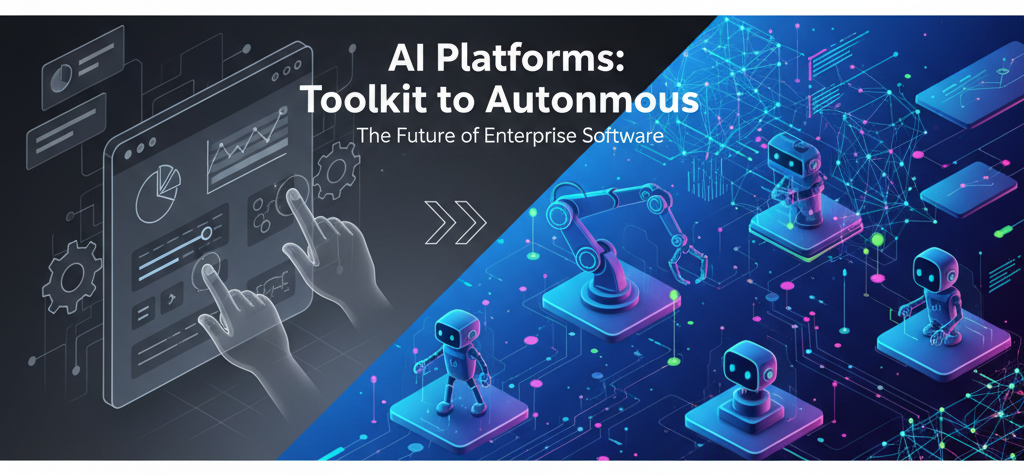
For the past two decades, the "platform" has been the dominant model in enterprise software. We've embraced SaaS platforms for CRM, ERP, marketing, and more. But these platforms, for all their power, have been fundamentally passive. They are sophisticated toolkits—digital workshops filled with powerful tools, dashboards, and workflows. They wait for a human operator to pick up a tool and use it. A human must still decide what to do, how to do it, and when to do it.
This entire "platform as a toolkit" paradigm is being rendered obsolete by AI in engineering. We are in the midst of a rapid and profound evolution. First, platforms evolved into "assistants" by embedding AI copilots. Now, they are making the final leap: from assistant to autonomous system. The future of enterprise software is not a platform you use, but an AI-driven platform that understands your goals and executes the entire process on your behalf. This is a fundamental shift in business strategy and the ultimate expression of AI-native engineering.
Stage 1: The Platform as a "Toolkit" (The Passive Era)
This is the SaaS model we are all familiar with.
What it is: A collection of pre-built, integrated applications and workflows. Think of a traditional CRM. It has tools for logging calls, managing contacts, and tracking deals.
The Problem: The platform has no agency. It is a "dumb" database that relies 100% on manual, human-driven data entry and operation. Its value is entirely dependent on the diligence of its human users.
Human's Role: The Operator. The human does all the work, using the platform as a record-keeping system.
Stage 2: The Platform as an "Assistant" (The Current Era)
This is the shift we are living through right now, driven by the integration of AI copilots and intelligent apps.
What it is: The same platform, but now with an AI layer. The CRM copilot can summarize a long email thread, suggest a reply, or draft a sales report based on a human prompt.
The Improvement: The AI assists with and accelerates discrete tasks. It's a powerful partner that takes direction from the user. It moves from a "passive tool" to a "collaborative assistant."
Human's Role: The Prompter or Director. The human is still in the loop, telling the assistant what to do, task by task.
Stage 3: The Platform as an "Autonomous System" (The Next Frontier)
This is the final, transformative leap. The platform evolves from an assistant that takes commands to an autonomous agent that accepts goals.
What it is: An AI-driven platform that understands your high-level business objectives. Instead of telling the CRM, "Draft an email to Client X," you give it a goal: "Increase renewal rates for my at-risk accounts this quarter."
The Leap in Capability: The autonomous platform receives this goal and independently orchestrates the entire process. It will:
Proactively monitor all customer data (support tickets, usage logs, communication).
Use a predictive model to identify the top 10 "at-risk" accounts.
Analyze the reason for the risk (e.g., "low usage," "unresolved high-priority tickets").
Autonomously draft personalized outreach emails for each account, tailored to their specific problem.
Flag the most critical accounts for immediate human follow-up, complete with a summarized briefing.
Human's Role: The Executive or Supervisor. The human sets the strategic goals and manages the system by exception, trusting the autonomous platform to handle the complex, multi-step execution. This is the new business strategy for innovation.
The Evolution of the Enterprise Platform
This journey shifts the cognitive load entirely from the human to the machine, allowing humans to focus on strategy, not tasks.
Why "Autonomous Systems" is the New Business Strategy
Companies that successfully build or adopt AI-driven platforms will have an insurmountable competitive advantage.
Shift from Selling Tools to Selling Outcomes: Why would you buy a "CRM tool" that requires 1,000 hours of manual data entry when you can buy an "Autonomous Customer Platform" that guarantees a 10% reduction in churn? This is the new business strategy.
Scalable Expertise: An autonomous system scales the expertise of your best employees. It learns the processes of your top salesperson or your most efficient support agent and executes those best-practice workflows 24/7, at scale.
The Ultimate Compounding Moat: These systems are built on an AI-native engineering foundation. They are designed to learn from every interaction and data point, becoming smarter, more efficient, and more valuable every single day.
How Hexaview is Engineering Your Autonomous Future
This future of autonomous systems is not plug-and-play. It requires a massive engineering effort to build the data pipelines, the orchestration layers, the APIs, and the AI models that allow a platform to think and act.
At Hexaview, this is the core of our product engineering services. We are not just building simple "apps"; we are engineering the deep, intelligent foundations for these next-generation AI-driven platforms.
Our AI in engineering and Intelligent Systems Engineering teams specialize in building the complex orchestration logic that allows AI to move from "assisting" to "acting."
We architect and build the robust, cloud-native architecture and data pipelines required to fuel these autonomous systems with high-quality, real-time data.
We create the intelligent apps and integration layers that give AI the ability to securely interact with your other enterprise systems, turning goals into actions.
We are the strategic partner you need to navigate the shift from building passive tools to engineering the autonomous, AI-native engineering systems that will drive your business.