


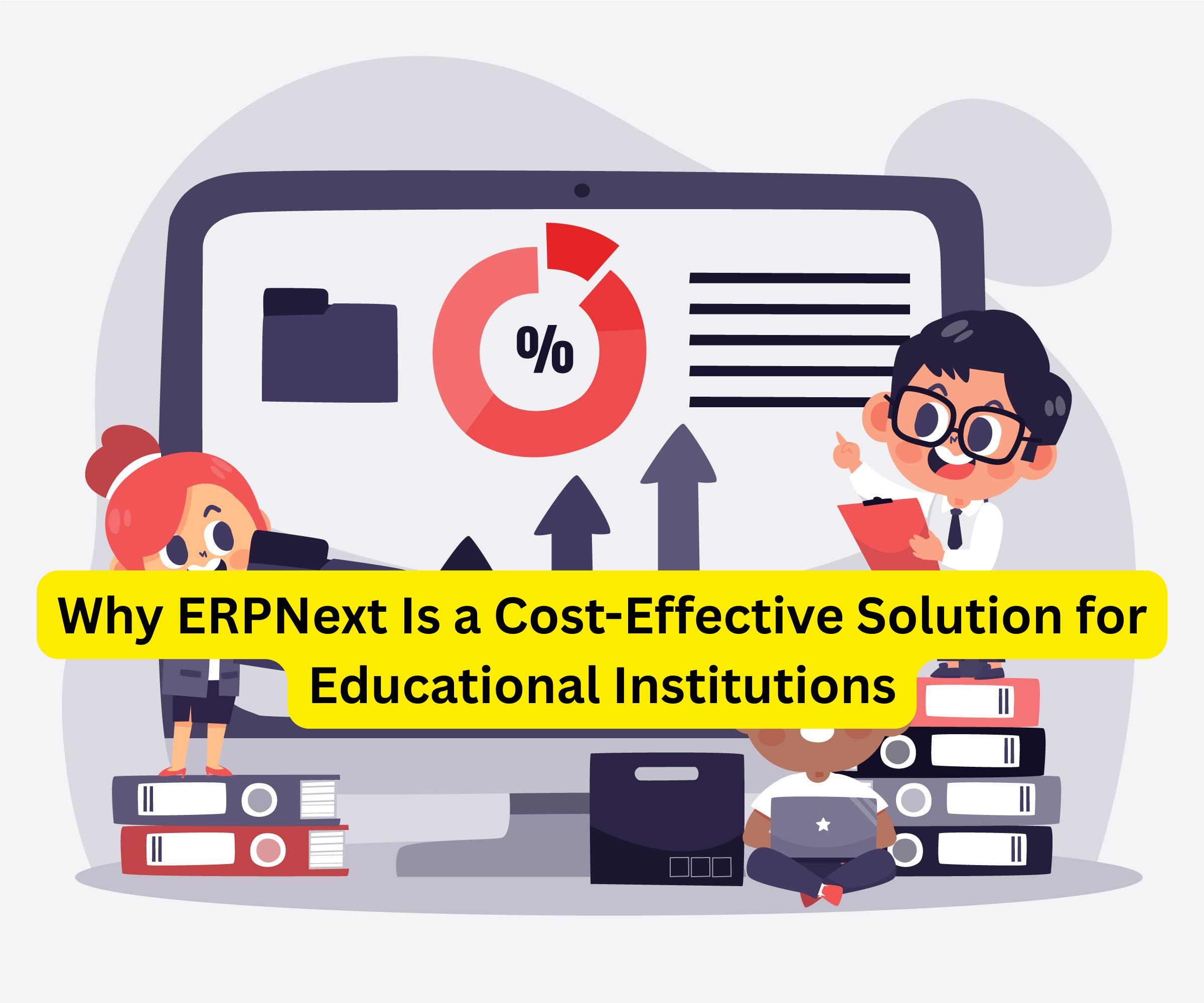
Educational institutions today operate in an increasingly complex environment. Schools and colleges must manage admissions, academics, finances, human resources, libraries, and communication, often with limited budgets and growing expectations from students, parents, and regulatory bodies. Many institutions still rely on manual processes or disconnected software systems, which leads to inefficiencies, errors, and higher operational costs.
This is where an integrated Enterprise Resource Planning (ERP) system becomes essential. A well-designed ERP can unify operations, improve visibility, and support data-driven decision-making across departments. ERPNext stands out as a cost-effective and flexible ERP solution tailored to the needs of modern educational institutions. It helps schools and colleges streamline operations, reduce administrative overhead, and improve overall efficiency without the high costs typically associated with traditional ERP systems.
Challenges Faced by Educational Institutions
Schools and colleges face a unique set of operational challenges that can directly impact the quality of education and institutional growth. One of the most common issues is the continued reliance on manual processes and paperwork. Admission forms, attendance records, fee receipts, and academic reports are often handled manually, increasing the risk of errors and delays.
Inefficient communication and collaboration between departments is another major challenge. Academic teams, administrative staff, finance departments, and management often work in silos, making it difficult to share information in real time. This lack of coordination can slow decision-making and create confusion.
Tracking student data and performance is also a significant concern. Without a centralized system, maintaining accurate records of attendance, grades, fee payments, and academic progress becomes cumbersome. Additionally, most institutions operate under strict budget constraints, limiting their ability to invest in expensive enterprise systems.
These challenges can lead to poor resource utilization, dissatisfied stakeholders, and reduced institutional efficiency—making the need for reliable business software more critical than ever.
Benefits of ERPNext for Educational Institutions
ERPNext offers a comprehensive set of tools designed to address the operational challenges faced by schools and colleges. One of its key benefits is streamlined student management and admissions. From inquiry handling to enrollment, ERPNext centralizes the entire admission process, ensuring accurate data capture and faster processing.
Automated fee management and accounting is another major advantage. ERPNext simplifies fee structure configuration, invoicing, payment tracking, and financial reporting. This reduces manual work, minimizes errors, and improves financial transparency an essential requirement for educational institutions.
Enhanced communication and collaboration are made possible through centralized dashboards and role-based access. Faculty, administrators, and management can access relevant information in real time, improving coordination across departments.
ERPNext also offers powerful data analysis and reporting capabilities. Institutions can generate academic reports, attendance summaries, financial statements, and performance analytics with ease. These insights support better planning and informed decision-making.
Scalability and flexibility further set ERPNext apart. Whether it’s a small school or a large multi-campus college, the system adapts to institutional growth without requiring major reinvestments. As a modern business solution, ERPNext enables institutions to overcome operational challenges while maintaining control over costs.
Cost-Effectiveness of ERPNext
One of the strongest reasons schools and colleges choose ERPNext is its cost-effectiveness. Compared to many proprietary ERP systems, ERPNext has significantly lower implementation and maintenance costs. Its open-source foundation eliminates expensive licensing fees, making it accessible even for institutions with limited budgets.
By automating routine administrative tasks, ERPNext reduces the need for extensive manual labor and paperwork. This leads to long-term savings in staffing, printing, storage, and operational overheads. Finance teams, administrators, and academic staff can focus more on value-driven activities rather than repetitive tasks.
ERPNext also improves resource utilization and allocation. Institutions gain clear visibility into expenses, assets, and human resources, allowing management to optimize budgets and avoid unnecessary spending.
Another key advantage is its scalable pricing model. Institutions can start with essential modules and expand as their needs grow. This flexibility ensures that schools and colleges only pay for what they use, making ERPNext a sustainable business software investment that delivers measurable returns over time.
Features of ERPNext for Educational Institutions
ERPNext includes a rich set of features specifically suited for the education sector. Student management and admissions modules help manage inquiries, applications, enrollments, and student records from a single platform.
Fee management and accounting features simplify financial operations by automating invoicing, payment tracking, scholarships, and accounting entries. This ensures compliance, accuracy, and transparency.
Academic management and grading modules support course planning, attendance tracking, assessments, and result management. Faculty members can manage academic activities efficiently while maintaining accurate records.
Library management features help track books, issue and return cycles, and inventory, ensuring smooth library operations. Human resource management modules handle staff records, payroll, attendance, and leave management, reducing administrative workload.
Together, these features enable educational institutions to manage their end-to-end operations efficiently using a single, unified business solution.
Implementation and Support
Successful ERP adoption depends heavily on proper implementation and ongoing support. ERPNext implementations are typically handled by experienced professionals who understand both the software and the education domain. A structured implementation approach ensures minimal disruption to daily operations.
Comprehensive training and documentation help staff and faculty adapt quickly to the new system. User-friendly interfaces and role-based access make it easier for different stakeholders to use the platform effectively.
Ongoing maintenance and regular updates ensure that the system remains secure, compliant, and aligned with evolving institutional needs. With the right implementation partner, schools and colleges can achieve a smooth transition and long-term success with ERPNext.
Conclusion
In today’s competitive education landscape, institutions need efficient, scalable, and affordable systems to manage their operations effectively. ERPNext offers a powerful combination of functionality, flexibility, and cost-efficiency, making it an ideal ERP solution for schools and colleges.
For institutions seeking expert guidance, Kyle Solutions, one of the leading business solution providers in Calicut and across Kerala, offers end-to-end ERPNext implementation, customization, training, and support. With deep industry expertise and a commitment to delivering reliable business solutions, Kyle Solutions helps educational institutions unlock the full potential of ERPNext and achieve operational excellence.




Hire erpnext developer from Serpent consulting services for erpnext solution as per your business requirements.
Erpnext experts for web and ecommerce development.We Offers Wide Range of Benefits such as Rapid Deployment, Efficient Business Management.Visit us: https://serpentcs.com/services/erpnext/hire-erpnext-developer