





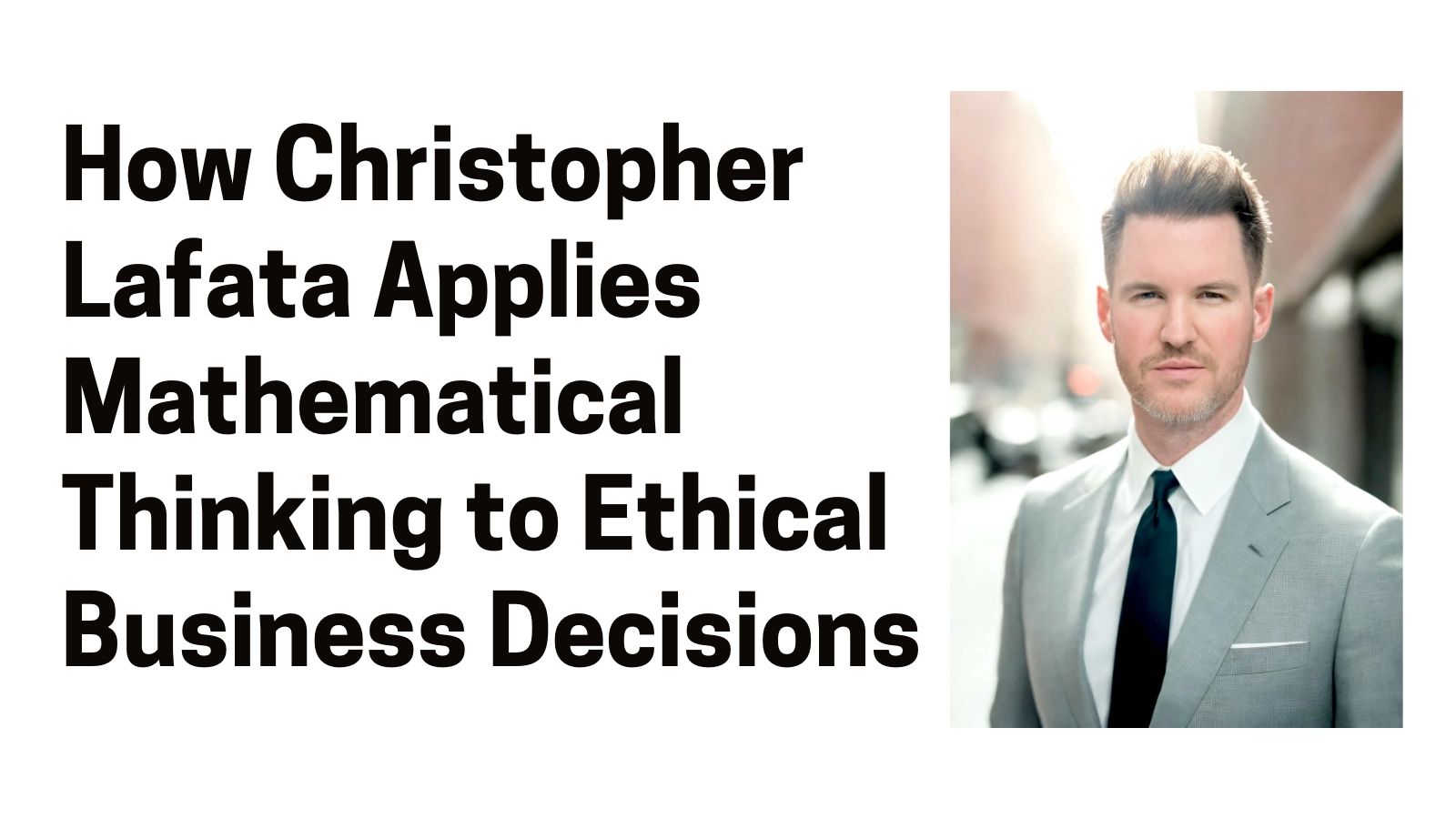
In today’s business environment, trust is often discussed as a feeling built through personal relationships, strong branding, or shared values. Christopher Lafata, a Florida-based business leader and founder of US Solar Connect, takes a different view. He believes trust should be designed into a business system, not left to emotion or intuition. By applying mathematical thinking to decision-making, Lafata shows how ethics can become measurable, repeatable, and dependable.
His approach challenges entrepreneurs to treat ethical behavior as a structured process rather than a vague principle. This mindset helps businesses make clearer choices, reduce risk, and maintain consistency as they grow.
The Role of Mathematical Thinking in Business Ethics
Mathematical thinking is not about complex formulas or abstract theory. In business, it means using logic, clear rules, and measurable outcomes to guide decisions. Christopher Lafata applies this mindset to ethics by asking practical questions:
- Can this decision be tested against defined rules?
- Are the outcomes predictable and transparent?
- Would the same decision apply in similar situations?
By framing ethics this way, Lafata removes ambiguity. Decisions are no longer based on mood, pressure, or short-term gains. Instead, they follow a logical structure that supports fairness and accountability.
Designing Trust Through Structure
One of Lafata’s core beliefs is that trust should be built through systems. In his work, “On the Mathematics of Trust in Business Systems,” he explains that trust grows when processes are consistent and visible.
He focuses on:
- Clear decision-making frameworks that apply equally to all stakeholders
- Documented rules that guide behavior across teams
- Systems that allow outcomes to be reviewed and verified
This structured approach helps businesses avoid ethical gaps that often appear during rapid growth. When rules are clear, employees know what is expected, and leaders are held to the same standards as everyone else.
Transparency as a Measurable Principle
Many companies claim to value transparency, but Christopher Lafata argues that transparency must be measurable to be meaningful. Mathematical thinking allows leaders to define what transparency looks like in practice.
Examples include:
- Tracking decision criteria rather than relying on verbal explanations
- Recording how and why major choices are made
- Sharing performance metrics that reflect both results and conduct
When transparency is treated as a measurable element, it becomes part of daily operations rather than a slogan. This strengthens trust with customers, partners, and internal teams.
Accountability Through Logical Systems
Accountability often fails when responsibility is unclear. Christopher Lafata uses logical frameworks to assign responsibility in a way that is fair and consistent.
Key elements include:
- Defined roles tied to specific outcomes
- Objective evaluation methods instead of subjective judgment
- Systems that highlight patterns rather than isolated mistakes
This approach reduces bias and helps organizations address problems without blame. Accountability becomes a tool for improvement rather than punishment.
Ethical Decisions That Scale With Growth
As businesses grow, ethical decision-making becomes more complex. What works for a small team may fail at scale. Lafata’s mathematical approach ensures that ethics grow alongside the organization.
By embedding logic and structure into business systems:
- Ethical standards remain consistent across locations and teams
- Decisions can be reviewed and improved over time
- Leaders can respond to challenges without compromising values
This scalability is especially important in industries where trust and long-term relationships matter.
A Practical Model for Modern Entrepreneurs
Christopher Lafata’s work offers a practical model for entrepreneurs who want to build ethical businesses without relying on personal judgment alone. By applying mathematical thinking, he demonstrates that ethics can be structured, tested, and refined.
Rather than treating trust as an emotional outcome, Lafata shows that it can be designed through clear systems. For business leaders seeking long-term stability, this approach turns ethics into a reliable foundation one built on logic, consistency, and measurable integrity.



You all might have got this question at least once in your life.Today, people are known to be successful or extraordinary, at some point in their past they were merely seen as ordinary individuals.
While some have been born leaders, some might not even have had enough resources like others but still managed to make it.Did they have any recipe to be successful?
They would not have made it if they didn’t have the required perseverance and patience in them.
They certainly would have followed their own instincts, overcame every obstacle and failure, and built their own path to reach where they are today.This clearly indicates that there is no such defined path or way that will ensure success.
You may end up building your own recipe of success, which may not work for others.If there is one thing that you can count on, it is studying their leadership styles and approaches and inculcate the same in your professional tenure.
In this edition of “The 10 Most Successful Business Leaders to Follow 2021”, we have handpicked those encouraging leaders who created their own successful sagas with their dedicated endeavors, grit, and determination.Featuring on the cover of this edition is Cameron Barrett, a personification of Accountability, Commitment, Teamwork, Innovation, Ownership, and Nimbleness.When passion meets expertise, the results achieved are transformative.