





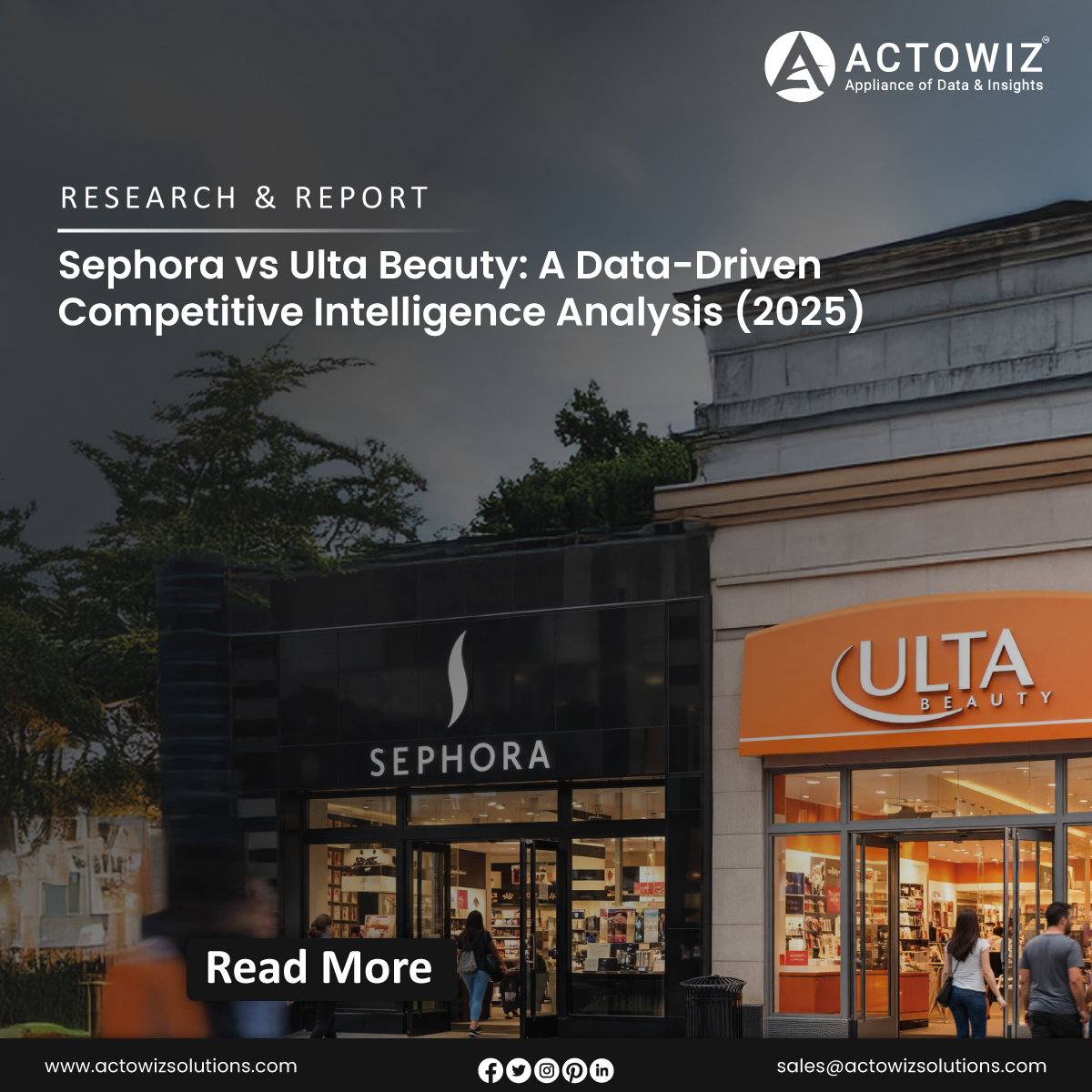
Introduction: Why Sephora vs Ulta Beauty Is a Data Problem
Sephora and Ulta Beauty are not just retail competitors. They represent two fundamentally different strategies in modern beauty commerce—one focused on premium brand authority, the other on accessibility and assortment breadth.
In 2025, competitive advantage in beauty retail is no longer driven by brand storytelling alone. It is driven by data visibility across physical stores, digital shelves, pricing behavior, and consumer engagement signals.
This technical blog by Actowiz Solutions breaks down the Sephora vs Ulta Beauty rivalry using structured retail, e-commerce, and digital data, showing how large-scale data extraction and normalization reveal strategic advantages that are invisible at surface level.
Methodology: How This Analysis Was Built
Unlike opinion-based comparisons, this analysis is grounded in multi-source data extraction, including:
Retail store location data
E-commerce product listings from Amazon & Walmart
Pricing and review signals
Digital engagement indicators
Platform-level assortment depth
Actowiz Solutions uses automated web scraping pipelines, location intelligence datasets, and structured data engineering to normalize this information into comparable metrics.
Physical Retail Strategy: Store Presence Where Spending Power Lives
Why Store Location Data Still Matters
Even in a digital-first world, beauty retail remains deeply physical. High-income zip codes drive:
Higher basket sizes
Premium brand adoption
Repeat loyalty
Using store-level POI (Point of Interest) data, Actowiz mapped Sephora and Ulta Beauty locations against high-GDP and high-income regions in the United States.
Key Observations
Sephora shows a concentrated footprint in affluent metro regions, aligning closely with premium consumption patterns.
Ulta Beauty has wider national coverage, but a comparatively lower density in ultra-high-income urban clusters.
In select high-value regions, Sephora’s store density per capita is significantly higher.
This suggests Sephora’s physical retail strategy is selective and margin-focused, while Ulta prioritizes volume and accessibility.
E-Commerce Scale: Measuring Digital Shelf Power
Why Digital Shelf Size Is a Leading Indicator
On marketplaces like Amazon and Walmart, brand success is often correlated with:
Number of SKUs listed
Review velocity
Visibility across search and category pages
Actowiz Solutions extracted product-level listing data to evaluate digital shelf presence.
Sample Digital Shelf Comparison (Illustrative Data)
Platform Brand Product Count Total Reviews Avg Rating
Amazon Sephora 980+ 85,000+ 4.2
Amazon Ulta Beauty 30+ 1,000+ 4.4
Walmart Sephora 200+ Limited 2.0
Walmart Ulta Beauty 90+ N/A N/A
Technical Insight
Sephora’s SKU dominance on Amazon creates a compounding advantage: more products → more reviews → higher algorithmic visibility.
Ulta Beauty’s limited Amazon assortment indicates controlled channel exposure rather than aggressive marketplace expansion.
Walmart emerges as a low-engagement channel for both brands, signaling platform-audience mismatch.
Pricing Intelligence: Premium vs Accessible Economics
Average Online Pricing Behavior
Actowiz Solutions normalized pricing data across platforms to remove:
Pack-size bias
Duplicate listings
Sponsored distortions
Sample Pricing Snapshot
Platform Brand Avg Price (USD)
Amazon Sephora $28.40
Amazon Ulta Beauty $26.90
Walmart Sephora $26.30
Walmart Ulta Beauty $13.90
What the Data Tells Us
Sephora consistently sustains a price premium without a proportional drop in ratings.
Ulta Beauty competes aggressively on price in mass channels but does not see equivalent engagement.
Price elasticity favors Sephora in premium ecosystems, particularly Amazon.
This confirms a critical retail principle: brand equity reduces price sensitivity.
Digital Engagement as a Demand Signal
Beyond Followers: Measuring Engagement Quality
Raw follower counts are not enough. Actowiz Solutions focuses on:
Engagement per post
Interaction velocity
Platform consistency
Social Engagement Snapshot
Brand Total Followers Avg Engagement/Post
Sephora 48M+ 12,500+
Ulta Beauty 13M+ 1,300+
Technical Interpretation
Sephora’s engagement-to-follower ratio indicates high audience relevance, not just reach.
Ulta Beauty’s posting frequency is higher, but engagement efficiency is lower.
Engagement density correlates strongly with conversion readiness.
For data teams, this confirms that engagement quality is a stronger predictor of brand strength than audience size alone.
Review Intelligence: Trust at Scale
Why Review Volume Matters More Than Rating Alone
Actowiz Solutions evaluates:
Review count
Review velocity
Rating consistency
A product with:
4.2 rating from 80,000 reviews is statistically more trustworthy than
4.5 rating from 500 reviews.
Sephora’s massive review footprint on Amazon indicates:
Higher transaction volume
Stronger post-purchase engagement
Ulta Beauty’s limited review presence suggests lower marketplace traction, not necessarily lower quality.
Data Engineering Behind the Analysis
This comparison required extracting and aligning data from:
Store locator pages
Marketplace product listings
Review widgets
Social platform metadata
Actowiz Technical Stack
JavaScript rendering for dynamic content
Pagination-aware crawlers
Deduplication logic for multi-SKU products
Schema normalization across platforms
Structured outputs for analytics
Sample Unified Dataset (Illustrative)
Brand Channel Metric Value
Sephora Amazon SKU Count 988
Sephora Amazon Avg Rating 4.2
Ulta Beauty Amazon SKU Count 32
Sephora Social Avg Engagement 12,500
Ulta Beauty Social Avg Engagement 1,300
Strategic Takeaways for Beauty Brands
From a data perspective:
Sephora wins on scale, engagement, and premium positioning
Ulta Beauty wins on accessibility and physical reach
Walmart is an underperforming channel for both
Amazon is the clearest digital battleground
For beauty brands, this reinforces the need for platform-specific strategies, not one-size-fits-all distribution.
Why Actowiz Solutions for Competitive Retail Intelligence
Actowiz Solutions enables brands, investors, and analysts to:
Track store expansion strategies
Monitor digital shelf performance
Analyze pricing and promotions
Measure consumer sentiment at scale
Build repeatable competitor intelligence systems
We don’t publish static reports. We build live, scalable data pipelines.
Conclusion
The Sephora vs Ulta Beauty rivalry is not about who is “better.” It is about who is optimized for which ecosystem.
Sephora dominates premium, engagement-driven channels.
Ulta Beauty thrives on reach and accessibility.
Only a data-first approach reveals these nuances.
With Actowiz Solutions, businesses can move beyond assumptions and build decisions on real, structured, continuously updated data.
📩 Email Us:
✉️ sales@actowizsolutions.com
📞 Call or WhatsApp:
📱 +1 (424) 377-7584
Source>> https://www.actowizsolutions.com/sephora-vs-ulta-beauty-data-driven-competitive-intelligence.php



Electro Keto To thwart these things, the individual concerned end being asked to have the alternative to rehearses conventionally.
To lessen the weight increment responses, the starches should be brought into dull ketogenic diet consistently.
Never adjust your Keto Diet plan program all of a sudden since this could have impacts .
By a tiny bit at a time introducing the changes, you could get unhinged.
You may require decay the use of fats after the starches are re-introduced.
Your security will a motivation against a stock of muscle to fat proportion.