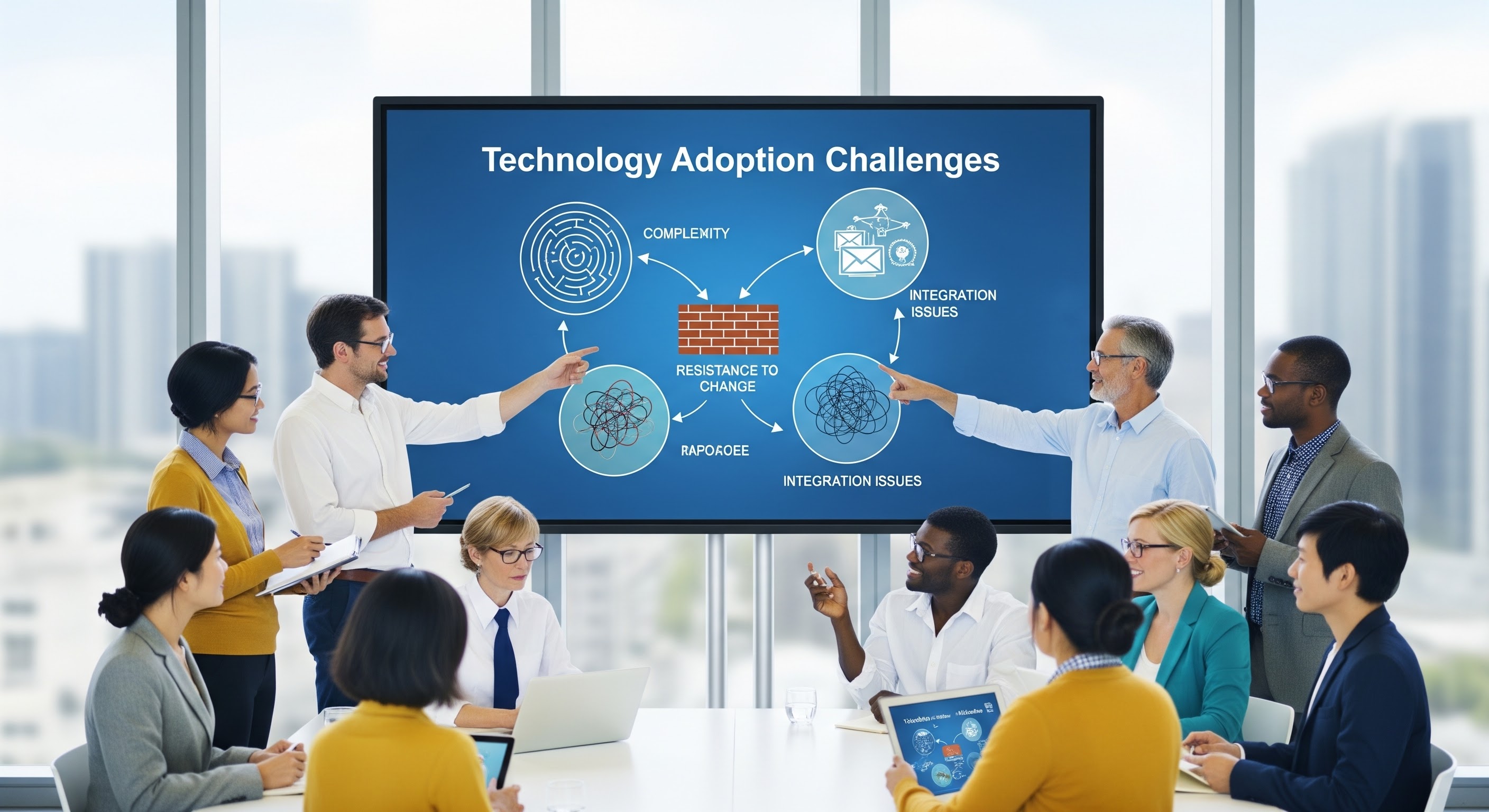


In the rapidly shifting landscape of 2026, technology is no longer just a support function; it is the core operating system of every modern enterprise. We have moved beyond the initial hype of generative AI and entered the era of agentic systems, physical AI, and multi-cloud optimization. However, as the digital frontier expands, the friction of implementation intensifies. Many organizations are finding that the leap from a successful pilot to an enterprise-wide rollout is steeper than anticipated. Understanding the primary Technology Adoption Challenges of this year is essential for any business leader aiming to remain competitive in a market that moves at the speed of an algorithm.
1. The Critical AI Talent and Digital Skill Vacuum
The most significant hurdle in 2026 remains the widening gap between technological capability and human expertise. While AI tools have become more sophisticated, the "prompt engineering" phase has evolved into a need for "AI Orchestrators"—professionals who can manage human-agent workflows. Gartner’s prediction that 60% of organizations would face setbacks due to skill shortages is now a daily reality. The shortage isn't just in data science; it extends to cybersecurity experts who understand AI-driven threats and cloud architects who can manage decentralized edge computing.
2. The "Pilot-to-Production" Scaling Gap
In 2025, many businesses experimented with "agentic" AI—autonomous systems that can execute tasks rather than just summarize text. In 2026, the challenge has shifted to scaling these agents. According to recent Deloitte insights, while over 40% of organizations are piloting agents, only a fraction have them in full production. This "Agentic Reality Check" reveals that automating a broken process only produces errors faster. Businesses are struggling to redesign their fundamental operations to accommodate autonomous systems, leading to stalled projects and wasted capital.
3. Legacy Infrastructure Drag and Technical Debt
One cannot build a skyscraper on a foundation of sand. Many enterprises are still tethered to legacy systems—on-premise servers and rigid monolithic architectures that were never designed for the real-time, high-compute demands of modern AI. Integrating advanced, cloud-native applications with these "dinosaur" systems creates massive technical debt. This incompatibility leads to data latency, security vulnerabilities, and a general inability to leverage real-time business intelligence, which is the gold standard for success in 2026.
4. Fragmented Data and the Governance Crisis
Data is the fuel for the 2026 economy, but most businesses are running on "dirty" fuel. Data silos—where marketing, finance, and operations information are stored in disconnected platforms—prevent a unified view of the customer. Furthermore, the rise of "Domain-Specific Language Models" requires high-quality, proprietary data. Without a robust governance framework to ensure data accuracy, privacy, and compliance (especially with escalating global regulations), AI models produce hallucinations or biased outputs that can lead to legal and reputational disaster.
5. Cultural Resistance to the "Silicon Workforce"
The introduction of AI agents into the daily workflow has created a unique set of Technology Adoption Challenges regarding workplace culture. Middle management, in particular, often views automation as a threat to job security rather than a tool for augmentation. This psychological resistance can manifest as "quiet sabotage," where teams revert to old manual processes because they don't trust the new systems. Overcoming this requires more than technical training; it requires a fundamental shift in leadership to foster "psychological safety" and a culture of continuous learning.
6. The Exploding Cost of Inference and Infrastructure
While the cost of training large models has stabilized, the cost of "inference"—running these models at scale—has skyrocketed. Enterprises are discovering that their cloud bills are growing faster than their revenue as AI usage explodes. In 2026, many businesses are forced into a "hybrid compute" strategy, balancing expensive public clouds with on-premises edge computing to keep costs manageable. Managing this infrastructure reckoning is a complex financial and technical challenge that few were prepared for two years ago.
7. Cybersecurity in a Decentralized Edge
The attack surface for the average business has grown exponentially. With employees working in hybrid environments and data being processed at the "edge" (on local devices and sensors rather than a central server), traditional perimeter-based security is obsolete. 2026 has seen a surge in AI-powered phishing and "poisoning" attacks on machine learning models. Adopting a Zero Trust architecture is now a necessity, but the complexity of verifying every user, device, and API call across a distributed network is a massive implementation hurdle.
8. The ROI Proof vs. Promise Struggle
In 2026, the "honeymoon phase" of AI is over. CFOs and stakeholders are no longer satisfied with flashy demos; they demand measurable Return on Investment (ROI). Proving that a technology has improved customer retention or reduced operational costs is difficult when the benefits are often intangible or long-term. Organizations that fail to set clear, outcome-driven KPIs from the start of their transformation journey often see their budgets slashed before the technology can reach maturity.
9. Ethics, Bias, and the "Black Box" Problem
As AI moves from a tool that suggests to a system that decides—hiring candidates, approving loans, or managing supply chains—transparency is non-negotiable. However, many deep-learning models remain "black boxes" where the logic behind a decision is unclear. Businesses face the challenge of implementing "Explainable AI" (XAI) to ensure fairness and mitigate bias. Failure to do so not only invites regulatory fines but also destroys the trust of the very customers the technology was meant to serve.
10. Sustainability and the Green Computing Mandate
The environmental impact of digital transformation has moved from a PR talking point to a financial constraint. Large-scale AI and data centers consume staggering amounts of electricity and water. In 2026, many regions have introduced "carbon taxes" on high-computer activities. Businesses are now challenged to adopt "Green AI"—optimizing their code and hardware to be more energy-efficient. Transitioning to sustainable tech while maintaining high performance is a delicate balancing act that requires specialized expertise.
How to Overcome These Hurdles
To navigate these obstacles effectively, leaders must stop looking at technology as a series of isolated upgrades and start viewing it as a holistic evolution. Here is a brief roadmap for success:
Audit Before You Automate: Use process mining tools to uncover hidden inefficiencies. Redesign the workflow for an AI-human hybrid team before you write a single line of code.
Invest in "Digital Dexterity": Move beyond one-off training sessions. Create "Centers of Excellence" where employees from different departments can experiment with new tools safely.
Prioritize Data Hygiene: Make data governance a daily operational task, not a quarterly check-up. Clean, unified data is the only way to ensure your AI investments pay off.
Choose Modular Architecture: Avoid vendor lock-in by using composable, cloud-native systems. This allows you to swap out components as technology evolves without breaking the entire chain.
By following this Technology Adoption Challenges guide, businesses can move from a state of reactive troubleshooting to one of proactive innovation. The winners of 2026 will not be the companies with the biggest budgets, but those with the most agile cultures and the clearest strategic vision.
Conclusion
The year 2026 represents a pivotal crossroads. The technologies available to us—from agentic AI to quantum-ready security—offer unprecedented opportunities for growth and efficiency. Yet, the challenges of talent, cost, and culture remain stubbornly human. The organizations that thrive will be those that recognize that digital transformation is 20% technology and 80% people and process. By addressing these ten challenges head-on, your business can turn the friction of adoption into the fuel for your next era of success.