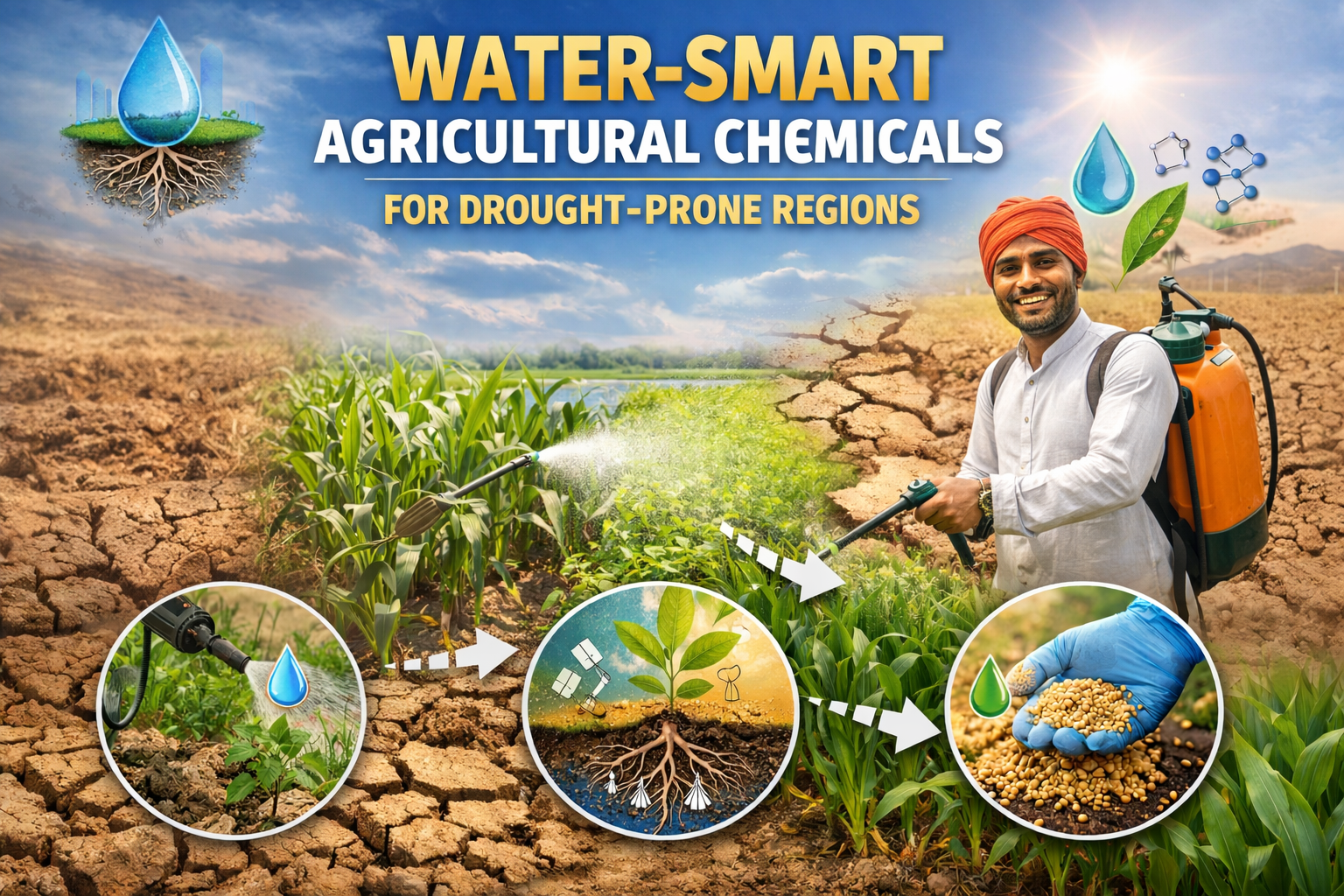
Climate change and unpredictable rainfall patterns are forcing farmers to rethink how they manage crops. In drought-prone regions, scarce water resources make it critical for growers to adopt water-smart agricultural chemicals that help crops thrive while conserving precious moisture. With rising temperatures and erratic monsoons, choosing the right inputs can mean the difference between a failed crop and a successful harvest.
In this blog, we’ll explore why water-efficient chemicals are shaping the future of sustainable farming, how they work, and which innovations are helping farmers beat the heat and maximize yields.
Why Water Efficiency Matters in Today’s Farming?
Farming in drought conditions presents daunting challenges. Water scarcity limits plant growth, reduces nutrient uptake, and increases crop vulnerability to weeds and pests. Traditional agricultural inputs, from pesticides to herbicide chemical formulations, often depend on significant water for proper application and absorption into crops. But the new wave of water-smart products changes that.
Using water-optimized agrochemicals can help farmers:
- Improve water use efficiency
- Reduce application losses
- Enhance nutrient absorption
- Maintain soil structure
- Boost crop resilience
This is critical in regions where water stress is becoming a norm rather than an exception.
Understanding Water-Smart Agricultural Chemicals
Water-smart agricultural chemicals are designed to perform well even when water is limited. They include enhanced formulations that maximize coverage and uptake with minimal water, controlled-release nutrients that feed plants longer, and surfactants or adjuvants that improve spray performance.
Here’s how these innovations help:
1. Controlled-Release Formulations
Traditional products may wash away with even a light rain or fail to penetrate plant tissues without adequate moisture. Controlled-release formulations, however, slowly deliver nutrients or active ingredients over time, reducing dependency on water and increasing efficiency.
2. Water-Efficient Herbicide Chemical Options
Herbicides are vital to weed control, but often require good spray coverage. Next-gen herbicide chemical solutions are being developed to:
- Activate with less water
- Penetrates plant cuticles faster
- Provide broader spectrum control with fewer applications
These traits make them ideal for dry regions, helping farmers stay ahead of weeds without excessive water use or repeated spraying.
Best Agro Chemicals Products for Drought Conditions
A key part of managing dryland farming is selecting products that align with a low-water strategy. These best agro chemicals products optimize performance under moisture stress and improve crop outcomes by facilitating better delivery and uptake.
1. Improved Herbicides with Enhanced Uptake
Modern herbicide chemical products are formulated to work with smaller droplet sizes that stick to leaf surfaces, improving absorption even in early morning dew or high temperatures. This ensures weeds are effectively controlled without requiring large volumes of water at the time of spraying.
2. Smart Surfactants and Adjuvants
Adding surfactants helps sprays spread more uniformly on plant leaves and soil surfaces. When built into formulations, they reduce run-off and evaporation, major problems in drought-prone fields.
3. Polymer Coatings and Water-Retention Technologies
These are added to both nutrient and pesticide sprays to slow evaporation and keep the active ingredients available on the plant surface longer, even in dry conditions. They help the crop make the most of every drop applied.
The Role of Digital and Precision Farming
While product chemistry is key, how farmers apply water-smart agricultural chemicals matters. Precision tools and digital platforms enable targeted applications, reducing waste and ensuring that chemicals reach the right spot with minimal water.
Precision Sprayers
Modern sprayers are equipped with sensors that adjust droplet size and delivery rate in real time. This ensures uniform coverage while conserving water.
Crop Health Monitoring
Apps and drones help farmers assess crop stress, enabling the timely application of products before drought stress becomes severe. Early application often leads to better absorption and less water use.
Sustainable Farming Meets Water-Smart Chemistry
Water-smart agrochemicals also support broader goals of sustainability. By improving the efficiency of agricultural inputs, farmers can reduce environmental impact while maintaining productivity. Many companies are innovating chemical formulations that align with integrated crop management, soil health, and reduced ecological footprint.
For example, some formulations are designed to minimize leaching into groundwater and reduce residual impact on non-target species. As farming systems evolve, these techniques will become standard practice in drought-affected regions.
Dhanuka’s Contribution to Efficient Crop Protection
A major player in India’s agrochemical market, Dhanuka Agritech continually expands its portfolio of herbicides and other crop-protection chemicals to meet diverse farming needs. From longstanding products like Targa Super and Ozone to newer solutions like DINKAR for paddy weed control, the company exemplifies how quality chemistry addresses field challenges.
With a diverse range of products and a strong distribution network, Dhanuka’s approach underscores the importance of reliable and efficient agrochemical solutions in supporting farmers across varying climatic zones.
Best Practices for Applying Water-Smart Agro Chemicals
It’s not just about selecting the right product how you apply it matters too. Here are some tips to get the most from your water-efficient chemicals:
1. Choose Optimal Spray Windows
Apply early in the morning or late afternoon when evaporation is lowest. This maximizes leaf contact time.
2. Match Dose to Crop Stage
Ensure sprays align with the crop’s growth stage. Younger crops generally absorb chemicals faster, reducing water needs.
3. Use Technology
GPS-enabled sprayers and variable-rate applications ensure precise delivery where it’s needed most, cutting down overall water use.
4. Monitor Soil Moisture
Combining soil moisture sensors with water-smart chemicals helps plan irrigation and spraying for maximum efficiency.
Challenges and Future Directions
Despite the advances, farmers in dry regions still face hurdles. Issues such as soil degradation, high temperatures, and frequent drought cycles demand continuous improvement in product technology. But the future looks promising as research focuses on:
- Biodegradable carrier systems
- Biostimulant-integrated chemical formulations
- Nano-enhanced nutrients and pesticides
- AI-enabled spray optimization
These innovations will ensure that agricultural chemicals not only protect crops but do so with minimal water input and environmental impact.
Conclusion
In drought-prone regions, water-smart agricultural chemicals are game changers. By choosing products designed for efficient water use, farmers can protect crops, save resources, and enhance yields under challenging conditions. Combining improved formulations with precision application and smart farming practices ensures that agriculture remains productive and sustainable even when water is scarce.
Whether it’s advanced herbicide chemical options that require less water for effective weed control or nutrient sprays that deliver longer-lasting benefits, water efficiency is at the heart of future farming.
Smart choices today make for resilient crops tomorrow, a necessity for farming in a changing climate.
FAQs
1. What are water-smart agricultural chemicals?
Water-smart agricultural chemicals are formulations designed to improve crop resilience and efficiency in water-limited conditions. They help plants absorb nutrients better and maintain growth during drought stress.
2. How do water-smart herbicide chemicals benefit drought-prone farming?
Water-smart herbicide chemicals minimize water loss and reduce stress on crops by targeting weeds efficiently, conserving soil moisture for crops that need it most in drought conditions.
3. Can agricultural chemicals improve crop performance during drought?
Yes. Certain agricultural chemicals enhance nutrient uptake, strengthen plant stress tolerance, and support healthy development even when water availability is low.
4. Are all herbicide chemicals suitable for drought-prone areas?
No. Only select herbicide chemicals with low volatility and water-friendly formulations are suited for drought-prone fields to avoid unnecessary moisture loss and plant stress.
5. How should farmers choose the best agro chemicals products for water-limited regions?
Farmers should select products with rapid action, soil compatibility, and minimal water dependency, focusing on formulations proven effective through field results in drought-prone regions.
6. Do water-smart agricultural chemicals reduce irrigation needs?
While they don’t replace irrigation entirely, water-smart agro chemicals help crops utilize available moisture more efficiently, reducing overall irrigation frequency.
7. What role does timing play when applying water-smart herbicide chemicals?
Timing is critical. Applying herbicide chemicals early when weed pressure is low helps preserve soil moisture and ensures more efficient weed control in drought conditions.
8. Can integrating water-smart chemicals boost crop yield under drought?
Yes. Integrated use of water-smart chemicals improves plant health and nutrient uptake, often resulting in higher yields even when water is scarce.
9. Are water-smart agricultural chemicals eco-friendly?
Many modern water-smart solutions are designed to reduce environmental impact by minimizing runoff, conserving soil structure, and improving nutrient efficiency.
10. How do water-smart chemical strategies fit into sustainable farming?
Water-smart chemical strategies complement sustainable practices by conserving water, enhancing nutrient use, and supporting drought resilience, crucial for long-term agricultural success.




Agro Products Franchise Agriculture Franchises Give the right platform to your entrepreneurial dream by taking up franchise opportunities in farm equipment, agricultural products and so on.
From fruits to pulses to tractors, becoming a franchisee of anything in the agro industry ensures attractive profits.