





For many small business owners, profitability doesn’t always equal financial stability. You might be making sales and still struggle to pay bills on time. This is where the cash flow statement becomes one of the most important financial reports to understand.
Unlike the profit and loss statement, a cash flow statement shows how money actually moves in and out of your business during a specific period.
This guide breaks it down in simple terms.
What Is a Cash Flow Statement?
A cash flow statement tracks:
How much cash comes into your business
How much cash goes out
Where that cash is coming from and where it’s being used
It helps business owners answer critical questions like:
Can I pay my expenses next month?
Do I have enough cash to grow?
Why am I profitable but still short on cash?
The 3 Main Sections of a Cash Flow Statement
Every cash flow statement is divided into three core activities.
1. Operating Activities
This section reflects cash generated from day-to-day business operations, such as:
Cash received from customers
Payments to suppliers and employees
Rent, utilities, and operating expenses
Why it matters:
Positive operating cash flow means your core business is generating enough cash to sustain itself.
2. Investing Activities
This section shows cash used for long-term assets, including:
Purchasing equipment or machinery
Selling business assets
Investments in property or technology
Why it matters:
Negative cash flow here isn’t always bad—it often means you’re investing in growth.
3. Financing Activities
This covers cash related to funding and ownership, such as:
Loan proceeds or repayments
Owner contributions
Dividend or profit distributions
Why it matters:
It shows how your business is financed and whether it relies heavily on debt or owner funding.
How to Read a Cash Flow Statement Step-by-Step
Here’s a simple way to analyze it:
Start with operating cash flow
This is the most important section. If it’s consistently negative, that’s a red flag.
Look at investing activity trends
One-time purchases are normal. Frequent large outflows may impact liquidity.
Review financing cash flows
Regular loan repayments reduce cash, while new loans temporarily increase it.
Check net cash change
This tells you whether your total cash balance increased or decreased during the period.
Common Mistakes Small Business Owners Make
Focusing only on profit, not cash
Ignoring operating cash flow trends
Treating loan money as “income”
Not reviewing cash flow monthly
Understanding these mistakes early can prevent serious cash shortages later.
Why Cash Flow Matters More Than Profit
A business can show profits on paper and still fail due to poor cash flow management. Cash flow determines:
Your ability to pay bills on time
How confidently you can hire or expand
Whether you can survive slow seasons
For a more detailed breakdown with real examples, you can refer to this cash flow statement guide for small businesses, which explains each section.
Final Thoughts
Learning how to read a cash flow statement empowers small business owners to make better financial decisions. It’s not just an accounting document—it’s a roadmap to financial stability and growth.
Review it regularly, understand the trends, and use it as a decision-making tool rather than a formality.



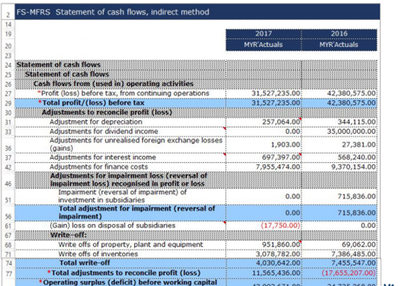
The options for preparing Statement of Cash Flows are Direct and Indirect.
For the indirect method, preparer should note that there are a number of cells that have been programmed to be autosubtracted from the subtotals/total in this statement.
After filling in the statement, preparers may hide unused rows by using the “Untagged rows” function at the tool box for ease of view.
Below are a step-by-step guide and an illustration of how it should be filled.
M1 — After filling in all the adjustments to the profit (loss) before tax, ensure to check that the “Operating surplus (deficit) before working capital changes” is equal to the figure in the FS.
M2 — After filling in all the cash generated from (used in) operating activities, ensure to check that the “Net cash flows from (used in) operating activities” is equal to the figure in the FS.