


Warehouses today are no longer simple storage locations. They are digitally connected, performance-driven environments where speed, accuracy, and visibility determine business success. As organizations migrate to SAP S/4HANA, traditional warehouse systems are failing to meet these expectations. This is where SAP Extended Warehouse Management (SAP EWM) becomes mission-critical—and why a professional SAP EWM course is increasingly essential for SAP professionals.
This article explores how SAP EWM addresses modern warehouse challenges and how structured SAP EWM training equips professionals to deliver real business value.
The Reality of Modern Warehouse Challenges
Organizations face persistent operational issues in warehouse management, such as:
Inaccurate inventory visibility
Delayed order fulfillment
Inefficient labor utilization
Poor integration between warehouse and production
Limited automation and scalability
Traditional systems cannot handle real-time execution, automated decision-making, and complex logistics flows. Businesses need intelligent warehouse solutions—and SAP EWM is built precisely for this purpose.
How SAP EWM Transforms Warehouse Operations
SAP EWM provides advanced tools that go beyond basic inventory tracking. It enables companies to design highly optimized and automated warehouse processes aligned with business goals.
https://forms.gle/czgkzmzjx2Bkt98P8
Key transformation areas include:
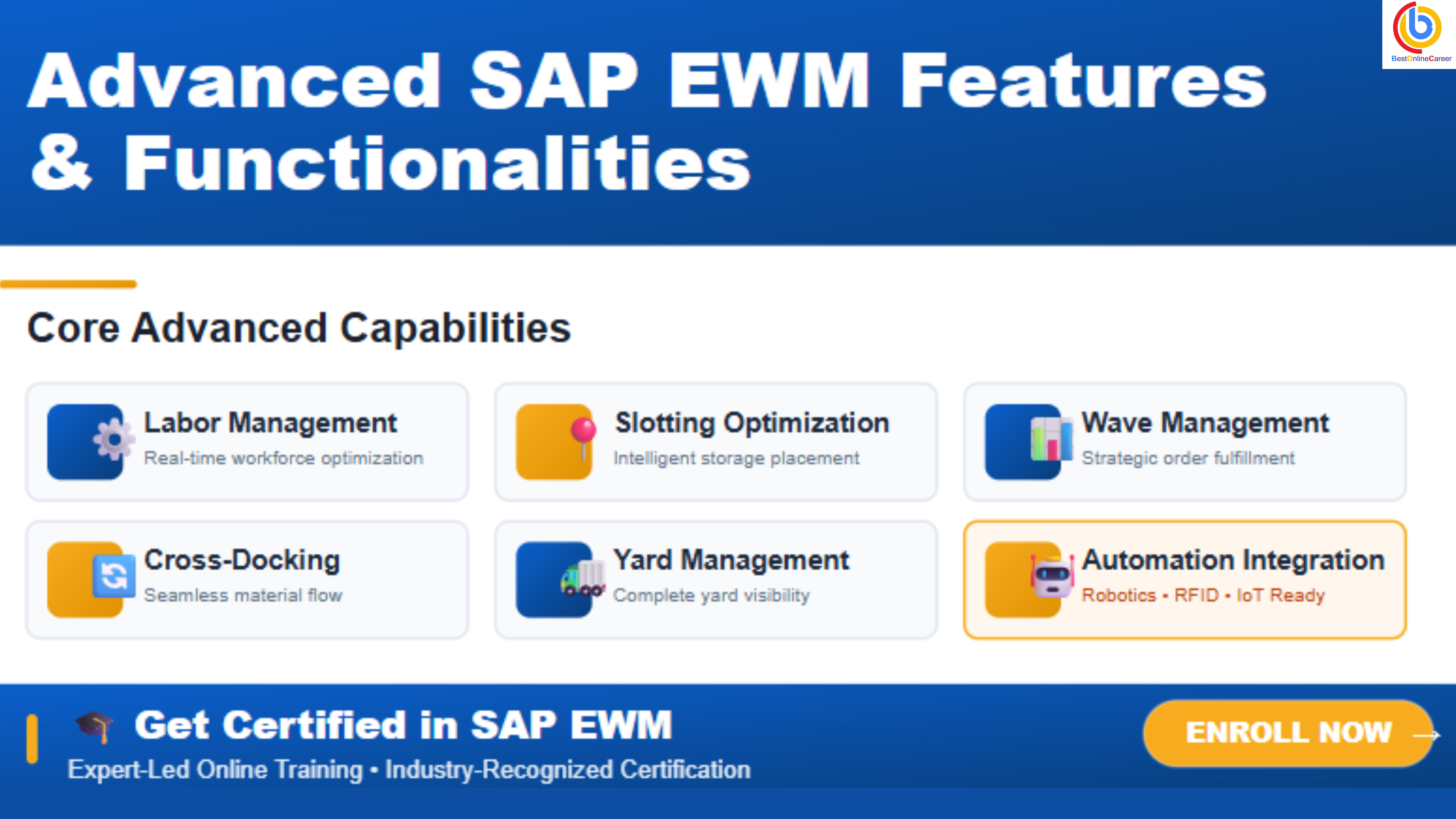
Real-time inventory monitoring across storage bins
Rule-based putaway and picking strategies
Labor management and workload balancing
Wave management for optimized outbound processing
Tight integration with SAP S/4HANA, manufacturing, and transportation systems
A professional SAP EWM course helps SAP consultants understand not just “how to configure,” but “why to configure” these features for real-world scenarios.
SAP EWM Course: Learning Through Business Scenarios
Unlike traditional module-based learning, a modern SAP EWM course focuses on scenario-driven training. SAP professionals learn how to design solutions for complex warehouse situations, such as:
High-volume inbound processing during peak seasons
Cross-docking scenarios to minimize storage time
Batch and serial number handling for regulated industries
Integration of warehouse execution with production planning
This approach ensures that SAP EWM training delivers problem-solving skills, not just theoretical knowledge.
Why SAP Professionals Need SAP EWM Training Now
With SAP WM reaching the end of innovation, organizations worldwide are migrating to SAP EWM under S/4HANA. This shift has created an urgent demand for skilled EWM consultants who can handle:
WM to EWM migration projects
New greenfield SAP EWM implementations
System optimization and performance tuning
Professionals who complete a structured SAP EWM course gain an immediate advantage by aligning their skills with current market demand.
The Role of SAP EWM Online Training for Working Consultants
Many SAP professionals hesitate to upskill due to project commitments. This is where SAP EWM online training becomes a practical solution.
Benefits include:
Live instructor-led sessions with real project insights
Access to SAP EWM systems for hands-on practice
Flexible schedules suitable for global professionals
Recorded sessions for revision and certification preparation
A high-quality SAP EWM online training program bridges the gap between ongoing work and continuous learning.
SAP EWM Certification: Proof of Real Capability
While experience builds confidence, SAP EWM certification builds credibility. Certification demonstrates that a professional understands SAP EWM concepts in alignment with SAP standards.
Employers and clients often prioritize certified consultants for mission-critical warehouse projects. Completing a SAP EWM course that includes certification guidance ensures professionals are exam-ready and industry-recognized.
Business Value of SAP EWM Skills
SAP professionals trained in EWM contribute directly to business outcomes, such as:
Reduced order processing time
Improved warehouse throughput
Lower operational costs
Enhanced customer satisfaction
This business-driven impact makes SAP EWM skills highly valuable across industries including retail, manufacturing, pharmaceuticals, and logistics.
Career Paths After Completing a SAP EWM Course
A professional SAP EWM course opens multiple career options, including:
SAP EWM Functional Consultant
SAP S/4HANA Supply Chain Consultant
Warehouse Solution Designer
Logistics Process Consultant
With experience and SAP EWM certification, professionals can move into global implementation and solution architecture roles.
Choosing the Right SAP EWM Course
To gain practical expertise, SAP professionals should choose a SAP EWM course that offers:
Scenario-based SAP EWM training
Real-time system access
S/4HANA-aligned curriculum
Certification support
Interview and project guidance
The right training transforms technical knowledge into professional confidence.
Final Perspective
In the S/4HANA era, warehouses are strategic assets, not cost centers. Organizations need SAP professionals who understand digital warehouse execution—not just system configuration. A well-structured SAP EWM course, supported by expert-led SAP EWM training, flexible SAP EWM online training, and recognized SAP EWM certification, prepares professionals to lead this transformation.





SAP S/4HANA is an advanced enterprise resource planning (ERP) system designed to help businesses run their operations using real-time data. It integrates key business functions such as finance, sup