




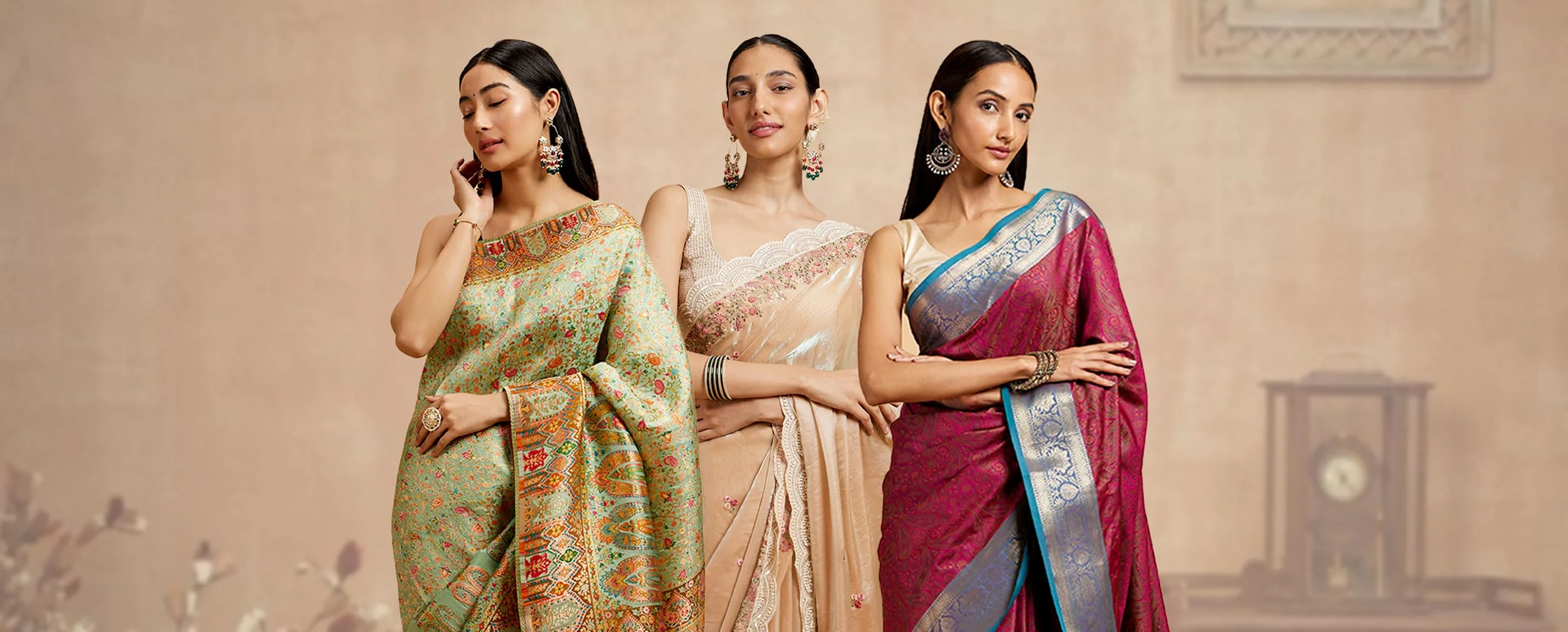
The market is flooded with power-loom imitations sold as "handloom." For the untrained eye, spotting the difference can be tricky. At Riivaa, we believe an informed customer is our best customer. Here are three simple ways to test the authenticity of a Banarasi saree.
1. The Reverse Side Test (The Float Check) Flip the saree over.
- Handloom: You will likely see "floats"—loose threads where the weaver has passed the shuttle. In intricate Kadhwa weaves, the back will be neat but will still show the distinct manual locking of threads.
- Power-loom: The reverse side often looks suspiciously smooth or has a "mesh-like" appearance where extra threads are cut away by machine.
2. The Pin Test Pick a hidden corner of the saree (like the hem) and gently prick it with a sharp pin.
- Pure Silk: The threads will move apart but can be rubbed back into place with your finger.
- Synthetic/Art Silk: The pin will likely poke a permanent hole or cause the threads to separate in a way that can't be fixed.
3. The Zari Shine Authentic Banarasi sarees use high-quality metallic threads.
- Real Zari: Has a subtle, elegant sheen that looks rich under light.
- Fake Zari: Often looks jarringly bright, "plastic-y," or overly garish. Over time, cheap zari will turn black or reddish, while quality zari maintains its antique gold or silver hue.
Don’t settle for imitations. Shop with confidence and browse the GI-tagged authentic collection at Riivaa.com.


If you are looking for Silk Sarees Online?
Buy traditional silk sarees online.
Explore more collections of pure Kanjivaram silk sari, Banarasi sarees, Cotton sarees, Mysore silk sarees & wedding silk sarees.
Buy well-designed Bridal sarees & Kanchipuram sarees at affordable prices.
You will get unique exclusive designs for Bridal Sarees also.
These sarees are made by well-experienced designers.