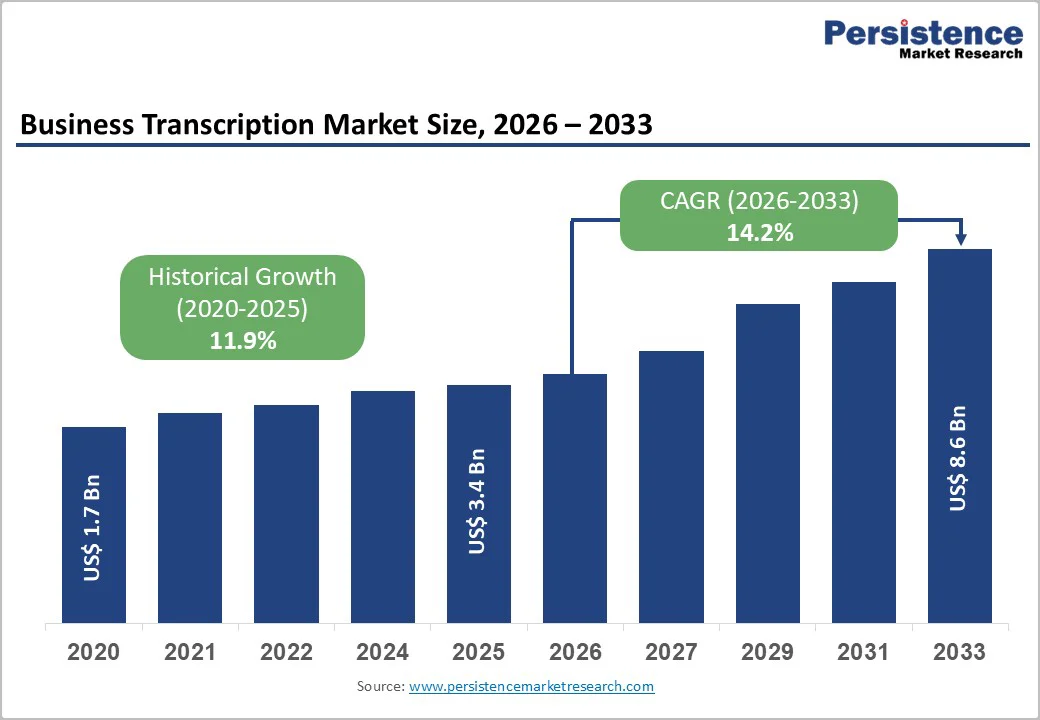
The global business transcription market is undergoing rapid evolution, driven by technological innovation, regulatory requirements, and a shift toward digital operations across industries. According to recent forecasts, the market is expected to grow from US$ 3.4 billion in 2026 to US$ 8.6 billion by 2033, reflecting a robust CAGR of 14.2%. This growth underscores the increasing reliance of enterprises on transcription solutions to improve efficiency, enhance compliance, and enable data-driven decision-making in a digital-first world.
Transcription services, once considered an administrative support tool, have now become strategic assets for organizations seeking operational excellence. The adoption of artificial intelligence (AI) and machine learning (ML) technologies has significantly improved transcription accuracy, reduced turnaround times, and lowered costs. By automating time-intensive tasks, businesses can reallocate human resources to higher-value activities, enabling improved productivity and competitiveness.
Drivers of the Business Transcription Market
Several converging factors are driving the growth of the business transcription market. Foremost among them is the accelerated adoption of AI and ML technologies. Modern transcription solutions leverage advanced natural language processing (NLP) algorithms to detect speech patterns, accents, and context-specific terminology. This results in a substantial reduction of errors compared to manual transcription, particularly in sectors where precision is critical, such as healthcare, legal, and financial services.
Another major driver is the rising demand for digital documentation. Organizations are increasingly moving away from paper-based records, which are prone to loss, inefficiency, and compliance risks. Digital transcripts facilitate quick access to information, secure storage, and real-time collaboration across geographically dispersed teams. The integration of transcription tools with cloud-based collaboration platforms further accelerates workflow efficiency, enabling remote teams to work seamlessly while maintaining accurate records.
Regulatory compliance also plays a pivotal role in market growth. In healthcare, adherence to standards like HIPAA ensures patient confidentiality, while in Europe, GDPR compliance protects personal data. Transcription solutions help enterprises meet these requirements efficiently, minimizing the risk of non-compliance penalties. Legal firms similarly rely on accurate transcripts for deposition, litigation support, and contract review, creating a steady demand for high-quality transcription services.
Market Segmentation Insights
By Component: Software vs. Services
The business transcription market is segmented into software and services, with software capturing a dominant 74.6% share. The preference for software solutions is driven by several factors:
- Cloud-based scalability: Modern transcription software can handle large volumes of audio and video data without infrastructure constraints.
- Real-time processing capabilities: Organizations benefit from immediate transcript generation for live meetings, conferences, or telemedicine consultations.
- Enterprise system integration: Transcription software seamlessly connects with customer relationship management (CRM) tools, electronic health records (EHR), and enterprise resource planning (ERP) systems.
- Flexible subscription models: By adopting SaaS-based offerings, enterprises reduce capital expenditure while gaining access to the latest updates and AI enhancements.
Service-based transcription, while smaller in market share, remains relevant for industries requiring highly specialized expertise or subject matter-specific accuracy. Legal and medical transcription services, for example, often demand professionals who understand technical jargon and industry-specific regulations, making service models indispensable for certain clients.
By Type: Intelligent vs. Verbatim
The transcription market can also be classified by type, with intelligent transcription emerging as the fastest-growing segment, projected to expand at a CAGR of 18%. Intelligent transcription balances accuracy with readability, offering summaries, context cues, and speaker identification. Unlike full verbatim transcription, which captures every word exactly as spoken, intelligent transcription transforms raw data into actionable insights, making it particularly valuable for business analytics, executive briefings, and decision-making processes.
Full verbatim transcription remains essential for sectors where precise language is critical, such as court proceedings or regulatory filings. However, the increasing demand for efficiency and actionable outputs favors intelligent transcription solutions, especially in environments with high volumes of audio data, such as call centers, corporate meetings, and telehealth consultations.
Regional Market Dynamics
North America: Leading Market
North America maintains the largest share of the global business transcription market, accounting for approximately 35% in 2025. This dominance is attributed to the region’s mature healthcare infrastructure, stringent regulatory requirements, and widespread adoption of AI-driven transcription technologies. The U.S., in particular, is home to a thriving ecosystem of software developers, transcription service providers, and healthcare organizations that continuously invest in automation and digital workflows.
The region’s regulatory framework also encourages the adoption of transcription solutions. Compliance with HIPAA and other federal and state regulations drives demand for accurate, secure, and auditable transcription records. Additionally, the prevalence of remote work and distributed teams in North America has increased reliance on cloud-based transcription tools, enabling seamless collaboration and data management.
Asia-Pacific: Fastest-Growing Market
While North America leads in terms of market size, Asia-Pacific is emerging as the fastest-growing regional market, projected to expand at a CAGR of 16% from 2025 to 2032. Growth in this region is fueled by several factors:
- Rapid healthcare digitalization in countries like China and India. Hospitals and clinics are increasingly adopting electronic health records and telemedicine platforms, creating demand for accurate transcription services.
- Expanding manufacturing and corporate sectors, which require multilingual transcription solutions for meetings, training, and compliance documentation.
- Cost-competitive outsourcing advantages, with many enterprises leveraging local transcription providers for affordable yet high-quality solutions.
- Increasing regulatory compliance requirements, as governments strengthen data protection laws and business reporting standards.
The Asia-Pacific market is particularly attractive to global transcription software providers and service operators, offering opportunities to tap into large, underpenetrated markets with growing digital infrastructure.
Key Market Opportunities
The convergence of telemedicine expansion, electronic health record adoption, and ambient clinical intelligence represents one of the most significant growth opportunities in the business transcription market. Telemedicine services, accelerated by the COVID-19 pandemic, rely heavily on accurate documentation for remote consultations. Integrating transcription services with EHR systems ensures real-time patient records, improving care coordination and operational efficiency.
Moreover, ambient clinical intelligence (ACI) is gaining traction as AI-powered systems capture physician-patient interactions and automatically generate structured documentation. This reduces physician burnout, streamlines administrative tasks, and enhances patient care. Such technological innovations are likely to drive further adoption of transcription solutions in the healthcare sector.
Another promising avenue lies in the enterprise collaboration and analytics domain. Businesses increasingly use transcription data to generate insights from meetings, webinars, and customer interactions. By applying AI-driven analytics to transcribed data, organizations can identify trends, monitor compliance, and optimize decision-making processes. This trend highlights the evolution of transcription from a passive administrative function to a strategic tool that drives business intelligence.
Challenges and Market Restraints
Despite strong growth, the business transcription market faces challenges that could affect adoption rates. Data privacy and security concerns remain critical, especially in sectors handling sensitive information, such as healthcare, finance, and legal services. Ensuring compliance with multiple regulations across regions can be complex and costly.
Another restraint is the variability of transcription accuracy in noisy environments or with speakers having strong accents. While AI-powered tools have made significant strides, certain scenarios still require human intervention to ensure error-free output. Furthermore, integration complexities with legacy enterprise systems can slow down adoption for some organizations.
Competitive Landscape
The business transcription market is highly competitive, with a mix of established software vendors, AI-driven startups, and specialized service providers. Key players focus on innovation, accuracy, multilingual capabilities, and seamless integration to differentiate their offerings. Strategic initiatives such as mergers, acquisitions, and partnerships with enterprise software providers or telehealth platforms are common to strengthen market presence and expand global reach.
Leading transcription software providers are increasingly investing in AI model training and natural language processing enhancements to improve contextual understanding and domain-specific accuracy. Service providers, on the other hand, are emphasizing scalability, multilingual support, and quick turnaround times to cater to growing enterprise demand.
Future Outlook
The outlook for the business transcription market remains highly promising. With the increasing adoption of digital workflows, remote collaboration, and AI-driven transcription technologies, enterprises are likely to continue investing in solutions that enhance productivity, compliance, and data accessibility. By 2033, the market is projected to more than double in value, reaching US$ 8.6 billion, reflecting the transformative role transcription services play across sectors.
Emerging technologies such as real-time multilingual transcription, speech-to-text analytics, and AI-powered summarization are expected to further reshape the market. Additionally, integration with next-generation collaboration platforms and healthcare IT systems will expand the market’s footprint, creating opportunities for software providers and service vendors alike.
Conclusion
The business transcription market is experiencing a period of accelerated growth fueled by AI adoption, regulatory compliance requirements, and digital transformation initiatives. North America leads the market in size, while Asia-Pacific offers the fastest growth potential, driven by healthcare digitalization and outsourcing advantages. Software solutions dominate the market, with intelligent transcription emerging as the fastest-growing type due to its balance of accuracy and usability.
Opportunities abound in healthcare, telemedicine, and enterprise analytics, making transcription solutions a strategic investment rather than a mere administrative tool. As organizations continue to prioritize efficiency, compliance, and actionable insights, the business transcription market is poised for sustained growth, innovation, and global expansion over the coming decade.
With AI-powered transcription, cloud integration, and real-time analytics becoming standard expectations, businesses that leverage these technologies are likely to gain a competitive edge, improve operational efficiency, and enhance overall business intelligence in an increasingly digital world.
Related Reports:


Texas businesses have cautiously begun opening after Governor Greg Abbott ended the statewide mask mandate almost a month ago.
Businesses have been able to open at 100% capacity since then also, leaving many businesses the option to choose how to move forward.Statistics show 62% of employees worked from home for most of last year.
Many studies revealed productivity increased while employees worked from home, contrary to popular belief.Towards the end of 2020, data suggested more employees were missing being in the office, and throughout the beginning of 2021, trends have continued to reflect the same tendency.While organizations plan their next move, employee safety is often at the top of the list.
Businesses must reimagine their pre-COVID policies with new priorities in mind.Examples of Priorities for Businesses Post-Covid are:1.
Productivity#1- Employee SafetyWith employee safety at the top of the list, many organizations may lean towards letting employees continue working from home until herd-immunity is achieved with vaccines.
As it stands now, only 16.1% of the population in Texas is fully vaccinated, and another 28.5% have had at least one dose.