





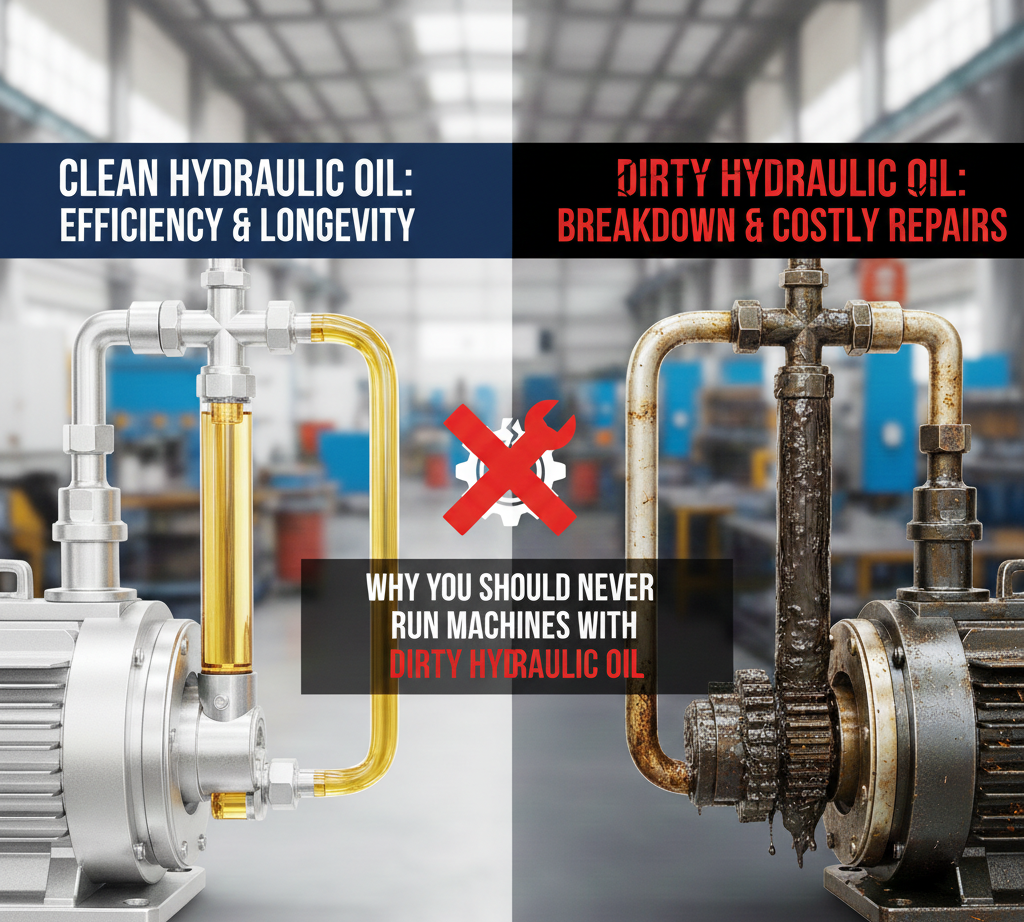
Did it ever happen that you switched on a machine and it just didn’t feel right? The power was on. The controls were fine. Yet the machine responded slowly—or not at all. Out of habit, you opened the hydraulic tank, and that’s when you saw it. The hydraulic oil looked dark, thick, and tired. At that moment, it became clear that this problem didn’t show up overnight. It had been quietly building up for days, weeks, maybe even months.
Most hydraulic systems continue to operate even when the oil quality starts degrading. This gives a false sense of safety. By the time visible symptoms appear, internal damage is already underway.
Let us understand how dirty hydraulic oil affects a machine which could have been avoided with timely attention.
How hydraulic oil gets contaminated over time
Hydraulic oil operates in a closed-loop system, but it is never completely isolated. Contamination enters through multiple routine activities. Oil top-ups, seal wear, breather vents, and temperature fluctuations allow dust and moisture to enter the system. At the same time, normal operation generates fine metal particles due to friction between internal components.
As the oil circulates, these contaminants remain suspended in the fluid. Even when the oil level is correct, its cleanliness level may no longer meet the system’s requirement. This is often overlooked because machines continue to function despite declining oil quality.
What happens when hydraulic oil inside machines get dirty?
Here are a few major problems that build up slowly if the hydraulic oil is not changed on time.
1. Pumps failure
The hydraulic pump is usually the first component to suffer when hydraulic oil becomes contaminated. It operates with extremely tight internal clearances, where clean oil is essential. Even microscopic dirt particles can scratch internal surfaces and break the protective oil film.
As contaminated oil circulates, internal leakage increases and the pump struggles to build pressure. Machine movements become slower, cycle times increase, and overall efficiency drops. These early signs are often ignored or accepted as normal wear.
2. Valves lose control
Hydraulic valves control how oil flows through the system. They decide the direction of movement, the speed of operation, and the pressure applied. For this to work properly, the oil must be clean.
When hydraulic oil becomes dirty, solid particles enter the valve assembly. These particles get caught between moving parts, causing valves to stick or respond slowly. As a result, machine movements become uneven, and pressure can rise suddenly without warning.
3. Cylinders and seals wear internally
Hydraulic cylinders depend on clean oil to keep seals and inner surfaces protected. When the oil is dirty, seals begin to wear unevenly and lose their ability to seal properly.
This leads to internal leakage, which usually happens long before any oil is seen leaking outside. The machine may still appear normal, but pressure is already being lost inside the cylinder.
Water in the oil makes the problem worse. Seals can become hard, swollen, or cracked, allowing more dirt and moisture to enter the system.
As dirty oil continues to circulate, cylinder walls get scratched and the cylinder loses its ability to hold the load securely.
Bottom line
The moment you open the hydraulic oil chamber and notice black soot, sludge, or a burnt smell, it is a sign of heat, contamination, and breakdown happening inside your machine. Change the hydraulic oil immediately. Do not top it up. .The fresh, clean oil restores lubrication, controls heat, and stops further damage from spreading.



The World Hydraulic (oil) Press Market Research Report 2023 (covering USA, Europe, China, Japan, India, South East Asia and etc), is an informative market report offered by DecisionDatabases.com.Hydraulic (oil) Press market research report provides the newest industry data and industry future trends, allowing you to identify the products and end users driving Revenue growth and profitability.
The industry report lists the leading competitors and provides the insights strategic industry Analysis of the key factors influencing the market.The report includes the forecasts, Analysis and discussion of important industry trends, market size, market share estimates and profiles of the leading industry Players.Final Report will cover the impact of COVID-19 on this industry.Access Full Report with Table of Contents @ https://www.decisiondatabases.com/ip/33851-hydraulic-oil-press-market-analysis-reportThe Players mentioned in our reportSchulerKomatsuYeh ChiunBeckwoodHare PressDakeNeff PressTianduan PressHaiyuan MachineryEnerpacGlobal Hydraulic (oil) Press Market: Product Segment AnalysisHydraulicOilVerticalHorizontalGlobal Hydraulic (oil) Press Market: Regional Segment AnalysisUSAEuropeJapanChinaIndiaDownload Free Sample Report of World Hydraulic (oil) Press Market @ https://www.decisiondatabases.com/contact/download-sample-33851There are 10 Chapters to deeply display the World Hydraulic (oil) Press market.Chapter 1 About the Hydraulic (oil) Press IndustryChapter 2 World Market Competition LandscapeChapter 3 World Hydraulic (oil) Press Market shareChapter 4 Supply Chain AnalysisChapter 5 Company ProfilesChapter 6 Globalisation & TradeChapter 7 Distributors and CustomersChapter 8 Import, Export, Consumption and Consumption Value by Major CountriesChapter 9 World Hydraulic (oil) Press Market Forecast through 2023Chapter 10 Key success factors and Market OverviewPurchase full World Hydraulic (oil) Press Market Research Report @ https://www.decisiondatabases.com/contact/buy-now-33851Other Reports by DecisionDatabases.com:World Hydraulic Power Unit Market Research Report 2025 (covering USA, Europe, China, Japan, India, South East Asia and etc)World Hydraulic Cylinders Market Research Report 2022 (covering USA, Europe, China, Japan, India, South East Asia and etc)About-Us:DecisionDatabases.com is a global business research reports provider, enriching decision makers and strategists with qualitative statistics.
DecisionDatabases.com is proficient in providing syndicated research report, customized research reports, company profiles and industry databases across multiple domains.Our expert research analysts have been trained to map client’s research requirements to the correct research resource leading to a distinctive edge over its competitors.
We provide intellectual, precise and meaningful data at a lightning speed.For more details:DecisionDatabases.comE-Mail: sales@decisiondatabases.comPhone: +91 9028057900Web: https://www.decisiondatabases.com/
The latest trending report Global Hydraulic (Oil) Press Market 2020 by Manufacturers Regions Type and Application Forecast to 2025 offered by DecisionDatabases.com is an informative study covering the market with detailed analysis.
The report will assist reader with better understanding and decision making.The Hydraulic (Oil) Press market report provides a detailed analysis of global market size, regional and country-level market size, segmentation market growth, market share, competitive Landscape, sales analysis, impact of domestic and global market players, value chain optimization, trade regulations, recent developments, opportunities analysis, strategic market growth analysis, product launches, area marketplace expanding, and technological innovations.This report also researches and evaluates the impact of Covid-19 outbreak on the Hydraulic (Oil) Press industry, involving potential opportunity and challenges, drivers and risks.
We present the impact assessment of Covid-19 effects on Hydraulic (Oil) Press and market growth forecast based on different scenario (optimistic, pessimistic, very optimistic, most likely etc.
).Final Report will cover the impact of COVID-19 on this industry.Browse the complete report and table of contents @ https://www.decisiondatabases.com/ip/41520-hydraulic-oil-press-industry-analysis-reportThe major players covered in Hydraulic (Oil) Press are:GasbarreDorstNeff PressSchulerEnerpacBeckwoodStandard IndustrialGreenerdFrenchPhoenixRK MachineryDakeMultipressBetenbenderBrown BoggsMacrodyneBy Type, Hydraulic (Oil) Press market has been segmented intoC-Frame Hydraulic PressH-Frame Hydraulic Press4-Post Hydraulic PressBulldozer Hydraulic PressBy Application, Hydraulic (Oil) Press has been segmented into:Appliances IndustryAutomotive IndustryCeramic and Abrasives IndustryElectrical IndustryFood Compaction IndustryGovernment/Military IndustryOthersThe report offers in-depth assessment of the growth and other aspects of the Hydraulic (Oil) Press market in important countries (regions), including:North America (United States, Canada and Mexico)Europe (Germany, France, UK, Russia and Italy)Asia-Pacific (China, Japan, Korea, India and Southeast Asia)South America (Brazil, Argentina, etc.
)Middle East & Africa (Saudi Arabia, Egypt, Nigeria and South Africa)Download Free Sample Report of Global Hydraulic (Oil) Press Market @ https://www.decisiondatabases.com/contact/download-sample-41520The content of the study subjects, includes a total of 15 chapters:Chapter 1, to describe Hydraulic (Oil) Press product scope, market overview, market opportunities, market driving force and market risks.Chapter 2, to profile the top manufacturers of Hydraulic (Oil) Press, with price, sales, revenue and global market share of Hydraulic (Oil) Press in 2018 and 2019.Chapter 3, the Hydraulic (Oil) Press competitive situation, sales, revenue and global market share of top manufacturers are analyzed emphatically by landscape contrast.Chapter 4, the Hydraulic (Oil) Press breakdown data are shown at the regional level, to show the sales, revenue and growth by regions, from 2015 to 2020.Chapter 5, 6, 7, 8 and 9, to break the sales data at the country level, with sales, revenue and market share for key countries in the world, from 2015 to 2020.Chapter 10 and 11, to segment the sales by type and application, with sales market share and growth rate by type, application, from 2015 to 2020.Chapter 12, Hydraulic (Oil) Press market forecast, by regions, type and application, with sales and revenue, from 2020 to 2025.Chapter 13, 14 and 15, to describe Hydraulic (Oil) Press sales channel, distributors, customers, research findings and conclusion, appendix and data source.Purchase the complete Global Hydraulic (Oil) Press Market Research Report @ https://www.decisiondatabases.com/contact/buy-now-41520Other Reports by DecisionDatabases.com:Global Powder Molding Hydraulic Press Machine Market 2020 by Manufacturers, Regions, Type and Application, Forecast to 2025Global Hydraulic Fittings Market 2020 by Manufacturers, Regions, Type and Application, Forecast to 2025Global Hydraulic Demolition Machines Market 2020 by Manufacturers, Regions, Type and Application, Forecast to 2025About-Us:DecisionDatabases.com is a global business research reports provider, enriching decision makers and strategists with qualitative statistics.
DecisionDatabases.com is proficient in providing syndicated research report, customized research reports, company profiles and industry databases across multiple domains.Our expert research analysts have been trained to map client’s research requirements to the correct research resource leading to a distinctive edge over its competitors.