The on-demand economy is changing local services, including laundry. By 2026, on-demand laundry apps will not be new ideas. They connect customers, service providers, logistics, and payments in real time. Launching a scalable on-demand laundry app takes more than creating an interface. It needs careful planning, good infrastructure, smooth data flow, and flexibility over time.
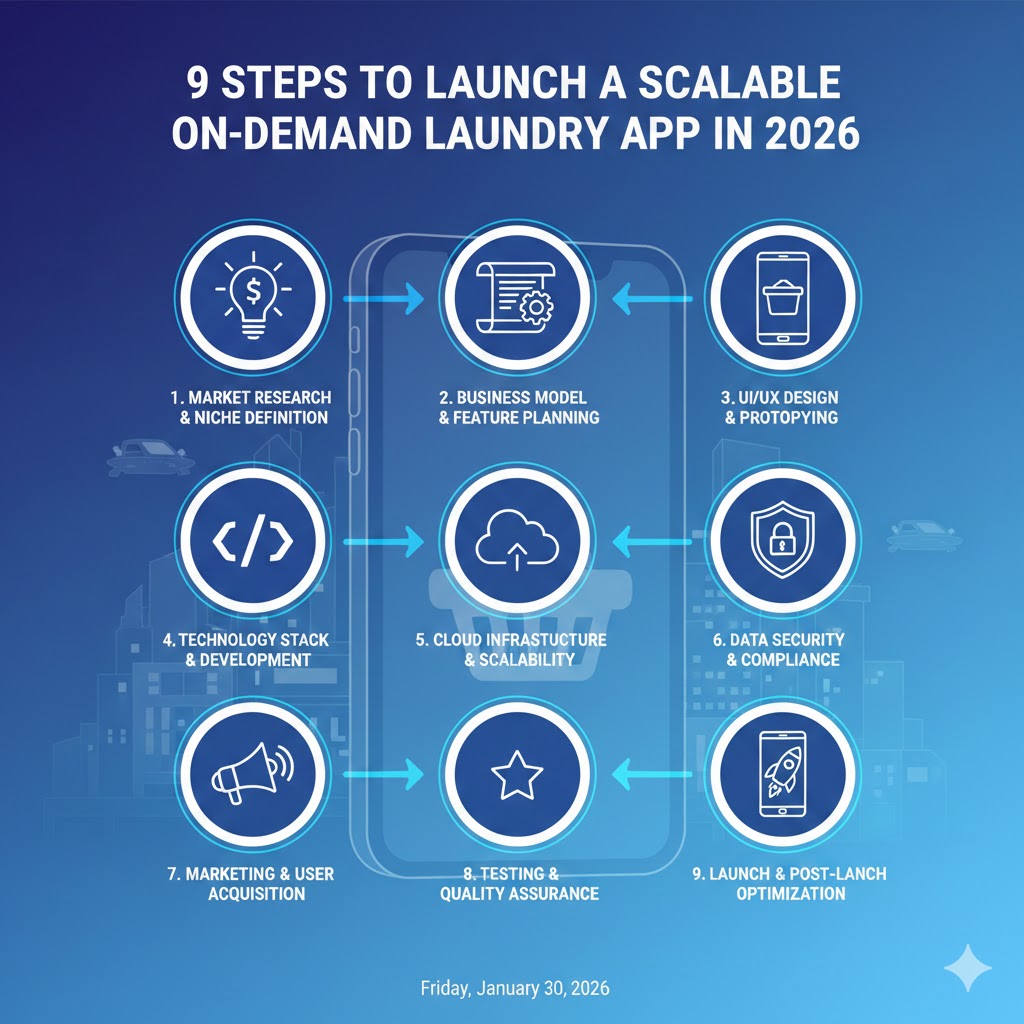
Here are 9 key steps to plan, build, and prepare scalable on-demand laundry apps for growth in 2026.
1. Understand the On-Demand Laundry Business Model
Before development begins, it is critical to understand how on-demand laundry platforms operate. These apps connect customers with laundry service providers. They handle scheduling, pricing, logistics, and communication.
Common business models include:
Aggregator model, where many laundry vendors operate under one platform
A single-brand model involves a business managing all operations within its organization
Hybrid model, combining owned facilities with partner vendors
Each model influences the app's structure, the flow of data, and the handling of scaling. Choosing the wrong model at first can limit your options later, especially if you move to new places.
2. Identify Core User Roles and Workflows
A scalable laundry app is not a single-user system. Most platforms involve many user roles, each with distinct workflows.
Typical roles include:
Customers placing and tracking orders
Delivery agents handling pickup and drop-off
Laundry operators managing processing status
Admin users overseeing operations, pricing, and performance
Mapping workflows for each role keeps the system organized as usage increases. Scalability depends on clear separation of responsibilities and efficient role-based access.
3. Define Essential Features Before Advanced Ones
Many apps face scalability issues when they launch with too many features. These extras can make things more complicated without providing real value. In 2026, successful on-demand apps rank functional stability before feature expansion.
Core features usually include:
User registration and authentication
Order scheduling and status tracking
Pricing calculation based on service type
Payment processing
Notifications and communication
Plan advanced features like AI-based recommendations and route optimization. But install them only after the core system is stable in real use.
4. Choose a Scalable Technology Architecture
The design of the backend architecture determines scalability above all else. In 2026, most on-demand laundry apps use cloud-native systems. These systems allow them to divide resources as needed.
Key architectural considerations include:
Microservices instead of monolithic systems
Cloud hosting with auto-scaling capabilities
API-driven communication between modules
Database structures optimized for high transaction volumes
A scalable architecture lets the app grow with users, orders, and locations. This way, performance stays strong even as demand increases.
5. Plan for Multi-Location and Regional Expansion
Many laundry apps launch in a single city but aim to expand. Scalability requires designing the system with multi-location support from day one.
Important considerations include:
Location-based pricing and availability
Time-zone and regional scheduling logic
Many service partners operate on their own
Regional admin controls
Apps that ignore geographic expansion may need expensive reengineering later. Designing with regional flexibility built in makes scalability easier.
6. Implement Reliable Logistics and Order Tracking
Laundry services rely on effective logistics management. We must synchronize pickup and delivery operations with processing timelines. In scalable systems, logistics management is a core part of the infrastructure. It's not an add-on.
Key elements include:
Real-time order status updates
Delivery assignment and tracking
Time-slot management
Delay handling and notifications
As order volumes rise, small logistics inefficiencies can lead to bigger problems. Scalability requires consistency and predictability in order flow.
7. Focus on Data Management and Analytics
Scalable platforms generate large amounts of data. In 2026, data is not only used for reporting but also for operational optimization.
Important data points include:
Order frequency and peak times
Customer retention patterns
Delivery performance metrics
Service turnaround times
Proper data structuring helps platforms find bottlenecks early. They can adjust resources based on their needs. Without analytics, scaling becomes reactive rather than planned.
8. Ensure Security, Compliance, and Reliability
As user volume grows, so does responsibility. On-demand laundry apps handle personal data, location details, and payment information. Scalability depends on trust and reliability, not just speed.
Key focus areas include:
Secure payment handling
Encrypted data storage and transmission
Role-based access control
System monitoring and uptime management
In 2026, users expect stability. Frequent downtime or security issues can stall growth regardless of feature quality.
9. Design for Continuous Improvement and Updates
Scalable apps are never static. User expectations, technology standards, and operational requirements undergo constant evolution. Developers build the most scalable laundry apps with modularity and update flexibility.
This includes:
Versioned APIs for safe updates
Modular feature deployment
Backward compatibility
Regular performance optimization
Scalable systems evolve through small, gradual updates rather than large, disruptive ones. This approach reduces risk while supporting long-term growth.
Benefits and Impact of a Scalable Approach
Building scalability into an on-demand laundry app delivers measurable operational and user-facing benefits:
Operational stability during high demand
Faster expansion into new markets
Consistent user experience across locations
Lower long-term maintenance costs
Data-driven decision-making
The impact is a platform that grows at a consistent rate, independent of changes. This helps cut down on technical debt and makes operations smoother.
Final Thoughts
Launching a scalable on-demand laundry app in 2026 prioritizes structure over speed. Professional laundry app development requires strong planning, a clear system architecture, and carefully considered features, along with continuous optimization. Apps that focus on core basics—clear workflows, flexible infrastructure, and strong data integrity—adapt more easily as demand grows.
Successful platforms aren’t about launching. They build on the idea that growth will happen. In that sense, scalability is not a feature. It is a design philosophy that shapes every decision from day one.
Washing clothes could be a tedious task and owing to our hectic schedule we often fail to handle the simple task of cleaning.
Thanks to the uber for laundry service because of which managing a household chore like laundry has become so much easier.
So, how about starting uber for a laundry app?
Well, you would be surprised to know that this is a billion dollar industry.
It is one of the most lucrative and profitable businesses today!
Check Out The Tools That You Will Require